
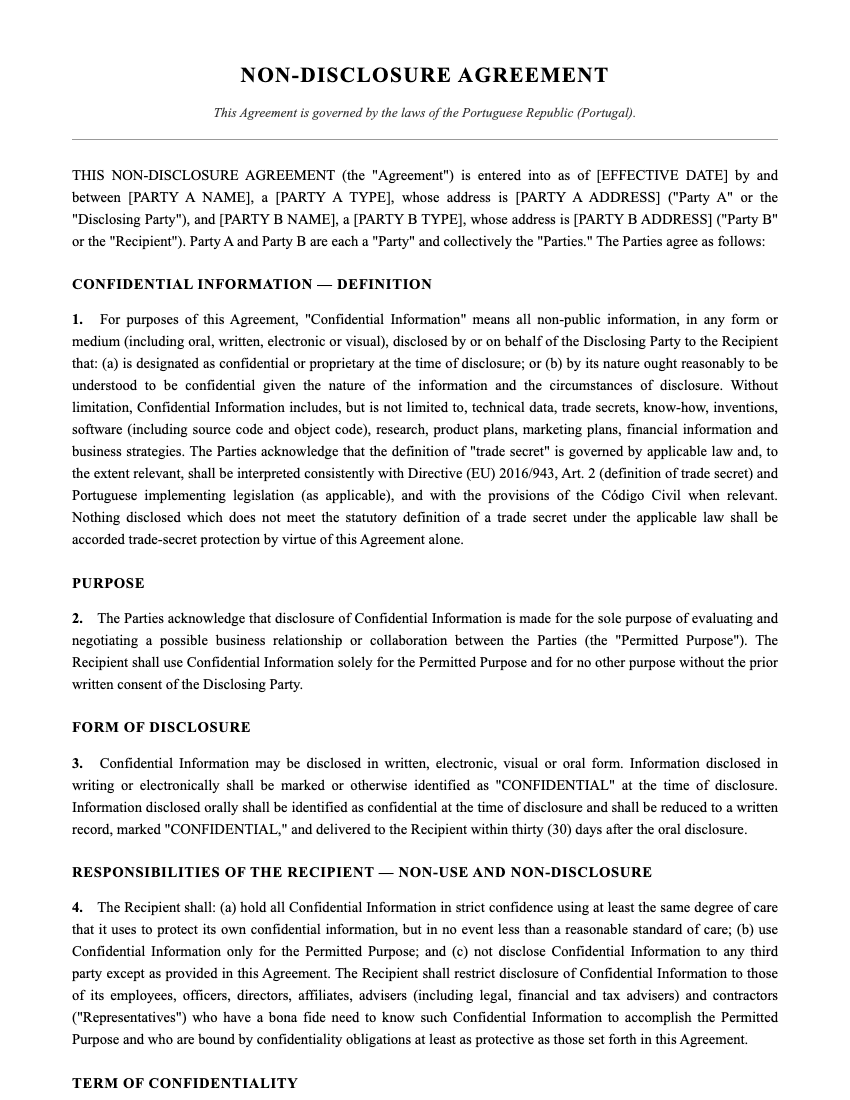
A Portugal Non-Disclosure Agreement (NDA) is a written contract that protects confidential business information and trade secrets consistent with Portuguese civil and labour law, EU data protection rules (Regulation (EU) 2016/679) and national implementing law (Lei n.º 58/2019). Unlike some “one-size-fits-all” templates, a Portugal NDA must respect special rules on post‑contractual restraints, personal data processing, and formality requirements under the Código Civil and Código do Trabalho.
What Is a Portugal NDA?
Definition: In Portugal an NDA is a contract under the Código Civil that creates obligations of secrecy and limited use over confidential information (commercial secrets, know‑how, client lists), and — where applicable — can coexist with post‑contractual non‑competition clauses governed by the Código do Trabalho.
Key domestic rules you must consider: the Portuguese Código Civil (contract law and general obligations), the labour rules in the Código do Trabalho (post‑contractual restraints for employees), GDPR (Regulation (EU) 2016/679) and its national complement Lei n.º 58/2019 (data protection), and Portugal’s transposition of the EU Trade Secrets Directive (protecting trade secrets against unlawful acquisition, use or disclosure).
For a complete guide to NDA terms, duration, and standard exclusions, see our NDA Agreement Guide.
Why "Generic" NDAs Are Dangerous in Portugal
Generic templates usually ignore three Portugal‑specific traps.
- Post‑contractual restraint requirements: Portugal permits employee non‑compete clauses but only if they meet statutory formality and compensatory rules in the labour code. An NDA that contains broad language restricting a former worker’s ability to work, without written agreement, defined scope, duration, geographic limits and required compensation, risks being void or unenforceable under labour law.
- GDPR and Lei n.º 58/2019 compliance: If your NDA involves transfer or processing of personal data, it must identify lawful bases, security measures, and data subject rights. A confidentiality clause that mandates disclosure of personal data (for due diligence, for example) without specifying lawful processing and safeguards will conflict with data protection obligations.
- Overbroad "trade secret" labels: The Portuguese approach distinguishes ordinary confidential business information from bona fide trade secrets (protected under the trade secrets framework). Calling everything a “secret” invites courts to narrow or refuse relief. To get injunctive relief you must show the information derives independent economic value from secrecy and that reasonable steps were taken to keep it secret.
Paradigm‑shifting insight for Portugal: Post‑employment restraints are legally permissible but conditional — they require express written consent, defined limits and often financial compensation. Many NDAs try to protect information by including mobility‑restrictive language; in Portugal that may convert a confidentiality agreement into an unlawful restraint if the compensation and other statutory requirements are not observed.
Real legal development (practical impact): Portugal transposed the EU Trade Secrets Directive, clarifying remedies for misappropriation of commercial secrets. At the same time, national courts continue to scrutinise post‑contractual restraints under the labour code — emphasising the need for explicit, proportionate clauses and compensation.
What’s Included in This Template? (Key Clauses)
- Purpose and narrow scope: define the precise business purpose for disclosure (due diligence, supply negotiation, pilot project).
- Clear definitions: distinguish "Confidential Information" (time‑limited business data) from "Trade Secrets" (indefinite protection while secret; state measures showing reasonable secrecy efforts).
- Obligations of the recipient: non‑use, non‑disclosure, standard of care consistent with the discloser’s practices, and return/destruction on request.
- Personal data safeguards: statements on lawful basis, security measures and cross‑border transfers (to comply with GDPR and Lei n.º 58/2019).
- Post‑contractual restraints: optional, employee‑specific clause that is enforceable only if it conforms to the Código do Trabalho (written form, limited scope/duration, and compensation where required).
- Exceptions and carve‑outs: public domain, prior knowledge, independent development, compelled disclosure (court order/regulatory requests) and whistleblowing rights under applicable law.
- Remedies and governing law: injunctive relief, damages, and Portuguese law / courts (include mediation/arbitration choices if desired).
Who Needs This Document?
| User Persona | Usage Scenario | Key Portugal Benefit |
|---|---|---|
| Startups (Lisbon/Porto) | Pitching investors, technology demos | Protect IP while respecting GDPR and avoiding unlawful post‑employment limits |
| Employers | Hiring developers or sales staff | Add narrowly tailored post‑contractual restraints with required compensation language |
| SMEs exporting services | Negotiating with EU partners | Include clauses for cross‑border data transfers and Trade Secrets protection |
| Manufacturers | Sharing prototypes with suppliers | Use strong use/return obligations and evidence of secrecy efforts |
How to Execute a Valid Portugal NDA
Step 1: Choose the right type — unilateral (one‑way) when only you disclose; mutual when both sides share and you need reciprocal protections.
Step 2: Define the precise purpose — Portuguese courts favour narrow, objective purposes. Vague terms reduce enforceability.
Step 3: Mark and document secrecy efforts — label documents, restrict access, keep circulation logs and store on secure systems; this evidences "reasonable steps" to protect trade secrets.
Step 4: Use proper form for restraints — if you include a post‑contractual non‑competition clause for an employee, put it in writing, set duration/scope, and include any compensation required under the labour code. Also sign before disclosure.
Never disclose sensitive information before the parties sign. If personal data is involved, confirm lawful processing under GDPR and Lei n.º 58/2019.
Receiving an NDA from a Client?
When you receive an NDA, review for: hidden mobility restraints, vague trade secret definitions, missing GDPR safeguards, and one‑sided return/destruction obligations. Use this template to counter‑propose balanced protections tailored to Portuguese law.
an AI contract review tool still helps: upload the other party’s NDA and get instant flags for mobility risks, GDPR gaps, and overbroad trade secret language — saving time and reducing negotiation risk.
Related NDA Templates
Get the Template
Sign up for our newsletter to receive the template.
Frequently Asked Questions

About Designer Content
Designer Content creates practical legal document resources for landlords, contractors, and small business owners. We simplify complex legal concepts into actionable guidance. Connect with us on LinkedIn.