
A Rhode Island Master Services Agreement (MSA) is a master contract that sets the core legal terms for ongoing service projects between a provider and a client under Rhode Island law. Instead of renegotiating basics like payment, liability, and IP ownership every time, you sign one MSA and then attach project-specific Statements of Work (SOWs). For Rhode Island SMBs, consultants, and agencies, the goal is speed with guardrails: predictable terms, fewer disputes, and fewer “template surprises” when something goes wrong.
Definition: A Rhode Island Master Services Agreement (MSA) is a written agreement that establishes the ongoing “umbrella” terms for a business-to-business services relationship governed by Rhode Island law. It typically covers payment and invoicing rules, confidentiality and data security, intellectual property ownership, limitations of liability, and dispute resolution. Individual projects are then described in separate Statements of Work (SOWs) that reference the MSA. This structure helps Rhode Island businesses manage repeat work (retainers, phased implementations, recurring consulting) without rewriting a full contract each time, while still complying with state-specific rules on late-payment interest, consumer/deceptive trade practices risk, and data breach obligations.
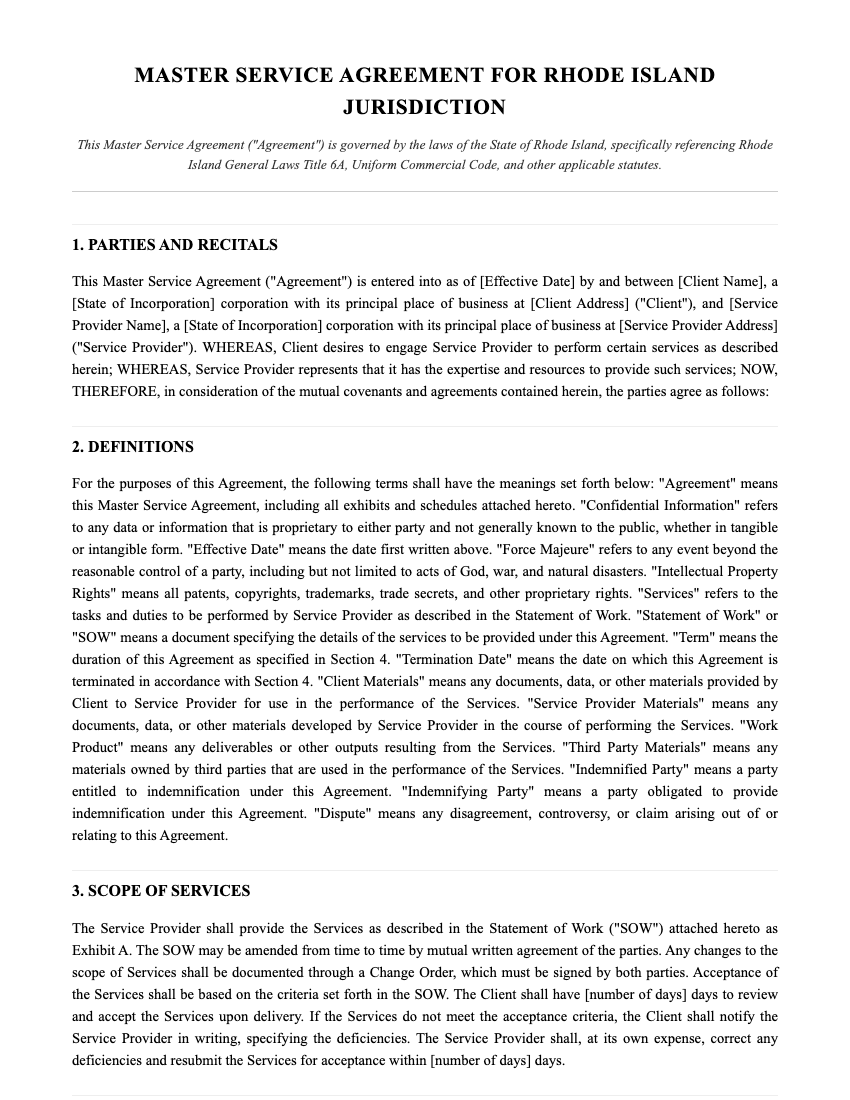
Why You Cannot Use a Generic MSA in Rhode Island
Using a “one-size-fits-all” MSA is risky because Rhode Island has specific rules that affect enforceability and your real-world leverage if the relationship breaks down. A generic template may (1) mis-handle worker classification language, (2) include non-compete clauses that Rhode Island restricts for many workers, or (3) gloss over data security and breach response duties that can create statutory exposure. It can also miss practical Rhode Island defaults like the 10-year statute of limitations for written contracts, meaning a poorly drafted clause may haunt you long after a project ends.
3a. Worker Classification Rules
Rhode Island uses an “ABC test” for wage-and-hour and unemployment contexts that can differ from how generic MSAs describe independent contractors. Under the Rhode Island Payment of Wages framework, the ABC test appears in R.I. Gen. Laws § 28-14-1 (definitions), and a similar ABC framework is used in unemployment insurance determinations under R.I. Gen. Laws § 28-42-7. In plain terms, you typically must show: (A) the worker is free from control and direction, (B) the service is outside the usual course of the hiring entity’s business or performed outside all the hiring entity’s places of business, and (C) the worker is customarily engaged in an independently established trade or business.
For a comprehensive guide to structuring MSAs and SOWs that protect your business, see our Freelancer Contracts Guide.
If you copy a generic “independent contractor” paragraph that only says “contractor controls the manner and means,” you may fail prongs B or C in practice—especially if a marketing agency hires a “contractor” to do core marketing work under close supervision. Misclassification can trigger back wages, taxes, unemployment contributions, penalties, and litigation exposure under Rhode Island’s wage laws (see generally R.I. Gen. Laws Title 28). A Rhode Island-ready MSA should include operational facts that support independence (right to work for others, tools, schedule control), and it should push project details (deliverables, milestones, acceptance criteria) into the SOW so you avoid day-to-day “control” language that undermines your position.
3b. Non-Compete Enforceability
Rhode Island does enforce some restrictive covenants, but generic non-compete language is often unenforceable or illegal as written. As a baseline, Rhode Island courts generally evaluate non-competes under a reasonableness framework (protectable interest, reasonable time and geographic scope, and no undue hardship). However, Rhode Island also has a statutory noncompete restriction for certain workers: the Rhode Island Noncompetition Agreement Act, R.I. Gen. Laws § 28-59-1 et seq. That statute prohibits noncompetition agreements with “low-wage employees” (as defined by the Act) and imposes notice and other requirements in covered situations.
Why this matters in an MSA template: many MSAs are used with freelancers, solo consultants, or small teams who may be paid hourly. A generic clause that broadly bans the provider from working with “any competitor” for 12–24 months can be attacked as unreasonable—or prohibited if the relationship looks like employment and the person falls into a protected category. Also, Rhode Island draws a practical line between (a) a true business-to-business restriction tied to sale of a business or protection of trade secrets and (b) a disguised employment restraint.
A Rhode Island-tailored template should either (1) omit non-competes entirely for most service relationships, or (2) keep them narrowly drafted and optional, with a clear compliance note tied to R.I. Gen. Laws § 28-59-1 et seq. In most service MSAs, better alternatives are: strong confidentiality/trade secret protection, a narrowly tailored non-solicitation of the client’s employees or active customers (where appropriate), and clear return/destruction-of-information obligations. Those tools often accomplish the real business goal—protecting relationships and proprietary know-how—without the enforceability risk of a broad non-compete.
3c. IP/Work-for-Hire Considerations
Generic MSAs often say “everything is work made for hire,” but that phrase is a federal copyright concept and doesn’t automatically fit service relationships. Under U.S. copyright law (17 U.S.C. § 101), “work made for hire” is limited and often does not apply to independent contractors unless the work fits specific categories and there is a signed writing. For Rhode Island businesses, the safer approach in an MSA is usually: the provider retains background tools and know-how, but assigns to the client the deliverables created and paid for under each SOW, with a clear license back if the provider needs reusable components. If you want “work made for hire” language, pair it with an express present assignment as a backstop.
What’s Included in This Template
Flexible SOW Structure
The template treats the MSA as the fixed legal backbone and uses SOWs for scope, timing, deliverables, pricing, and change orders. That means you can reuse the same MSA for a year (or longer) and only sign short SOWs as new projects arise—reducing negotiation cycles and scope creep.
Rhode Island-Specific Indemnification
Indemnity is drafted to be mutual and realistic for SMBs, focusing on third-party claims tied to each party’s negligence, willful misconduct, or IP infringement. It avoids vague “all claims of any kind” language that can create uninsurable, unlimited exposure. It also aligns with commercial expectations under Rhode Island’s UCC principles (R.I. Gen. Laws Title 6A) when services are bundled with deliverables.
Dispute Resolution and Venue
The template includes an arbitration option seated in Providence, Rhode Island, with Rhode Island governing law and venue concepts baked in. This helps prevent “home court disadvantage” clauses that force a small provider to arbitrate or litigate across the country.
Additional Rhode Island provisions included (with statutory hooks): late-payment interest aligned to R.I. Gen. Laws § 6-26-2 (12% per annum where applicable); written-contract limitation awareness under R.I. Gen. Laws § 9-1-13 (10-year limitations period); deceptive trade practices compliance language referencing R.I. Gen. Laws § 6-13.1-1 et seq.; and data security/breach cooperation clauses aligned to the Rhode Island Identity Theft Protection Act, R.I. Gen. Laws § 11-49.3-1 et seq.
Who Needs This Document?
| User Type | Relationship | Key Benefit |
|---|---|---|
| Marketing or design agencies | Retainers and repeat campaigns | Keeps pricing and change orders in SOWs while the MSA controls IP and payment terms |
| IT consultants / MSPs | Ongoing support and implementations | Clarifies SLAs, liability limits, and data security duties under RI breach rules |
| Software developers | Build phases and maintenance | Protects background code while assigning paid deliverables cleanly |
| Business consultants | Strategy + deliverables | Prevents scope creep with written SOW acceptance and milestone invoicing |
How to Use This MSA Template
Step 1: Identify the Parties Correctly
Use the exact legal names (LLC/corporation) as registered with the Rhode Island Secretary of State, plus addresses for notice. If you operate as a sole proprietor, use your personal legal name and DBA if applicable.
Step 2: Set the Master Term and Termination
Pick a fixed term (e.g., 12 months) or evergreen renewal, and include a clean termination-for-convenience rule with a final invoice process. Keep “termination of an SOW” separate from “termination of the MSA” so other projects can continue.
Step 3: Attach the First Statement of Work
Put deliverables, deadlines, acceptance testing, and pricing in the SOW—not the MSA. If scope changes, use a written change order so you can prove what was authorized.
Step 4: Sign Once, Then Reuse for Future SOWs
Have both parties sign the MSA a single time, then execute new SOWs as needed. This keeps negotiations focused on project specifics rather than re-litigating boilerplate every time.
Related MSA Templates
Get the Template
Sign up for our newsletter to receive the template.
Frequently Asked Questions

About Designer Content
Designer Content creates practical legal document resources for landlords, contractors, and small business owners. We simplify complex legal concepts into actionable guidance. Connect with us on LinkedIn.