
A Rhode Island Non-Disclosure Agreement (NDA) is a contract that protects confidential business information and trade secrets while tailored to Rhode Island law. Unlike jurisdictions that categorically void non-competes, Rhode Island courts will enforce restrictive covenants and confidentiality provisions if they are reasonable in scope, duration, and geographic reach. This template is drafted to preserve both contract remedies and statutory trade secret remedies in Rhode Island's legal environment.
What Is a Rhode Island NDA?
Definition: A Rhode Island Non-Disclosure Agreement is a contractual promise by a receiving party to keep certain information secret and to limit its use to a defined purpose. NDAs in Rhode Island interact with several important legal rules: the Uniform Commercial Code (Title 6A, Rhode Island General Laws), trade secret protection (statutory and common law), the state's deceptive trade practices rules, and the statute of limitations for written contracts (R.I. Gen. Laws § 9-1-13).
This matters because Rhode Island does not follow the absolute non-compete ban found in a few states. Instead, courts apply a reasonableness test: is the restriction necessary to protect a legitimate interest, reasonable in scope and duration, and not unduly harsh on the public or employee? An overbroad NDA that looks like a disguised restraint on trade risks being narrowed or struck down by a court.
For a complete guide to NDA terms, duration, and standard exclusions, see our NDA Agreement Guide.
Why "Generic" NDAs Are Dangerous in Rhode Island
Free NDA templates are typically written for broader enforcement regimes or for states that favor a particular employer-friendly approach. In Rhode Island, poorly drafted NDAs create three principal hazards:
- They may be treated as an unreasonable restraint subject to judicial modification.
- They can impair your ability to pursue the most favorable remedy for trade secret misappropriation if you don’t preserve statutory claims alongside contractual remedies.
- They can misstate notice and whistleblower carve-outs required by federal law, which limits damage recovery in federal trade secret suits.
Paradigm-shifting insight for Rhode Island: the dual-remedy statute-of-limitations trap
Rhode Island has a long statute of limitations for written contracts—10 years under R.I. Gen. Laws § 9-1-13—but trade secret claims under statute or federal DTSA often run on shorter discovery-based limitations. The practical insight: draft NDAs so you preserve both (a) a clear contractual claim (with the benefit of the 10-year written-contract limitation) and (b) statutory or federal trade-secret claims (which may be subject to shorter discovery rules). If your NDA relies solely on contract language without clear trade-secret identification and statutory notice (see DTSA), you may lose important remedies or be forced into a limited timeframe for recovery.
The whistleblower / DTSA notice trap
Under the federal Defend Trade Secrets Act (DTSA, 18 U.S.C. § 1833(b)), to be eligible for enhanced damages and certain fee-shifting provisions, an employer must include a notice in agreements that informs employees of their right to report suspected violations to government officials or make protected disclosures under federal law. Without that notice, some remedies in federal court are limited—even if Rhode Island courts would otherwise enforce the NDA contractually.
Overbroad "protection" language
Language that bans use of any information that could be useful to a competitor, or language restricting the employee's ability to work in an entire industry, risks judicial narrowing or invalidation. Rhode Island courts are willing to blue-pencil agreements only to the extent they are severable and reasonable; otherwise a court may refuse to enforce the restriction.
Real-world development
Rhode Island appellate and trial courts consistently apply the familiar employer-employee interest balancing test when adjudicating covenants and NDAs. Business practitioners in Rhode Island increasingly emphasize the dual approach: (1) identify and categorize trade secrets with specificity; (2) preserve contract remedies and statutory/federal remedies separately in the NDA. That drafting practice has become the standard recommendation in Rhode Island counsel advisories and bar publications.
What’s Included in This Template? (Key Clauses)
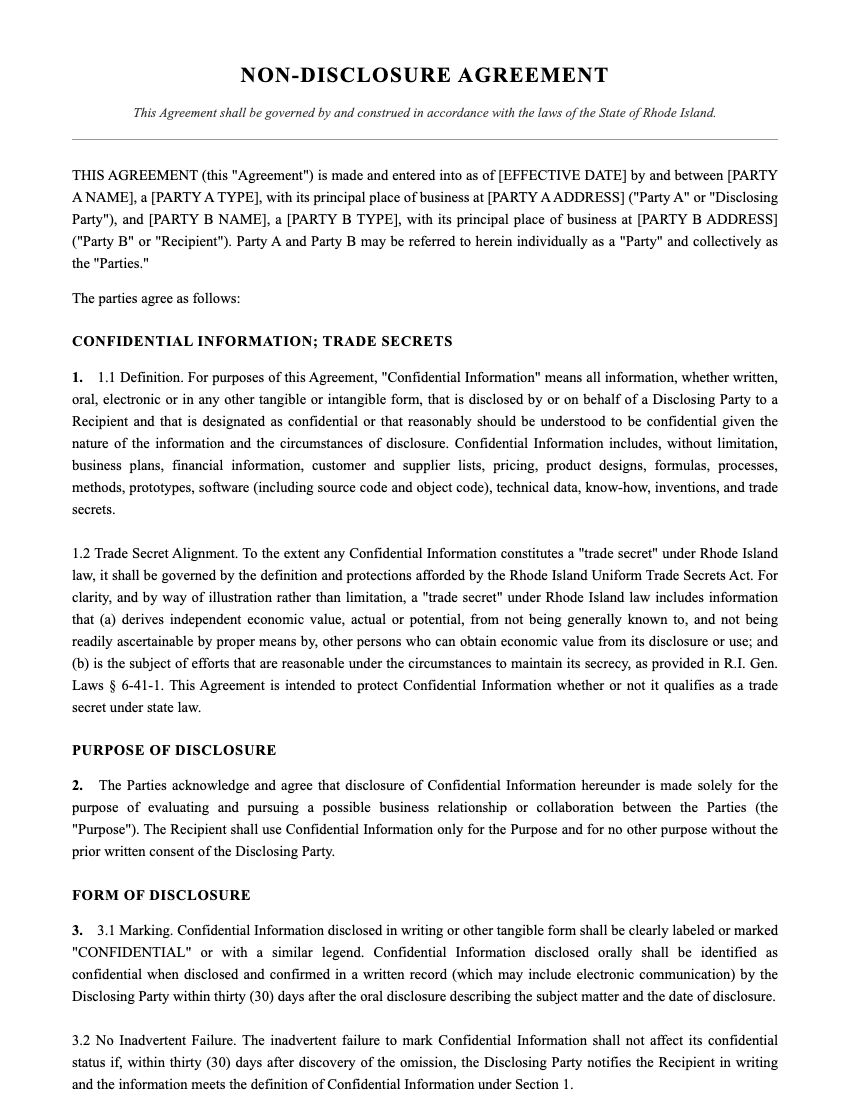
- Purpose clause: narrowly defines the reason for disclosure so courts can enforce use limits.
- Definitions: separates "Confidential Information" (time-limited, contract-based protection) from "Trade Secrets" (information treated as a statutory trade secret and preserved for statutory remedies).
- Use restrictions: limits permitted uses to the defined Purpose and expressly prohibits competitive exploitation without an overbroad industry ban.
- Residuals carve-out (optional): allows unaided memory use of general skills and concepts, protecting hiring markets while preserving secrecy for true trade secrets.
- DTSA whistleblower notice: federal-compliant text preserving enhanced remedies for DTSA claims in federal court.
- Remedies & choice-of-law: preserves both contract remedies (note R.I. Gen. Laws § 9-1-13 for written contracts) and statutory relief; includes injunctive relief clause recognizing Rhode Island courts’ equitable powers.
- Severability & blue-pencil language: drafted to maximize enforceability under Rhode Island’s reasonableness standard.
Who Needs This Document?
| User Persona | Usage Scenario | Key Benefit in Rhode Island |
|---|---|---|
| Local Tech Startups | Sharing product roadmaps with contractors | Protects code and algorithms while allowing employees to move between companies under reasonable limits |
| Manufacturers | Sending drawings to New England suppliers | Places trade-secret labels and contractual protections that survive contract claims for up to 10 years |
| Small Businesses | Due diligence for a sale | Enables M&A diligence while preserving statutory remedies and contractual protections |
| Professional Service Firms | Protecting client lists and proposals | Ensures enforceable covenants under RI reasonableness standards without overbroad employment bans |
How to Execute a Valid Rhode Island NDA
- Choose the right template: unilateral (one-way) if only you disclose; mutual if both sides exchange confidential information.
- Be specific about the Purpose and label trade secrets clearly. The clearer you are, the easier a Rhode Island court will enforce the agreement.
- Include DTSA notice language if you want federal remedies preserved in the event of misappropriation litigated in federal court.
- Sign before disclosing: the NDA protects information disclosed after execution. Keep signed copies and consider using an electronic signature platform recognized under Rhode Island law.
If you receive an NDA from a counterparty, check for disguised restraints on trade (e.g., language that effectively prevents future employment), excessive durations, or missing federal DTSA notice language.
an AI contract review tool can instantly flag risky clauses, compare terms against Rhode Island precedent and statutory requirements, and suggest negotiation points—saving time and reducing litigation exposure.
Related NDA Templates
Get the Template
Sign up for our newsletter to receive the template.
Frequently Asked Questions

About Designer Content
Designer Content creates practical legal document resources for landlords, contractors, and small business owners. We simplify complex legal concepts into actionable guidance. Connect with us on LinkedIn.