
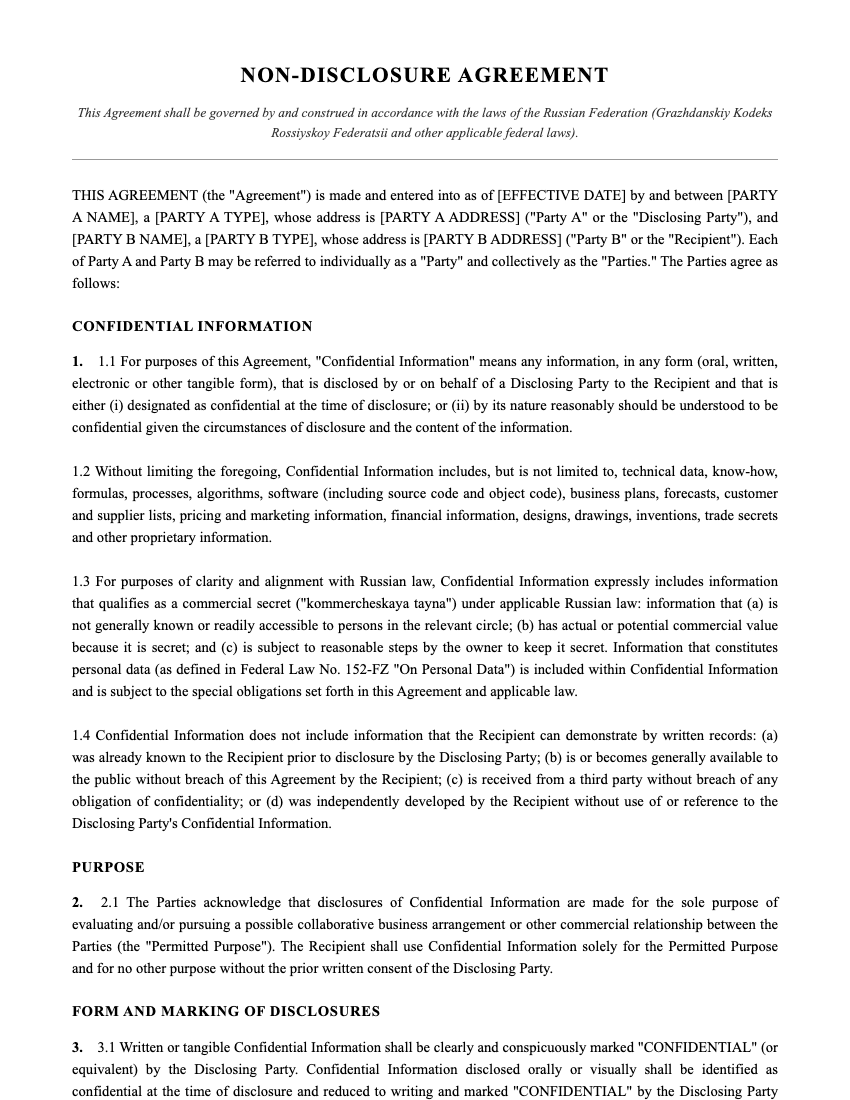
A Russia Non-Disclosure Agreement (NDA) is a contract to protect "commercial secrets" and other confidential information shared in business, employment, or transactional contexts. In Russia, confidentiality sits at the intersection of contract law (Civil Code), labour law (Labour Code), personal data regulation (Federal Law No. 152‑FZ), and sometimes criminal liability. This template is drafted to work in that legal environment.
What is a Russia NDA?
Definition: In Russia, an NDA is a civil contract that creates obligations of non-disclosure and limited use with respect to confidential information, including commercial secrets as protected under the Civil Code of the Russian Federation (Grazhdanskiy Kodeks RF) and related norms. Key statutory frameworks you must consider: Civil Code of the Russian Federation (commercial secret protection and remedies), Federal Law No. 152‑FZ "On Personal Data" (2006) (processing and localization requirements for personal data), the Labour Code (restrictions applicable to employees and any post‑employment non‑competes), and Federal Law No. 63‑FZ "On Electronic Signature" (2001) for e-signatures.
This matters because in Russia an NDA is not just a confidentiality checkbox: it must align with personal data obligations (152‑FZ), respect employee protections, and be drafted to prove reasonable secrecy measures in court.
For a complete guide to NDA terms, duration, and standard exclusions, see our NDA Agreement Guide.
Why "Generic" NDAs Are Dangerous in Russia
Using a generic, jurisdiction‑agnostic NDA exposes you to at least three local traps.
- Data localization and personal data mishandling (Paradigm‑shifting insight)
Russia requires special treatment of personal data of Russian citizens. Under Federal Law No. 152‑FZ (and its amendments implementing data localization), controllers who transfer or process Russian personal data must comply with localization and other processing rules. An NDA that treats personal data as mere "confidential information" without specifying lawful processing, data controller responsibilities, storage location, and consent can create administrative liability and undermine enforcement of the NDA itself.
Practical effect: If confidential information includes employee or customer personal data, add express data processing clauses, a lawful basis for processing (consent or contract performance), and clauses requiring that recipients store Russian personal data on servers in Russia when required by law.
- Employee non‑compete and compensation rules
Post‑termination non‑competition and confidentiality obligations tied to employment are governed by the Labour Code and must be reasonable and, for some categories, supported by compensation. Clauses that attempt absolute post‑employment restraints or that impose penalties inconsistent with labour rules may be void or unenforceable in employment relationships.
- Proving "commercial secret" status in court
Russian courts require demonstration of: (a) the information qualifies as a commercial secret by content and commercial value, (b) written internal rules and marking that establish secrecy (for example, internal policy and document stamps), and (c) reasonable protective measures. An NDA that fails to require internal marking, restricted access, or demonstrable security measures makes it harder to obtain injunctive relief or damages.
Real development: Russian Supreme Court practice and commercial litigation in recent years show judges scrutinize whether companies actually maintained secrecy (internal regulations, access lists, and technical protections). Doctrine and legal analyses from major Russian law firms have emphasized the interaction of commercial secret protection with personal data obligations—missteps in 152‑FZ compliance have led to administrative fines and weakened civil claims.
Key Clauses Adapted for Russia
- Clear definition: Distinguish "Commercial Secret" (retain indefinite protection while secret) and "Confidential Information" (time‑limited protection). Include objective criteria that match Civil Code requirements (economic value, secrecy, and reasonable protective measures).
- Purpose limitation: Narrowly define permitted use (e.g., "for evaluation of a potential supply agreement regarding Project X").
- Data processing clause: Specify whether confidential disclosures include personal data, name the data controller/processor, state lawful basis, and require compliance with Federal Law No. 152‑FZ and data localization obligations.
- Employee/non‑compete carve‑outs: If used in an employment context, state whether any non‑competition is agreed, the compensation during the restriction period (if any), and duration—aligned with Labour Code requirements.
- Marking & protective measures: Require the disclosing party to mark documents as "COMMERCIAL SECRET" and require recipients to maintain access logs, encryption, and limited access lists.
- Remedies and Limitation: The remedies available to the parties include injunctive relief (including preliminary and permanent injunctions), specific performance, and recovery of monetary damages, costs and legal fees to the extent permitted by law. In addition to any other remedies, a party shall have the right to seek immediate injunctive or other equitable relief to prevent or curtail any actual or threatened unauthorized use, disclosure or distribution, and to require the return or certified destruction of all Confidential Information, materials and any copies thereof upon termination of this Agreement or upon written request. All rights and remedies are cumulative and in addition to any other rights or remedies available at law or in equity. Notwithstanding the foregoing, any claim arising under or relating to this Agreement must be commenced within the Civil Code limitation period: the general statute of limitations is 3 years under the Civil Code.
- Electronic signature and execution: Allow execution by qualified electronic signature consistent with Federal Law No. 63‑FZ.
Who Needs This Document?
| User Persona | Use Case in Russia | Key Benefit |
|---|---|---|
| Exporting IT vendor | Sharing source code with Russian integrators | Adds data localization clause and protects source as commercial secret |
| Russian startup | Investor diligence | Enables safe disclosure while showing internal secrecy measures to courts |
| Employer | Senior employee hire | Aligns confidentiality with Labour Code and any allowed non‑compete compensation |
| Manufacturer | Sharing CAD with a contract factory | Preserves manufacturing know‑how and requires marking and technical safeguards |
How to Execute a Valid Russia NDA
- Choose the right type: one‑way for unilateral disclosure, mutual if both parties share. For employees, use a tailored employment confidentiality addendum.
- Define the purpose and the categories of information, and expressly flag personal data subject to 152‑FZ.
- Mark documents and implement internal secrecy measures: policies, restricted access, stamps/labels "COMMERCIAL SECRET".
- Sign before sharing. Use a qualified electronic signature under Federal Law No. 63‑FZ or a handwritten signature; retain evidence of execution and delivery.
When You Receive an NDA
When a counterparty sends an NDA, check for: data processing obligations, precise definitions, mandatory data localization clauses, overly broad post‑employment restraints, and realistic protective measures. Don’t sign contract language that automatically converts ordinary business knowledge into a perpetual commercial secret without compensation or reason.
an AI contract review tool still helps: our AI reviews NDAs and flags clauses that conflict with 152‑FZ, that impose suspect non‑compete restrictions under the Labour Code, or that lack sufficient marking/technical safeguards to support a commercial secret claim.
Related NDA Templates
Get the Template
Sign up for our newsletter to receive the template.
Frequently Asked Questions

About Designer Content
Designer Content creates practical legal document resources for landlords, contractors, and small business owners. We simplify complex legal concepts into actionable guidance. Connect with us on LinkedIn.