
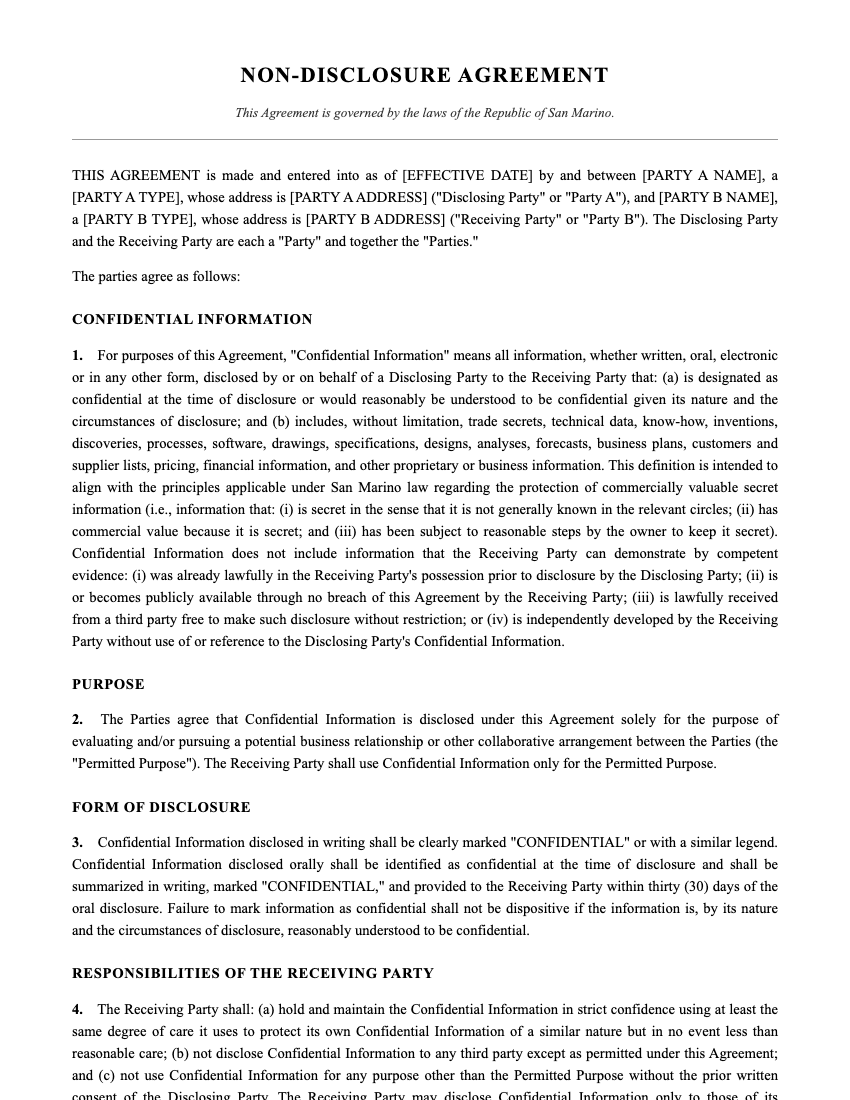
A San Marino Non-Disclosure Agreement (NDA) is a confidentiality contract that protects business secrets and proprietary information while conforming to the civil-law rules and formal requirements that govern contracts in the Republic of San Marino. Because Sammarinese doctrine and practice reflect strong Italian influence, NDAs for use in San Marino must be drafted with attention to local restraints on post‑employment covenants (patto di non concorrenza), data-protection obligations (Legge sulla protezione dei dati personali), and the civil-law prescription term (prescrizione decennale).
What is a San Marino NDA?
Definition: A San Marino Non-Disclosure Agreement is a written contract in which a Disclosing Party entrusts Confidential Information to a Receiving Party and lawfully limits the Receiving Party’s use and disclosure of that information for a limited purpose.
In San Marino the NDA serves two complementary functions: (1) to document the parties’ expectations and lawful limits on use of information; and (2) to help establish the “reasonable secrecy measures” that courts consider when deciding whether information qualifies as a trade secret or confidential business information. NDAs should also show compliance with the Legge sulla protezione dei dati personali when personal data is involved.
For a complete guide to NDA terms, duration, and standard exclusions, see our NDA Agreement Guide.
Why generic NDA templates are dangerous in San Marino
Many online NDA templates are written for common-law jurisdictions and assume broad enforceability of post‑employment restraints. In San Marino that approach creates several risks.
- Patto di non concorrenza must meet formal limits. Unlike California’s broad ban on non‑competes, San Marino practice (following Italian influence) allows post‑employment non‑compete clauses for employees only if they are limited as to scope, duration and territory and are accompanied by adequate compensation. If you bury a broad “no‑competition” restriction inside an NDA, a Sammarinese court may strike the restraint — and sometimes the offending clause — leaving the remainder of the agreement vulnerable to attack.
- Data protection obligations: The Legge sulla protezione dei dati personali requires lawful bases and safeguards for processing personal data. If an NDA governs exchanges that include personal data (employee lists, customer contacts), you must state processing purposes, retention limits and security measures; failing to do so can bring regulatory attention from the data protection authority and undermine enforcement.
- Prescription (prescrizione decennale): Civil claims in San Marino commonly carry a ten‑year prescription period for contractual and tortious claims. While this gives longer time to enforce rights, it also affects drafting of notice, mitigation, and preservation provisions. Put plainly: do not assume a short statute of limitations.
Paradigm‑shifting insight: the “formal consideration + specificity” trap
In practice the single greatest drafting mistake in San Marino is treating NDAs as a one‑size‑fits‑all instrument that also attempts to operate as a non‑compete. The decisive insight for San Marino is this: post‑employment restraints are not automatically void, but they are delicate. Courts will scrutinize any non‑competition-like language for (i) clear geographic and temporal limits, (ii) objective linkage to a protectable business interest (trade secret or customer goodwill), and (iii) adequate economic consideration. Drafting an NDA that protects secrets while avoiding an impermissible or unenforceable restraint requires separating confidentiality obligations from any post‑employment restraint clause and, when a restraint is needed, making it a distinct, clearly negotiated provision with agreed compensation.
Real case study and local practice note
Sammarinese courts publish fewer reported decisions than larger jurisdictions. Practitioners therefore often rely on Italian precedent on the patto di non concorrenza and on EU instruments (e.g., the Trade Secrets Directive) for principles on trade secret protection and enforcement. A useful practice development is that Sammarinese authorities increasingly emphasize explicit data‑processing clauses in commercial contracts after the republic modernized its data-protection framework to align with EU standards.
Key clauses to include (San Marino‑adapted)
- Definition of Confidential Information and separate definition of Trade Secrets: make the latter subject to objective criteria (economic value from secrecy; reasonable protective measures).
- Purpose and limited use: narrow, specific stated purpose for disclosure (e.g., “evaluate a supply agreement for Project X”).
- Duration: tiered protection — limited-term for ordinary confidential information (1–5 years), indefinite protection for bona fide trade secrets while secrecy is maintained.
- Exclusions: information already public, independently developed, lawfully known prior to disclosure, or required to be disclosed by legal process (with notice obligations).
- No disguised non‑compete language: avoid broad restrictions on employment or professional activity inside confidentiality sections. If you need a restraint, create a separate patto di non concorrenza clause with explicit compensation and limits.
- Data protection addendum: state data controller/processor roles, lawful basis, retention periods, technical and organizational measures, and cross‑border transfer rules if data leaves San Marino.
- Remedies and preservation: injunctive relief, contractual indemnity language, and evidence preservation obligations consistent with civil procedure practice.
Who needs this document?
| User Persona | Usage Scenario | Key Local Benefit |
|---|---|---|
| Local SME exporting goods | Sharing supplier specs with foreign factories | Ensures trade secrets are defined and protected while respecting data transfer rules |
| Tech startup in Borgo Maggiore | Pitching to investors or hiring devs | Separates residuals and memory claims from enforceable restraints; preserves ability to hire talent |
| Law firms / consultants | Taking on confidential client materials | Meets data‑protection formalities and evidences purpose-limited processing |
| Manufacturers | Disclosing prototypes to local contractors | Preserves secrecy and gives grounds for urgent remedies in civil court |
How to execute a valid San Marino NDA (practical steps)
Step 1 — Choose the right form: unilateral (one‑way) when only you disclose; mutual when both sides exchange sensitive items.
Step 2 — Be precise about the Purpose and list the categories of Confidential Information. Vague “general business discussions” language weakens protection.
Step 3 — Include a Data Processing Addendum if personal data is involved: name the controller, processing purposes, retention, and safeguards in compliance with the Legge sulla protezione dei dati personali.
Step 4 — Sign and preserve evidence: use a signed original or a qualified electronic signature where available. Record dates of disclosure and mark documents “CONFIDENTIAL.” In San Marino civil practice, written proof of the agreement and of secrecy measures is crucial.
Receiving an NDA from a client?
Review it for disguised non‑compete language, insufficient data‑processing detail, and indefinite or overly broad definitions of “confidential.” If they insist on a post‑employment restraint, require a separate patto di non concorrenza with explicit compensation and limits.
an AI contract review tool can help scan incoming NDAs for risky clauses under Sammarinese and Italian-influenced law, flagging disguised restraints, data‑processing gaps, and missing preservation language.
Related NDA Templates
Get the Template
Sign up for our newsletter to receive the template.
Frequently Asked Questions

About Designer Content
Designer Content creates practical legal document resources for landlords, contractors, and small business owners. We simplify complex legal concepts into actionable guidance. Connect with us on LinkedIn.