
Opening
The Singapore (Chinese) Master Services Agreement (MSA) is a master agreement used within Singapore's legal framework to set out core rules for payments, liability, intellectual property, confidentiality, data protection, and dispute resolution all at once, then rapidly implement each project through subsequent SOWs (Statement of Work). For SMEs, consultants, and agencies, it helps reduce repeated negotiations and lowers compliance risk, especially when PDPA personal data and cross-border collaboration are involved.
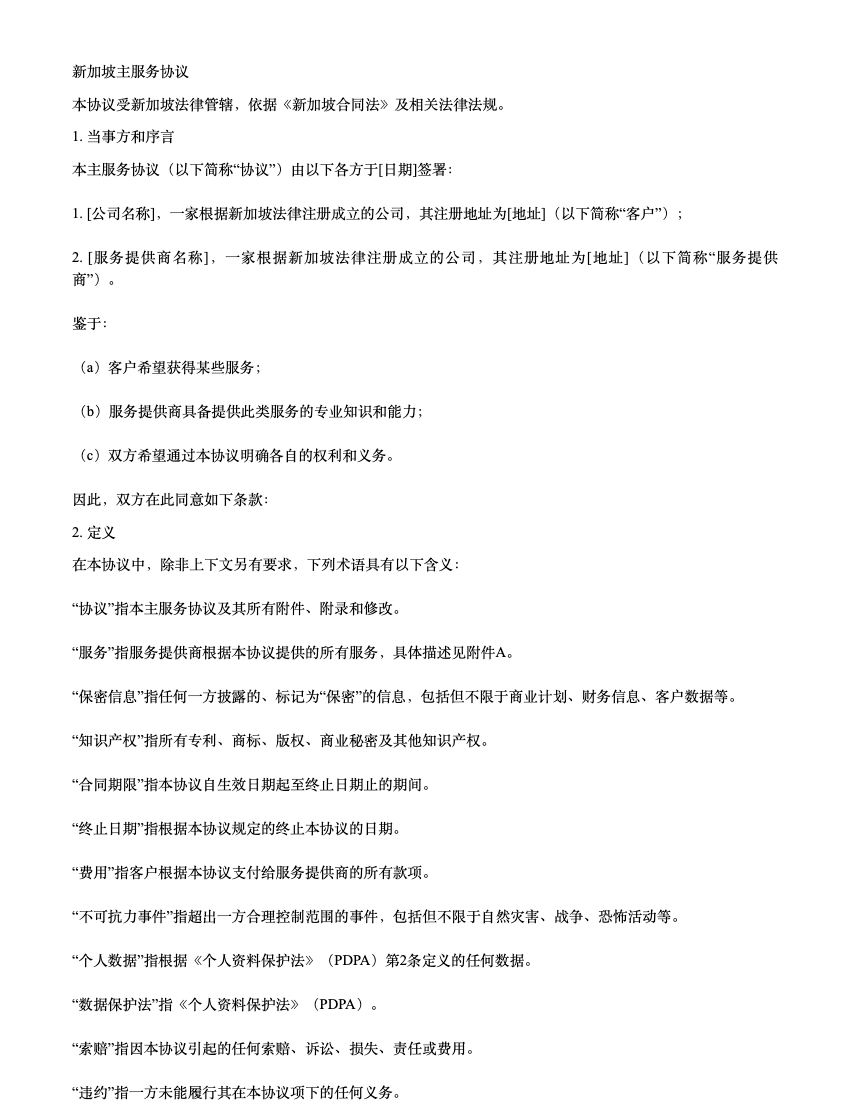
For a comprehensive guide to structuring MSAs and SOWs that protect your business, see our Freelancer Contracts Guide.
Definition Box
Definition: The Singapore (Chinese) Master Services Agreement (MSA) is a reusable master agreement signed by the service provider and the client in Singapore to establish the common terms across multiple projects: how the scope of services is defined (via SOW), fees and invoicing, late interest, confidentiality and personal data processing, ownership of intellectual property, liability limits and indemnification, termination and handover, and dispute resolution (commonly via Singapore courts or SIAC arbitration). In a common-law system, the enforceability of an MSA heavily depends on the clarity and reasonableness of its terms, particularly non-compete and liability limitations.
Section 3: Why You Cannot Use a Generic MSA in Singapore (Chinese)
A generic MSA template often assumes “the whole world is the same”: broad non-compete, loose treatment of employee/contractor relationships, data terms treated as optional, or even defaulting to the law of a U.S. state. Singapore falls within a common-law jurisdiction, where many key issues cannot be resolved by a one-line “mutual agreement,” but depend on how the court identifies the true relationship, whether the terms are reasonable, and whether you fulfill statutory compliance obligations.
Worker Classification Rules
In Singapore, whether someone is an “employee” does not depend on whether the contract says “independent contractor” or “freelancer,” but on the overall assessment of the factual relationship under common law. Courts and regulators typically consider factors such as degree of control, integration into the organization, economic reality, provision of tools, and bearing of risk; this multi-factor approach is often described as the “multiple test” or analyses such as “control/organisation/economic reality.” The risk of misclassification goes beyond civil claims (e.g., for unpaid leave, overtime, termination benefits disputes) and can touch statutory employment rights and mandatory contributions (e.g., CPF). For foreign personnel, work passes and compliance arrangements also come into play. Practically, your MSA/SOW should clearly address points like deliverable-oriented focus, non-time management, substitutable personnel, and allocation of independent business and tax/CPF responsibilities to reduce the chance of being deemed an employee relationship.
Non-Compete Enforceability
Unlike California, Singapore’s non-compete restrictions are not automatically invalid, but the bar for enforceability is high: they must protect the employer/client’s legitimate business interests (such as trade secrets and stable client relationships) and be reasonable in geographic scope, duration, and business field. Overbroad restrictions are often deemed to restrain trade and will not be enforced. Many generic templates state “global, two years, any competing business,” which poses substantial risk in Singapore. A more practical approach is to use a combination of more enforceable substitute terms to protect the client—for example, strict confidentiality clauses (covering trade secrets and client data), limited non-solicitation (not poaching clients or key employees), and limiting the scope of contact and access in the SOW. If a non-compete is required, tie the scope to the clients/projects and competitive activities you actually engage with, and keep the duration to what is reasonably necessary for the business.
IP/Work-for-Hire Considerations
Singapore treats IP ownership as very “term-driven.” If you are the service provider developing software, content, or design for a client, a generic template often only says “work for hire,” but that has different meanings across jurisdictions. A more robust approach is to distinguish in the MSA: the service provider’s pre-existing materials (background IP) remain with the service provider; deliverables created for the project (project IP) are transferred or licensed after payment as agreed. Where copyrights are involved, it’s best to use explicit “assignment” language plus handling of moral rights/consents, and list deliverables and the scope of source files in the SOW to avoid disputes later.
What's Included in This Template
Flexible SOW Structure
This template treats the MSA as the “master rule,” and writes the scope, milestones, acceptance criteria, change control, and fees into each SOW. This way you only sign the MSA once, and subsequent projects can be launched with 1–2 page SOWs, reducing scope creep and disputes over verbal changes.
Singapore (Chinese)-Specific Indemnification
Indemnity and liability provisions are drafted to reflect common B2B risks in Singapore: third-party IP infringement claims, data breaches, breaches of confidentiality/PDPA obligations, and allocation of liability for the deliverables, with reasonable caps and exclusions (such as fraud or willful misconduct).
Dispute Resolution and Venue
Dispute resolution can be pursued via Singapore courts or SIAC arbitration, suitable for cross-border clients. The template provides key arbitration clause elements (seat in Singapore, SIAC rules applicable, language and number of arbitrators) and requires initial executive-level negotiation to reduce litigation costs.
Also included are key terms (with statutory references):
- Late payment interest provisions (note to specify the rate and calculation method, with reference to the interest rules under 《民事法律法令》)
- PDPA personal data processing and transfer arrangements (PDPA Articles 13–26; definitions see PDPA Article 2)
- Anti-bribery and compliance statements (compliance commitments under Singapore’s anti-corruption framework)
- Waiver, entire agreement, notices and electronic signatures clauses (common in Singapore contract practice)
Who Needs This Document?
| User Type | Relationship | Key Benefit |
|---|---|---|
| Digital marketing/design agencies | Long-term service providers to enterprise clients | Use SOW to control scope and acceptance, reduce “infinite revisions” |
| IT outsourcing/software development teams | Phased delivery and maintenance | Clear IP ownership, defect-fix windows, and liability caps |
| Consulting/training professionals | Per-project or retained consulting fees | Set billing units, travel and cancellation policies |
| Human resources outsourcing/contract personnel | Providing services to multiple clients | Use contract-based structure and deliverable-focused language to reduce misclassification risk |
How to Use This MSA Template
Step 1: Fill in the Parties’ Information
Use the full legal name registered with ACRA, UEN, registered address, and the signatory’s title. If one party is overseas, specify a notice address and service of notices.
Step 2: Set Term and Renewal
Choose a fixed term (e.g., 12 months) or automatic renewal, and clearly specify the notice period for early termination and post-termination handover obligations.
Step 3: Attach the First SOW
Put deliverables, milestones, acceptance criteria, change control, fees, and payment milestones in the SOW; do not pack project details into the MSA body.
Step 4: Sign and Archive
Use verifiable electronic signatures and maintain version control. When changes arise in project communications, confirm via a written SOW change order.
Already Receiving Contracts from Clients?
Often you’re not the one issuing the MSA, but you receive a client’s MSA for signature. Common pitfalls in Singapore projects include: unlimited liability, overly broad non-compete/non-solicit, transferring your background IP as well, and missing PDPA data-processor obligations. Before signing, review liability caps, data terms, dispute resolution venue, and payment triggering conditions to significantly reduce downstream payment and compliance risk. To quickly identify risk points, you can use an AI contract review tool.
Download Options
Free PDF Version: Suitable for quick previews and internal approvals, easy to discuss term structure with your client.
Editable Word/Google Docs Version: Provides editable terms and SOW attachment templates, convenient for industry-specific customization (software, consulting, marketing) and adding your quotes, acceptance, and delivery lists.
Disclaimer
This article and template are for general information only and do not constitute Singapore legal advice. For specific transactions, consult a Singapore-licensed lawyer and align with your business and data flows.
Related MSA Templates
Get the Template
Sign up for our newsletter to receive the template.
Frequently Asked Questions

About Designer Content
Designer Content creates practical legal document resources for landlords, contractors, and small business owners. We simplify complex legal concepts into actionable guidance. Connect with us on LinkedIn.