
A Singapore (Chinese) Non-Disclosure Agreement (NDA) is a confidentiality contract that protects confidential business information and trade secrets under Singapore common law while also aligning with statutory obligations such as the Personal Data Protection Act 2012 ("PDPA" / Geren Ziliao Baohu Fa) and the Electronic Transactions Act ("ETA"). This Chinese-language contract should be drafted in Chinese when parties agree to use Chinese; Singapore courts will enforce Chinese-language contracts provided the terms are sufficiently certain.
What Is a Singapore (Chinese) NDA?
Definition: Under Xinjiapo Hetong Fa (Singapore contract law, common law), an NDA is a bilateral or unilateral contract creating enforceable obligations of confidentiality and limited-use for information disclosed during commercial dealings. Confidential information and trade secrets are protected mainly through equitable breach-of-confidence remedies, contractual obligations, and, where appropriate, injunctive relief.
Unlike jurisdictions with a statutory trade secrets regime, Singapore relies on a mix of common-law breach of confidence principles, contractual remedies, and statutory overlay (for personal data) under the PDPA. Reasonable, narrowly tailored restraints tied to legitimate commercial interests are generally enforceable in Singapore; overly broad restraints risk being denied by the courts.
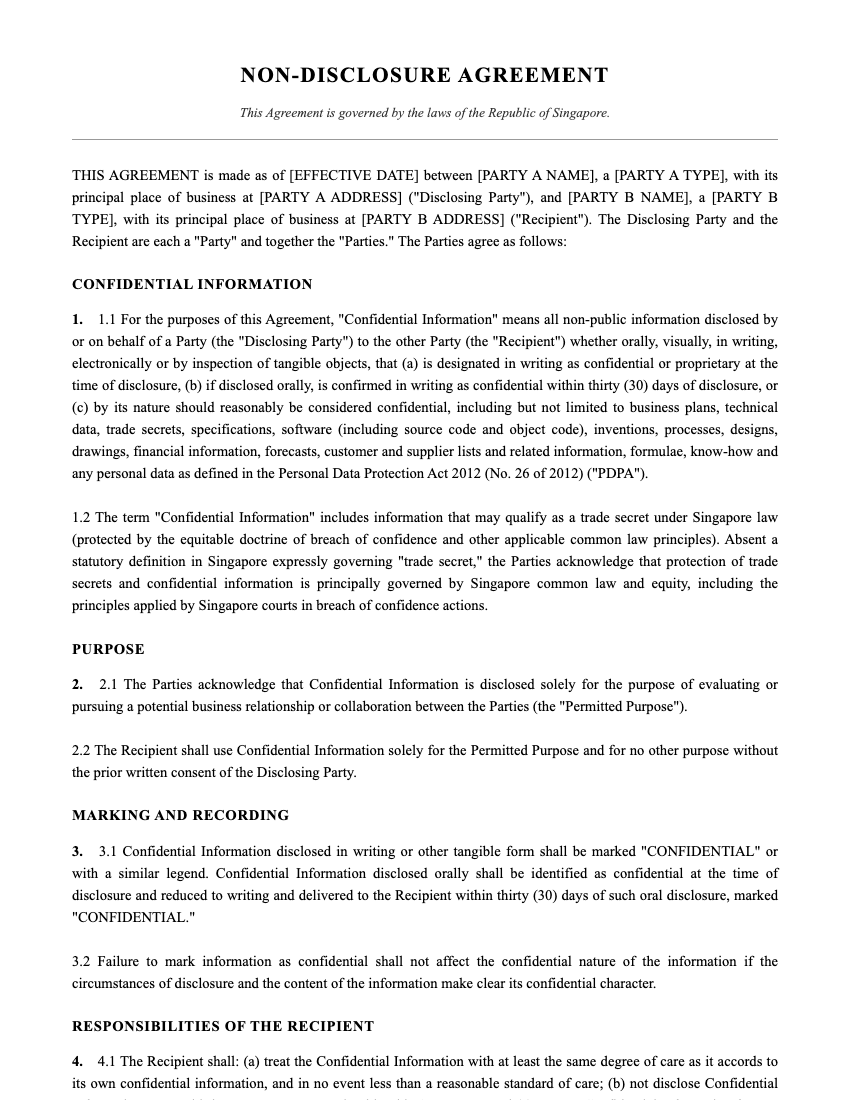
For a complete guide to NDA terms, duration, and standard exclusions, see our NDA Agreement Guide.
Why "Generic" NDAs Are Dangerous in Singapore (Chinese)
Using a one-size-fits-all NDA written for another jurisdiction creates three Singapore-specific risks.
- PDPA Compliance Trap
NDAs commonly collect or process personal data (names, contact details, staff lists). Under the PDPA, parties must state purposes, legal bases for processing, retention periods and breach-notification cooperation. An NDA that lacks PDPA-compliant personal-data clauses can expose the disclosing party and the recipient to regulatory action by the Personal Data Protection Commission (PDPC).
- Overbroad Use Restrictions and Enforceability
Singapore does not categorically void non-competes the way some U.S. states do. Instead, courts assess reasonableness—scope, duration, and territory—against legitimate interests (e.g., protection of trade secrets or client connections). A generic NDA that reads like a carte blanche restraint (“Recipient shall not compete with Discloser”) may be recharacterised or resisted in enforcement. The paradigm-shifting insight for Singapore: well-drafted NDAs can support injunctive relief and interim preservation orders, but only if the restriction is proportionate and the confidential classes are narrowly defined.
- Evidence-Preservation & Equitable Remedies
Singapore courts are active users of powerful equitable remedies (injunctions, Norwich Pharmacal orders for third‑party disclosure, and freezing orders). If you fail to require prompt notice, preservation of evidence, or cooperation for third-party disclosure, you may lose the ability to obtain timely relief. NDAs should include provisions obligating the receiving party to preserve electronic logs and assist with applications to courts for disclosure or interim relief.
Paradigm-Shifting Insight
In Singapore the NDA is not just a defensive paper contract—it is the gateway to equitable remedies. Courts will issue urgent injunctive and disclosure orders to prevent ongoing misuse of confidential information, but they will only do so when confidentiality obligations are clear, narrowly tailored, and supported by prompt preservation and cooperation clauses. Draft NDAs accordingly: define confidential classes, include PDPA-compliant data handling, and add express preservation/cooperation obligations.
Recent Legal Development
The PDPA Amendment Act 2019 (implemented in phases) strengthened enforcement and introduced mandatory data-breach notification obligations. PDPC guidance and enforcement actions since 2019 have made data-handling clauses in NDAs essential (see PDPC guidance links in Sources). While Singapore still lacks a single trade-secrets statute, regulatory focus on data protection has changed how NDAs are drafted and enforced.
Key Clauses — Singapore (Chinese) Edition
- Precise definition of Confidential Information and an explicit carve-out for independently developed or publicly known information.
- Purpose and limited use clause: restrict use strictly to an expressly described commercial purpose.
- PDPA/Data handling clause: parties’ roles (data controller/processor), permitted processing, retention periods, security measures, breach notification cooperation and cross-border transfer assurances.
- Preservation and cooperation clause: obligation to preserve logs, metadata, and to assist in Norwich/Anton Piller-style applications.
- Narrow injunctive-relief clause: acknowledges possibility of equitable relief and waiver of inadequate damages argument (without excluding other remedies).
- Residuals clause (optional): carefully worded to allow unaided memory use of general skills but not trade secrets.
- Governing law and language clause: specify Singapore law (Xinjiapo Hetong Fa) and that the Chinese-language contract is authoritative.
- Electronic signature clause referencing the Electronic Transactions Act (ETA) to confirm e-signature validity.
Who Needs This Document?
| User Persona | Usage Scenario | Key Singapore Benefit |
|---|---|---|
| Tech Startups | Discussing product with Singapore investors or contractors | PDPA clauses and narrow trade-secret definitions protect IP and personal data |
| MNCs / Regional HQs | Sharing SOPs with Singapore vendors | Preservation/cooperation clauses enable quick injunctive relief if misused |
| Law firms / Compliance | Onboarding outsourced teams in Singapore | Clarifies data controller/processor roles under PDPA |
| Manufacturers | Sending designs to Singapore-based factories | Enables court-ordered disclosure and interim relief if necessary |
How to Execute a Valid Singapore (Chinese) NDA
Step 1: Choose One-Way or Mutual
Pick One-Way if only you disclose. Use Mutual for bilateral diligence. Clarity reduces enforcement friction.
Step 2: Be Specific About Purpose and Duration
Describe the exact project and set narrow durations for non-trade-secret confidential data (e.g., 1–5 years). Trade secrets remain protected while secret under common law.
Step 3: Comply with PDPA and Mark Documents
Include PDPA roles, retention limits and breach-notification cooperation. Mark electronic and physical materials "CONFIDENTIAL" (in Chinese if appropriate) and preserve metadata.
Step 4: Sign Before Sharing and Preserve Evidence
Use ETA-compliant electronic signing where convenient, but obtain firm execution before disclosing. Ensure recipients agree to preserve logs and assist with urgent court applications.
Receiving NDAs From Others?
When a client or partner sends you an NDA, review PDPA clauses, the scope of "confidential information," and any implied restrictive covenants. If a clause feels like a disguised non-compete, narrow the language: Singapore courts require proportionality.
an AI contract review tool still helps: it flags PDPA gaps, overbroad restraints, and missing preservation or injunctive-relief language—saving negotiation time.
Related NDA Templates
Get the Template
Sign up for our newsletter to receive the template.
Frequently Asked Questions

About Designer Content
Designer Content creates practical legal document resources for landlords, contractors, and small business owners. We simplify complex legal concepts into actionable guidance. Connect with us on LinkedIn.