
Opening
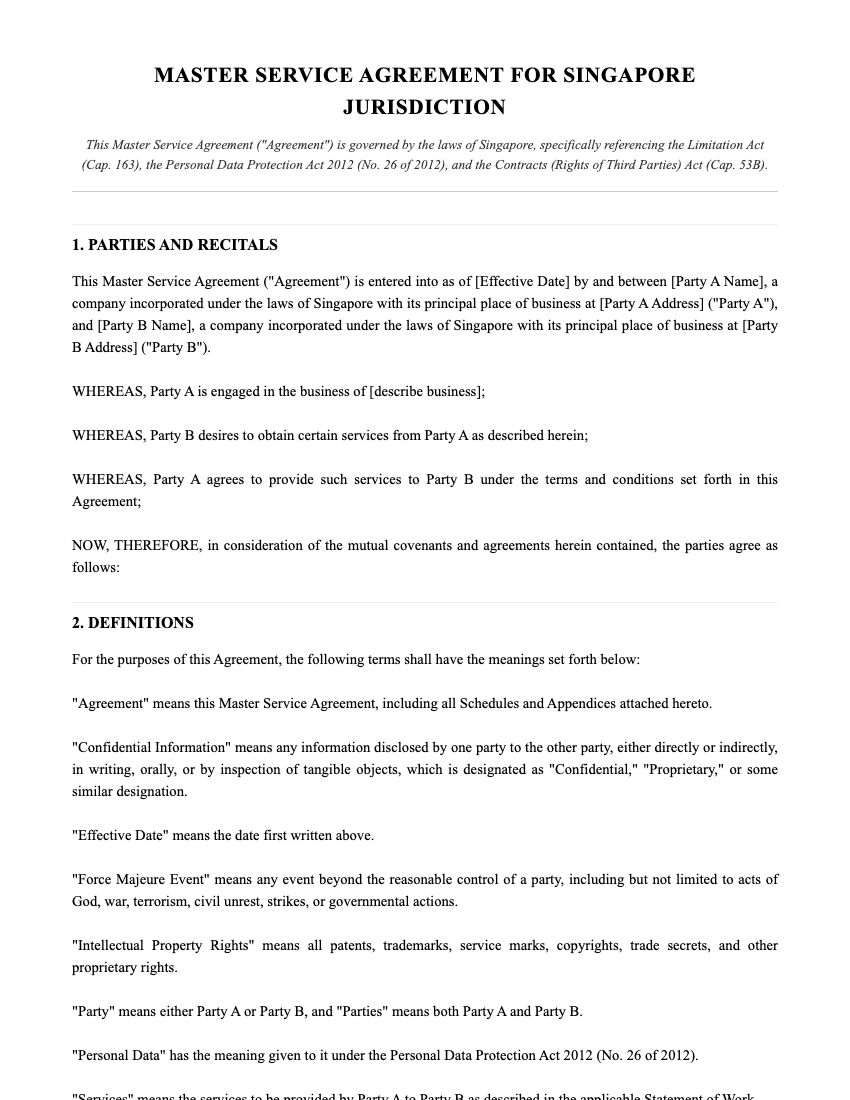
A Singapore Master Services Agreement (MSA) is a contract that sets the baseline legal terms for ongoing services, allowing you to reuse them across multiple projects via short Statements of Work (SOWs). For Singapore-based SMBs, agencies, and consultants, an MSA helps prevent scope creep, standardises payment and IP ownership, and reduces negotiation time with repeat clients. But it must also reflect Singapore-specific rules on worker status, enforceable non-competes, PDPA compliance, and liability limits.
For a comprehensive guide to structuring MSAs and SOWs that protect your business, see our Freelancer Contracts Guide.
Definition Box
Definition: A Singapore MSA is a master contract governed by Singapore law that defines the overarching terms for a series of services engagements between a service provider and a client. It typically covers pricing mechanics, invoicing and late-payment consequences, confidentiality, data protection obligations under the Personal Data Protection Act 2012 (No. 26 of 2012) (PDPA), intellectual property ownership and licensing, warranties, indemnities, limitations of liability (including constraints under the Unfair Contract Terms Act (Cap. 396) (UCTA)), and dispute resolution. Individual projects are then documented in SOWs that inherit the MSA’s terms.
Why You Cannot Use a Generic MSA in Singapore
Generic MSAs are often drafted for the US or the UK and can quietly clash with Singapore’s approach to worker classification, restraint of trade, and IP ownership. That mismatch matters because a court will interpret your contract through Singapore’s statutes and common law principles—and some “standard” clauses can become ineffective or risky.
Worker Classification Rules
Singapore does not use the US “ABC test.” Instead, worker status is assessed under Singapore’s common law “multiple / dominant impression” approach, looking at control, integration, economic reality, and the overall substance of the relationship. This is crucial because the Employment Act 1968 applies statutory employment protections to employees (and certain “workmen”), while true independent contractors sit outside that regime. If your MSA reads like an employment contract—fixed hours, close supervision, company tools, exclusivity, or “manager” approval for leave—it can undermine your independent contractor position.
Misclassification can trigger downstream liabilities: statutory benefits and protections (for eligible employees), CPF contribution exposure if the individual is actually an employee (CPF obligations are policed and can involve penalties), and tax/payroll compliance issues. Your Singapore MSA template should clearly document an independent business-to-business engagement, while still allowing reasonable quality standards through an SOW.
Non-Compete Enforceability
Unlike California-style blanket bans, non-competes (restraints of trade) can be enforceable in Singapore—but only if they are reasonable and protect a legitimate proprietary interest. Singapore courts generally start from the presumption that restraints are void as contrary to public policy unless justified, and they scrutinise scope, duration, and geography. If a clause is drafted too widely (for example, “no work in the industry for 24 months worldwide”), it is likely to fail.
A Singapore-focused MSA should therefore avoid copy-paste non-competes and instead use a calibrated toolkit: confidentiality and trade secret protection, narrow non-solicitation of customers you actually dealt with, and tailored restrictions tied to specific sensitive roles. Where a restraint is necessary, draft it narrowly to protect legitimate interests (confidential information, customer connections), and align the duration to what is truly needed.
IP/Work-for-Hire Considerations
“Work made for hire” is a US concept and can be misleading in Singapore templates. In Singapore, copyright ownership is governed by the Copyright Act 2021. As a practical rule, ownership does not automatically transfer to the client simply because payment has been made—especially when services are delivered by an independent contractor or an agency. Your MSA should use clear present-tense assignment language (or a license model) and specify when ownership transfers (often tied to full payment). If software is involved, separate pre-existing tools from project deliverables and reserve provider background IP.
What’s Included in This Template
Flexible SOW Structure
This template uses an “umbrella + SOW” model: the MSA sets core legal rules once, while each SOW defines deliverables, milestones, acceptance criteria, fees, and timelines. That keeps negotiations fast and reduces the risk that an operational email thread accidentally becomes the only record of scope.
Singapore-Specific Indemnification
Indemnities are drafted with Singapore enforceability in mind and paired with liability caps and exclusions that account for statutory controls. Because UCTA can police certain exclusions and limitations, the template frames risk allocation clearly, links caps to fees, and includes carve-outs for fraud and willful misconduct.
Dispute Resolution and Venue
The dispute clause is designed for Singapore as the governing law and forum, with an option to use arbitration seated in Singapore for cross-border deals. It also works with third-party rights rules so you can prevent unintended enforcement by non-parties.
Additional Singapore provisions included (with statute anchors):
- Data protection obligations aligned to PDPA 2012 (No. 26 of 2012) (collection, use, disclosure, security, cross-border transfers)
- Limitation and exclusion clause drafting mindful of Unfair Contract Terms Act (Cap. 396)
- Third-party rights “opt-out” aligned to Contracts (Rights of Third Parties) Act (Cap. 53B)
- Contract claims timing awareness under the Limitation Act (Cap. 163)
- Late payment interest language drafted to avoid unintended “moneylending” characterisation under the Moneylenders Act (Cap. 188)
Who Needs This Document?
| User Type | Relationship | Key Benefit |
|---|---|---|
| Marketing or design agencies | Retainers + repeat campaigns | Clear SOWs prevent scope creep and preserve portfolio/IP permissions |
| IT managed service providers | Ongoing support + SLAs | Sets response times, exclusions, and capped liability across all tickets |
| Software/dev consultancies | Build + maintenance engagements | Separates background IP from deliverables and ties assignment to payment |
| Independent consultants | Advisory projects | Standardises fees, expenses, confidentiality, and PDPA handling |
How to Use This MSA Template
Step 1: Identify the right parties
Use the legal entity names (ACRA-registered company name, UEN where appropriate) and signature blocks that match your corporate authority rules. Mismatched names can complicate enforcement and invoicing.
Step 2: Set the commercial defaults
Fill in payment terms, late-payment interest, expense policies, and tax treatment. Keep day-to-day pricing in SOWs, not in the master.
Step 3: Attach a first SOW
Define scope, milestones, acceptance testing, and deliverables in the SOW. If you want an IP transfer, specify deliverables and the transfer trigger (commonly full payment).
Step 4: Sign once, reuse often
Execute the MSA once, then issue new SOWs for each project. This reduces friction with repeat clients and ensures every project inherits the same PDPA, IP, and liability framework.
Already Receiving Contracts from Clients?
If you’re a provider, you’ll often be asked to sign the client’s MSA instead of sending your own. Don’t assume it’s “standard.” Review governing law (is it Singapore?), liability (is it uncapped?), IP (are you giving away background tools?), and PDPA clauses (are you taking processor obligations you can’t meet?). For a faster first-pass review before negotiating, use an AI contract review tool to spot red flags and prioritize edits.
Download Options
Free PDF Version: A read-only Singapore MSA template for reference, internal review, and quick sharing with counterparties.
Editable Word/Google Docs Version: An editable template with clause placeholders (SOW structure, IP options, PDPA addendum language, and liability cap toggles) so you can customise for each client.
Disclaimer
This template is general information, not legal advice. For high-value,regulated, or cross-border projects, consult a Singapore-qualified lawyer for tailored drafting.
Related MSA Templates
Get the Template
Sign up for our newsletter to receive the template.
Frequently Asked Questions

About Designer Content
Designer Content creates practical legal document resources for landlords, contractors, and small business owners. We simplify complex legal concepts into actionable guidance. Connect with us on LinkedIn.