
What is a Singapore NDA?
A Singapore Non-Disclosure Agreement (NDA) is a contractual tool that records the parties' agreement to keep specified information confidential. Unlike jurisdictions with a dedicated trade-secrets statute, Singapore protects trade secrets primarily through common-law doctrines (breach of confidence), equitable remedies, and contractual enforcement. NDAs in Singapore must be drafted with reference to related statutory regimes—most importantly the Personal Data Protection Act 2012 (PDPA), the Contracts (Rights of Third Parties) Act (CRTPA), and the Electronic Transactions Act—because these affect enforceability and compliance.
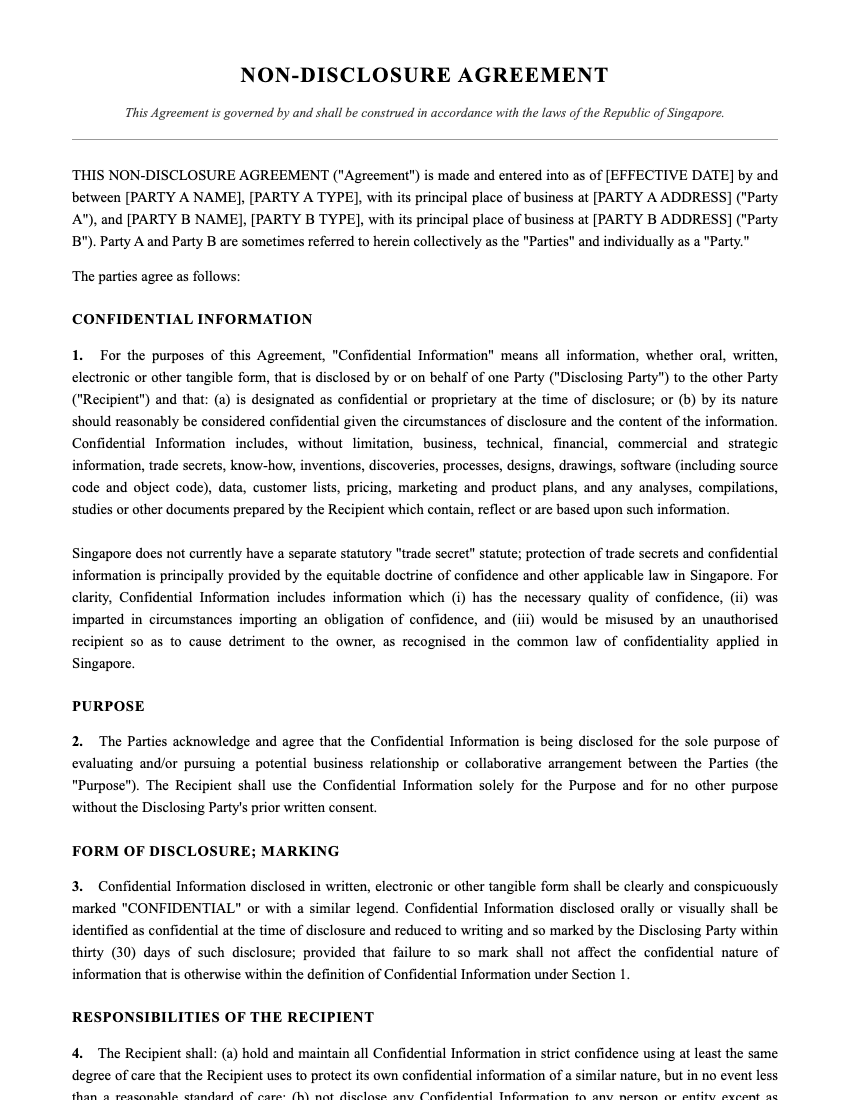
Definition: For practical purposes in Singapore an NDA (also called a confidentiality agreement) sets out: (1) what information is "Confidential"; (2) permitted uses (the "Purpose"); (3) exclusions; (4) duration; and (5) remedies for breach. Because courts will treat trade secrets differently from general confidential information, this template separates "Trade Secrets" (potentially protected indefinitely) from time-limited confidential business information.
Why "Generic" NDAs Are Dangerous in Singapore
Templates designed for other common-law systems can create three distinct risks when used in Singapore without adaptation.
- PDPA compliance gaps
For a complete guide to NDA terms, duration, and standard exclusions, see our NDA Agreement Guide.
If the confidential package contains personal data (names, contact details, customer lists), the PDPA applies. NDAs that simply say "recipient must keep personal data confidential" may not satisfy PDPC expectations for data-processing clauses, retention, access controls, cross-border transfers, or notification obligations. Failure to include PDPA-compliant processing terms can expose parties to regulatory scrutiny by the Personal Data Protection Commission (PDPC).
- Unintended third-party rights under the CRTPA
The Contracts (Rights of Third Parties) Act (2001) allows a person who is not a contracting party to enforce contractual terms if the contract expressly says so or the term purports to confer a benefit on them. A boilerplate NDA that fails to exclude third-party enforcement can allow suppliers, acquirers, or other stakeholders to assert rights or liabilities they were never meant to have. This is a uniquely Singapore statutory trap—fix it by expressly excluding or confirming third-party rights.
- Hidden restraints of trade disguised as "confidentiality"
Singapore courts enforce reasonable post-termination restraints (non-compete or non-solicit) where they are ancillary to a contract and necessary to protect legitimate business interests. Unlike California's near-absolute ban, Singapore applies the restraint-of-trade doctrine (reasonableness in time, geography and scope). Generic NDAs that forbid "any use of Confidential Information that could compete" may slip into unenforceable or, conversely, unexpectedly enforceable restraint language. Draft confidentiality narrowly: prohibit misuse of confidential information, not lawful competition.
Paradigm-shifting insight for Singapore: NDAs live at the intersection of contract, PDPA and the CRTPA. If you ignore any one of those three, you can lose remedies, create unintended third-party claimants, or trigger data-protection liabilities. Treat an NDA as both an IP confidentiality instrument and a data-processing contract.
A Real Development to Watch
The Personal Data Protection Commission has repeatedly emphasised contractual safeguards for data sharing. PDPC guidance (see Sources) makes clear that when confidential disclosures include personal data, organisations must document the purpose, retention, access controls, and cross-border transfer mechanisms in their agreements. This regulatory guidance functions as a practical legal development—NDAs that do not address PDPA obligations will be viewed skeptically by regulators and courts.
What's Included in This Template? (Key Clauses)
- Precise Confidentiality Definition: Separates "Trade Secrets" (value from secrecy + steps to keep secret) from ordinary "Confidential Information" with a recommended 2–5 year shelf-life.
- Purpose Limitation: Narrow, objective purpose clause to avoid broad-use disputes and reduce the risk of being read as a restraint of trade.
- PDPA/Data Processing Schedule: Mandatory clauses that allocate responsibilities for personal data (controller/processor roles), security measures, and cross-border transfer safeguards.
- CRTPA Carve-In/Out: Explicit language either to exclude third-party enforcement or to permit identified third parties to enforce (as needed for supply chains/M&A diligence).
- Remedies & Injunctive Relief: Singapore courts grant injunctive relief for breach of confidence; the template includes a freezing/return provision and a cost-shifting clause.
- Electronic Execution Clause: Confirms that electronic signatures and scanned counterparts are valid under the Electronic Transactions Act.
- Optional Non-Solicit/Non-Compete Annex: If you need a post-termination restraint, use the narrow annex that states the legitimate interest and sets reasonable scope—Singapore courts will test reasonableness.
Who Needs This Document?
| User Persona | Usage Scenario | Key Singapore Benefit |
|---|---|---|
| Tech Startups | Sharing pitch decks with VCs and contractors | PDPA-compliant data-processing clauses protect customer data and investor diligence packages |
| Professional Services | Engaging external advisors | CRTPA carve-outs prevent unintended third-party enforcement by clients/suppliers |
| Manufacturers | Sharing drawings with overseas factories | Cross-border transfer and confidentiality interplay reduce regulatory risk under PDPA |
| Employers & Recruiters | Protecting client lists and proposals | Carefully scoped non-solicit language (if needed) that passes Singapore's restraint-of-trade test |
How to Execute a Valid Singapore NDA (4 Steps)
Step 1: Choose One-Way or Mutual
Select One-Way if only one side discloses (pitching/investor). Choose Mutual for collaborations or joint development. Pick the form that reflects who has the obligation—this affects remedies.
Step 2: Define the Purpose & Classify Data
Be specific about the Purpose and identify whether the package contains "Personal Data" (PDPA) or "Trade Secrets". If personal data is included, attach the PDPA/Data Processing Schedule and state who is the data controller/processor.
Step 3: Add Statutory Safeguards
Include explicit CRTPA language (either excluding or permitting third-party rights) and confirm electronic signing under the Electronic Transactions Act. Mark documents "CONFIDENTIAL" and record reasonable steps taken to keep them secret.
Step 4: Sign Before You Share
Execute the agreement (electronic signatures accepted under the Electronic Transactions Act). Only disclose after signatures are exchanged. Keep auditable delivery records and apply access controls for shared files.
Receiving NDAs from Others?
If a counterparty sends you an NDA, review it for PDPA obligations (don’t accept unilateral processing responsibilities without capacity), CRTPA effects (are they giving third-party rights?), and hidden restraints. an AI contract review tool flags these issues instantly—compare terms against Singapore statutes and PDPC expectations to negotiate safely.
Related NDA Templates
Get the Template
Sign up for our newsletter to receive the template.
Frequently Asked Questions

About Designer Content
Designer Content creates practical legal document resources for landlords, contractors, and small business owners. We simplify complex legal concepts into actionable guidance. Connect with us on LinkedIn.