
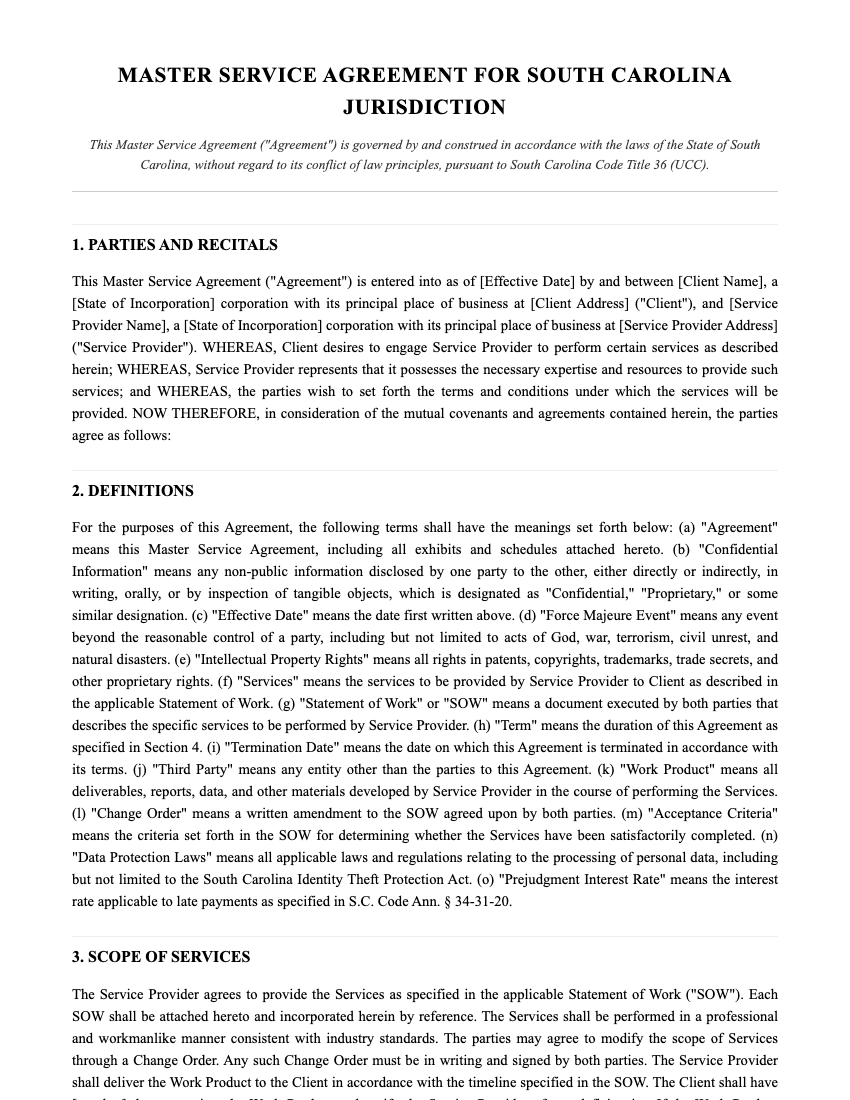
A South Carolina Master Services Agreement (MSA) is a reusable contract that sets the legal ground rules for ongoing service work between a provider and a client in South Carolina. Instead of renegotiating core terms for every project, the parties sign one MSA and then issue short Statements of Work (SOWs) for each engagement. This structure is especially useful for agencies, consultants, and IT providers that do repeat work under changing scopes. A jurisdiction-specific template reduces enforceability risk and negotiation time.
Definition: A South Carolina Master Services Agreement is an “umbrella” agreement governed by South Carolina law that establishes baseline terms—payment, invoicing, confidentiality, ownership of deliverables, liability limits, and dispute procedures—for a series of service projects. Individual projects are documented in separate SOWs that incorporate the MSA by reference. The goal is speed and consistency: the MSA handles the legal boilerplate once, while each SOW captures the business specifics (deliverables, milestones, fees, and timelines). A South Carolina-focused MSA also aligns key clauses with state rules on time-to-sue, interest on late payments, and unfair trade practices.
Why You Cannot Use a Generic MSA in South Carolina
Generic MSAs are often written for “any U.S. state,” but they quietly assume legal rules that vary by jurisdiction. In South Carolina, those assumptions can create real friction: a mis-drafted independent contractor section can undermine your classification position; a non-compete copied from another state may be unenforceable as written; and an IP clause that relies on vague “work made for hire” language can fail to transfer ownership for many deliverables. A South Carolina-specific template is not about adding legalese—it’s about making sure the business deal you think you made is the deal a South Carolina court is likely to enforce.
3a. Worker Classification Rules
South Carolina does not use California’s ABC test as a general rule. Instead, worker status is typically evaluated under a multi-factor, common-law “right to control” approach, especially in unemployment and workplace contexts. The South Carolina Department of Employment and Workforce (DEW) applies a control-based analysis that looks at who directs the work, who supplies tools, whether the worker can realize profit or loss, and whether the relationship is ongoing (a practical, fact-driven test rather than a single bright-line rule). Misclassification can trigger back taxes and unemployment insurance exposure, because employers may be liable for unemployment contributions and related assessments under South Carolina’s unemployment insurance statutes (e.g., definitions and coverage concepts in S.C. Code Ann. Title 41, including S.C. Code Ann. § 41-27-10 et seq.).
For a comprehensive guide to structuring MSAs and SOWs that protect your business, see our Freelancer Contracts Guide.
A South Carolina-ready MSA should do two things: (1) clearly state independent contractor status and allocate responsibilities like taxes and insurance; and (2) avoid “control” language in the SOW (fixed hours, mandatory daily check-ins, required on-site attendance) that contradicts contractor status. Contract language is not dispositive, but it matters: a well-drafted MSA supports the facts you want to be true, while a generic template can accidentally create employee-like obligations.
3b. Non-Compete Enforceability
South Carolina generally enforces non-compete agreements, but only when they are reasonable and narrowly tailored. Courts typically require a legitimate business interest (such as protecting goodwill, customer relationships, or trade secrets), reasonable geographic scope, and reasonable duration; the restriction also cannot be unduly harsh on the worker or contrary to public policy. A common “generic” mistake is inserting a nationwide non-compete for a local business, or setting a duration (like three to five years) without justification. Another frequent problem is drafting an overbroad restriction and assuming a court will rewrite it.
South Carolina is known for being less willing than some states to “blue pencil” or rewrite overly broad non-competes; if a restriction is unreasonable, a court may refuse to enforce it rather than fix it for you. That makes precision critical. Even though enforceability primarily comes from South Carolina case law, your MSA should still be drafted with state policy in mind and paired with trade secret/confidentiality protections. If a full non-compete is risky for your facts, alternatives can be more enforceable and business-friendly: a strong confidentiality clause, narrow non-solicitation of customers, non-solicitation of employees, and clear return/destruction obligations for company data. For businesses also concerned about deceptive conduct in contracting, South Carolina’s Unfair Trade Practices Act (SCUTPA), S.C. Code Ann. § 39-5-10 et seq., is another reason to keep restrictive covenants and marketing/poaching provisions precise and not misleading.
3c. IP/Work-for-Hire Considerations
A generic MSA often says “all deliverables are work made for hire,” but U.S. copyright law only treats certain works as “work made for hire,” and many contractor deliverables don’t qualify unless specific statutory conditions are met (17 U.S.C. § 101). In practice, South Carolina businesses should rely on a belt-and-suspenders approach: (1) a present-tense assignment of intellectual property rights in deliverables upon payment (or upon creation, depending on the deal), plus (2) a backup “work made for hire to the extent permitted” clause. Your template should also address pre-existing IP (like the provider’s tools, code libraries, or templates) and grant the client a license to that background IP only as needed.
What’s Included in This Template
Flexible SOW Structure. The MSA sets default terms once, while each SOW defines scope, acceptance criteria, milestones, pricing, and change-order rules. That helps stop scope creep: when the client requests “just one more thing,” the SOW change process creates a clean path to approve additional fees and timeline extensions.
South Carolina-Specific Indemnification. The template uses mutual, business-to-business indemnity concepts with clear triggers (third-party claims, IP infringement allegations, and confidentiality breaches). It also includes carve-outs for gross negligence and willful misconduct, which is important because overreaching risk shifts can create negotiation deadlocks and practical unenforceability concerns.
Dispute Resolution and Venue. The template anchors governing law to South Carolina and sets a predictable venue (often county/state court where a party is located) to avoid being dragged into distant courts. It also adds notice-and-cure and escalation steps so routine disputes are more likely to settle before litigation.
Additional South Carolina-focused provisions included:
- Late-payment interest aligned with S.C. Code Ann. § 34-31-20 (interest rate rules that can inform contract drafting)
- Time-to-sue awareness tied to S.C. Code Ann. § 15-3-530 (commonly relevant limitations periods)
- Unfair/deceptive practices compliance reminders under S.C. Code Ann. § 39-5-10 et seq.
- Data handling and breach-response alignment with S.C. Code Ann. § 37-20-110 et seq. (South Carolina data security/privacy provisions)
- Anti-corruption representations referencing the federal FCPA, 15 U.S.C. § 78dd-1 et seq., for companies selling into regulated or multi-state supply chains
Who Needs This Document?
| User Type | Relationship | Key Benefit |
|---|---|---|
| Marketing or creative agency | Repeat campaigns, retainers | Reusable terms + clean SOW scoping to control revisions |
| IT managed services provider (MSP) | Ongoing support + projects | Standardized SLAs, change orders, and liability boundaries |
| Business consultant | Advisory + implementation phases | Clear deliverables, acceptance, and billing triggers |
| Software/dev shop | Builds, integrations, maintenance | Strong IP ownership, background IP licensing, and payment gates |
How to Use This MSA Template
Step 1: Identify the parties correctly
Use each party’s exact legal name and entity type (LLC, corporation, sole proprietor). For South Carolina entities, match the name used with the South Carolina Secretary of State to reduce enforceability and invoicing problems.
Step 2: Set the term and termination mechanics
Choose a fixed term (e.g., 12 months) or an evergreen term with notice to terminate. Include termination for convenience vs. for cause, and specify what happens to in-flight SOWs and unpaid invoices.
Step 3: Attach your first SOW
Keep project specifics out of the MSA. Put deliverables, deadlines, pricing, assumptions, and acceptance criteria in the SOW so each project is easy to approve without reopening the entire contract.
Step 4: Sign, then reuse for future work
Once the MSA is signed, each new project is a new SOW that incorporates the MSA by reference. This speeds procurement and keeps your legal posture consistent across clients and engagements.
Related MSA Templates
Get the Template
Sign up for our newsletter to receive the template.
Frequently Asked Questions

About Designer Content
Designer Content creates practical legal document resources for landlords, contractors, and small business owners. We simplify complex legal concepts into actionable guidance. Connect with us on LinkedIn.