
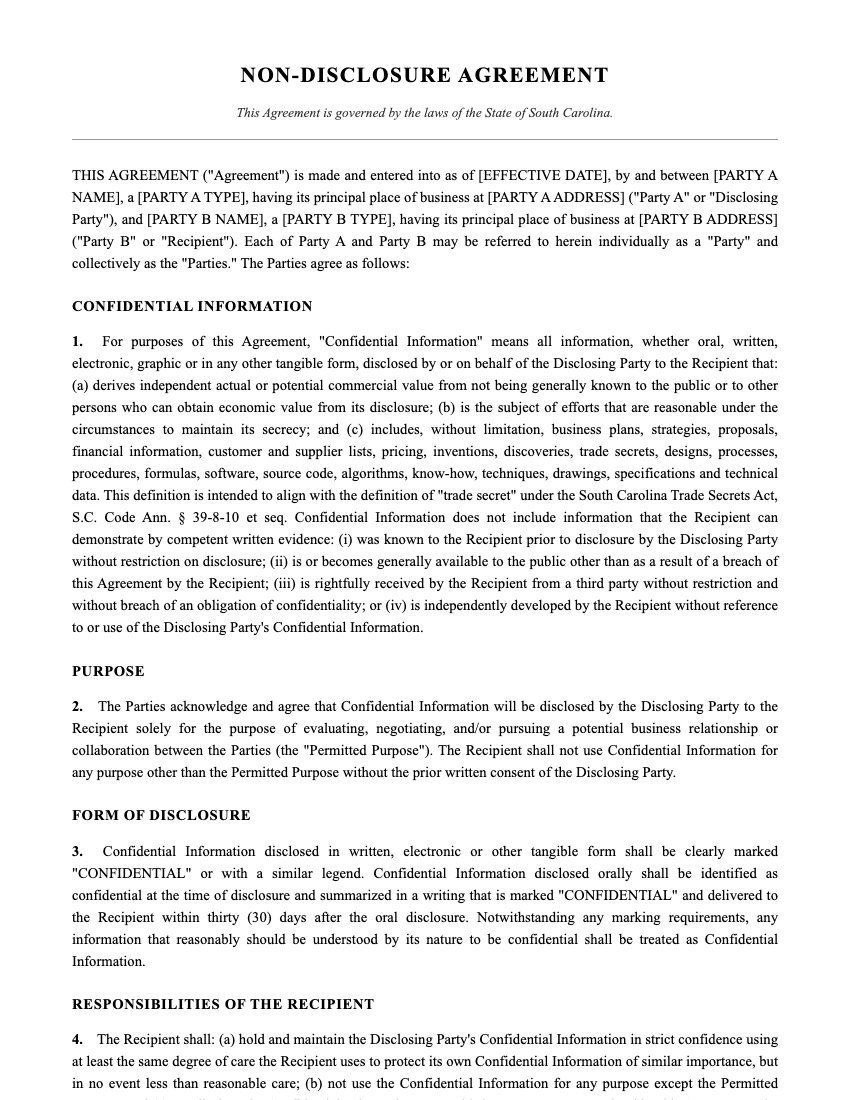
A South Carolina Non-Disclosure Agreement (NDA) is a contractual tool that protects confidential information, trade secrets, and goodwill while fitting within South Carolina's common-law approach to restrictive covenants. Unlike some states that categorically invalidate non-competes, South Carolina enforces reasonable restraints tied to a legitimate business interest—so the drafting details matter.
What Is a South Carolina NDA?
Definition: A South Carolina NDA is a contract where a party (Receiving Party) promises to keep specified information confidential and to use it only for a stated purpose (e.g., evaluating a partnership, performing services). NDAs in South Carolina are interpreted against the backdrop of state trade secret law (Uniform Trade Secrets Act, codified at S.C. Code Ann. § 39-8-10 et seq.), the Unfair Trade Practices Act (S.C. Code Ann. § 39-5-10 et seq.), and general contract law (contract claims often governed by the three-year limitation in S.C. Code Ann. § 15-3-530).
That legal framework means two things: (1) a properly drafted NDA protects trade secrets and confidential business information, and (2) you must avoid hidden restraints on competition or overbroad terms that purport to be "confidential" but are really non-compete or customer-restraint covenants in disguise.
For a complete guide to NDA terms, duration, and standard exclusions, see our NDA Agreement Guide.
Why "Generic" NDAs Are Dangerous in South Carolina
Many free NDA templates are written for states with different attitudes toward restraints. In South Carolina those templates often contain three common traps:
- Backdoor restraints disguised as confidentiality. A clause that forbids the Receiving Party from using Confidential Information "to compete" or that broadly bars contacting customers can operate as an enforceable non-compete or non-solicit—if the clause is tied to a protectable interest (trade secrets or goodwill) courts may enforce it, but if it is overbroad courts can void the restraint or refuse to reform it. The drafting line between a legitimate confidentiality restriction and an unlawful restraint is narrow.
- Failure to preserve statutory remedies. If you plan to seek federal Defend Trade Secrets Act (DTSA) remedies in the future, your NDA should include the DTSA whistleblower notice (see 18 U.S.C. § 1833(b)). Without it, you may be unable to recover enhanced damages or attorney's fees under the DTSA.
- Misunderstanding time limits. Contract claims in South Carolina are subject to the three-year limitations period in S.C. Code Ann. § 15-3-530. If you rely solely on contract remedies and miss the window, you can lose valuable relief. Trade-secret claims under the UTSA also have timing traps; discoverability matters.
Paradigm-shifting insight (South Carolina): Courts enforce covenants only to the extent they protect a legitimate business interest such as customer goodwill, trade secrets, or specialized training. But South Carolina's courts will also attempt to preserve reasonable covenants through judicial modification in some cases—so the real drafting risk is ambiguity. An NDA that mixes confidentiality with vague "no competition" language can turn a narrow protection into a litigated restraint; conversely, narrowly defined protections tied to demonstrable interests are more likely to be upheld.
Real case study: In practice, South Carolina courts have enforced confidentiality and narrowly tailored restrictive covenants where employers show a legitimate interest in protecting trade secrets and customer relationships. For current practitioner guidance and examples of enforcement trends, see state-focused analyses from employment and IP law firms (sources below). Those materials reflect how courts weigh protectable interests, temporal/geographic scope, and public policy in deciding enforceability.
What's Included in This Template (Key Clauses)
- Clear Purpose Clause: Limits use to "Evaluating a potential [partnership/engagement] concerning [Project X]." Narrow purposes reduce the risk the agreement will be read as an improper restraint.
- Definitions: Separates "Confidential Information" (time-limited, business data) from "Trade Secrets" (as defined by S.C. Code Ann. § 39-8-10—information deriving independent economic value from secrecy and subject to reasonable efforts to maintain secrecy).
- Permitted Disclosures: Industry-standard carve-outs (public domain, pre-existing knowledge, independently developed, compelled by law) and a required notice procedure for compelled disclosures.
- DTSA/Whistleblower Notice: Required language so you preserve federal remedies under 18 U.S.C. § 1833(b).
- Non-Solicitation vs. Non-Compete: Optional non-solicit language narrowly focused on protecting specific customers or employees; explicit avoidance of broad non-compete phrasing unless supported by separate consideration and clear scope.
- Remedies & Injunctive Relief: Equitable remedies clause acknowledging that monetary damages may be inadequate for trade secret breaches—important in jurisdictions that grant injunctions to prevent imminent harm.
- Choice of Law & Limitations: South Carolina choice-of-law with acknowledgment of S.C. contract limitations (S.C. Code Ann. § 15-3-530).
Who Needs This Document?
| User Persona | Usage Scenario | Key Benefit in South Carolina |
|---|---|---|
| Carolina tech startups | Pitching to investors & contractors | Protects source code and roadmaps while avoiding overbroad restraints |
| Manufacturing suppliers | Sharing process specs with vendors | Preserves trade secrets and creates enforceable injunctive remedy pathway |
| Service firms | Hiring rainmakers or consultants | Narrow non-solicit carve-outs protect client lists without creating unlawful non-competes |
| Buyers & Sellers | M&A due diligence in SC | Permits safe disclosure during sale while preserving S.C. trade-secret remedies |
How to Execute a Valid South Carolina NDA
Step 1: Pick the right form—One-Way (unilateral) if only you disclose; Mutual if both sides will exchange confidential information.
Step 2: Define a narrow Purpose—The court will enforce use-limits tied to the written purpose.
Step 3: Mark and secure documents—Label documents "CONFIDENTIAL" and adopt reasonable security steps (passwords, limited access) to show you took steps to preserve secrecy under the UTSA.
Step 4: Sign before sharing—Under federal E-SIGN (15 U.S.C. § 7001) and South Carolina's electronic signature laws, electronic signatures are valid, but preserve audit trails (signed PDF, timestamped emails) to prove the agreement was in effect when disclosure occurred.
Receiving an NDA from a Client?
Review for hidden restraints: watch for language that limits future employment or contact with customers. Ask to replace overly broad "no competition" phrasing with narrow confidentiality and limited non-solicit provisions tied to specific customers and reasonable duration.
an AI contract review tool helps spot ambiguous or overbroad clauses, compares terms to South Carolina enforcement norms, and flags provisions that could be read as unlawful restraints—saving you negotiation time.
Related NDA Templates
Get the Template
Sign up for our newsletter to receive the template.
Frequently Asked Questions

About Designer Content
Designer Content creates practical legal document resources for landlords, contractors, and small business owners. We simplify complex legal concepts into actionable guidance. Connect with us on LinkedIn.