
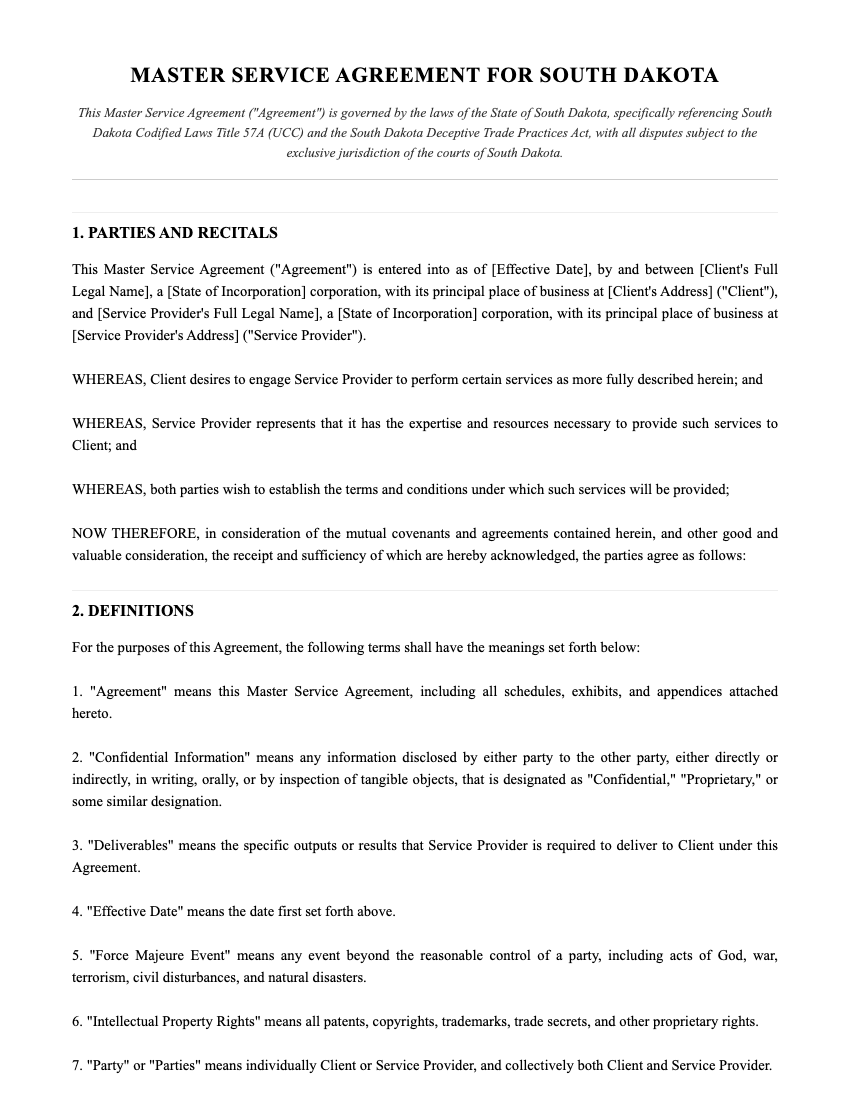
A South Dakota Master Services Agreement (MSA) is a contract that sets the ground rules for an ongoing service relationship so you can run future projects through short Statements of Work (SOWs) instead of renegotiating legal terms each time. For South Dakota SMBs, agencies, and consultants, a state-tailored MSA helps avoid avoidable payment disputes, misclassification risk, and “boilerplate” clauses that don’t match South Dakota statutes. This guide explains what to include in a South Dakota-ready MSA template and how to use it in 2025.
Definition: A South Dakota Master Services Agreement is a written “umbrella” contract between a service provider and a client that governs all present and future services performed under separate SOWs. The MSA typically covers payment mechanics, late interest, confidentiality, IP ownership, warranties, liability limits, and dispute resolution, while each SOW describes the specific deliverables, timeline, and fees for an individual project. Because South Dakota enforces written contracts under its own statutes (including time limits to sue on written agreements under SDCL 15-2-13), a jurisdiction-specific MSA template helps ensure your terms are actually enforceable where the work and the parties are based.
Why You Cannot Use a Generic MSA in South Dakota
Generic MSAs often assume “national” rules that don’t align with South Dakota’s statutes on restraints of trade, consumer/deceptive practices, and interest. They also frequently default to out-of-state venue (or a one-size-fits-all arbitration clause), which can be expensive and impractical for a Rapid City or Sioux Falls business. A South Dakota-specific template should address three recurring pitfalls.
3a. Worker Classification Rules
South Dakota does not use California’s AB 5 “ABC test” as the general, across-the-board rule for business service contracts. Instead, worker status is commonly evaluated using a control-based, common-law style analysis for many purposes, and state unemployment insurance law uses a statutory framework that focuses on whether the worker is an “employee” or an “independent contractor.” In practice, the more control a client has over how, when, and where services are performed—and whether the worker is integrated into the client’s business—the higher the misclassification risk.
For a comprehensive guide to structuring MSAs and SOWs that protect your business, see our Freelancer Contracts Guide.
For unemployment insurance, South Dakota’s worker-classification provisions appear in SDCL Title 61 (Reemployment Assistance), including definitions of “employment” and “wages” and related coverage rules. A South Dakota-specific MSA should avoid “employee-like” language (set hours, mandatory on-site work without business need, day-to-day supervision) and instead document independent business indicia: the provider sets its own methods, can use subcontractors (if allowed), supplies tools/software, carries insurance, and invoices by milestone or retainer.
Misclassification can trigger back taxes and contributions, interest, and penalties under the reemployment assistance system, and it can also cascade into wage and hour, workers’ compensation, and tax issues. Your MSA template should therefore include an Independent Contractor clause that matches operational reality and a mutual representation that each party will comply with applicable state and federal tax and employment laws.
3b. Non-Compete Enforceability
Unlike states that broadly ban non-competes, South Dakota generally permits them—but only within narrow statutory limits. South Dakota’s key restraint-of-trade statute is SDCL 53-9-11, which states that any contract restraining someone from exercising a lawful profession, trade, or business is void, except in limited circumstances. One major exception allows a non-compete tied to the sale of goodwill of a business, and another relates to certain employment relationships in connection with a business.
For service providers and clients using an MSA, the practical takeaway is: a “standard” broad non-compete clause copied from a national template can be risky and may be void under South Dakota law if it goes beyond the statutory exceptions or operates as a general restraint of trade. Even where a restriction might be permissible, enforceability typically turns on whether it is reasonable in scope, geography, and duration and whether it protects a legitimate business interest rather than simply reducing competition.
A South Dakota-appropriate MSA template should therefore avoid sweeping “you can’t work for any competitor” language. Instead, it should use enforceable alternatives that better fit SDCL 53-9-11’s framework: (1) strong confidentiality and trade secret protections, (2) a narrowly drafted non-solicitation of the other party’s employees or customers (tailored to legitimate relationships), and (3) clear ownership/return-of-materials terms. If you truly need a non-compete (for example, in a business acquisition scenario), it should be handled in a separate, carefully drafted agreement tied to the sale of goodwill rather than buried in a generic services MSA.
3c. IP/Work-for-Hire Considerations
Most IP rules for “work made for hire” come from federal copyright law (17 U.S.C. § 101), but South Dakota contract drafting still matters because ownership often depends on what your written agreement says. A South Dakota MSA template should clearly distinguish: (1) pre-existing materials each party already owns, (2) deliverables created under an SOW, and (3) any licensed third-party components. If you want the client to own deliverables, use an explicit IP assignment clause triggered upon payment. If the provider needs reusable know-how, reserve “background IP” and grant a limited license. This avoids accidental overreach and prevents disputes when a client later claims ownership of the provider’s tools.
What's Included in This Template
Flexible SOW Structure
The template separates the long-term legal rules (the MSA) from project specifics (SOWs). That means you sign the MSA once, then use short SOWs to define scope, dates, acceptance criteria, and pricing for each new project. This structure reduces negotiation time and helps prevent scope creep.
South Dakota-Specific Indemnification
Indemnification should be mutual and tied to realistic risks: third-party IP infringement claims, bodily injury/property damage caused by negligence, and breaches of confidentiality. The template also includes practical limitations so the clause doesn’t become an unlimited guarantee. For South Dakota businesses, this balance is important because overbroad indemnities can shift uninsurable risk.
Dispute Resolution and Venue
A South Dakota MSA should name South Dakota law as governing law and specify venue in South Dakota state courts (or federal court in South Dakota where appropriate). This avoids being forced into distant forums and supports predictability if a payment dispute or deliverables dispute arises.
Additional South Dakota-tailored provisions included:
- Late payment interest drafted with SDCL 54-3-5.1 in mind (and clear “when interest starts” language).
- Deceptive marketing and representations compliance aligned to SDCL 37-24-6 (South Dakota Deceptive Trade Practices Act).
- Contract claims timing awareness for written agreements under SDCL 15-2-13 (six-year limitations period for many written contract actions).
- UCC alignment for mixed goods/services projects where relevant under SDCL Title 57A (UCC).
- Release language that avoids unintended waivers and is drafted with South Dakota’s approach to releases in mind, including SDCL 20-9-1 (release effect).
Who Needs This Document?
| User Type | Relationship | Key Benefit |
|---|---|---|
| Marketing agencies | Ongoing campaigns with multiple SOWs | Standardizes payment, approvals, and change orders |
| IT consultants/MSPs | Retainers + ticketed work | Defines response times, limits liability, and sets late-interest rules |
| Software developers | Build + maintenance phases | Clarifies IP ownership, licensing, and acceptance criteria |
| Professional services firms | Recurring advisory projects | Prevents scope creep and locks in dispute venue in South Dakota |
How to Use This MSA Template
Step 1: Identify the Parties Correctly
Use the full legal names (LLC/Corp/individual) and addresses. If you’re an LLC, match the name on your South Dakota filings to prevent enforceability problems and invoicing delays.
Step 2: Set the Term and Termination Rules
Choose an initial term (often 12 months) with auto-renewal or month-to-month continuation. Add a clean termination for convenience notice period, plus termination for breach with a cure window.
Step 3: Attach Your First SOW
Put deliverables, dates, pricing, and acceptance criteria in the SOW, not in the MSA. Include assumptions and out-of-scope examples so change requests become paid change orders.
Step 4: Sign Once, Then Reuse
After the MSA is executed, each new project should only require a new SOW referencing the MSA. Keep a consistent signature process (e-sign or wet ink) so there’s a clear audit trail.
Related MSA Templates
Get the Template
Sign up for our newsletter to receive the template.
Frequently Asked Questions

About Designer Content
Designer Content creates practical legal document resources for landlords, contractors, and small business owners. We simplify complex legal concepts into actionable guidance. Connect with us on LinkedIn.