
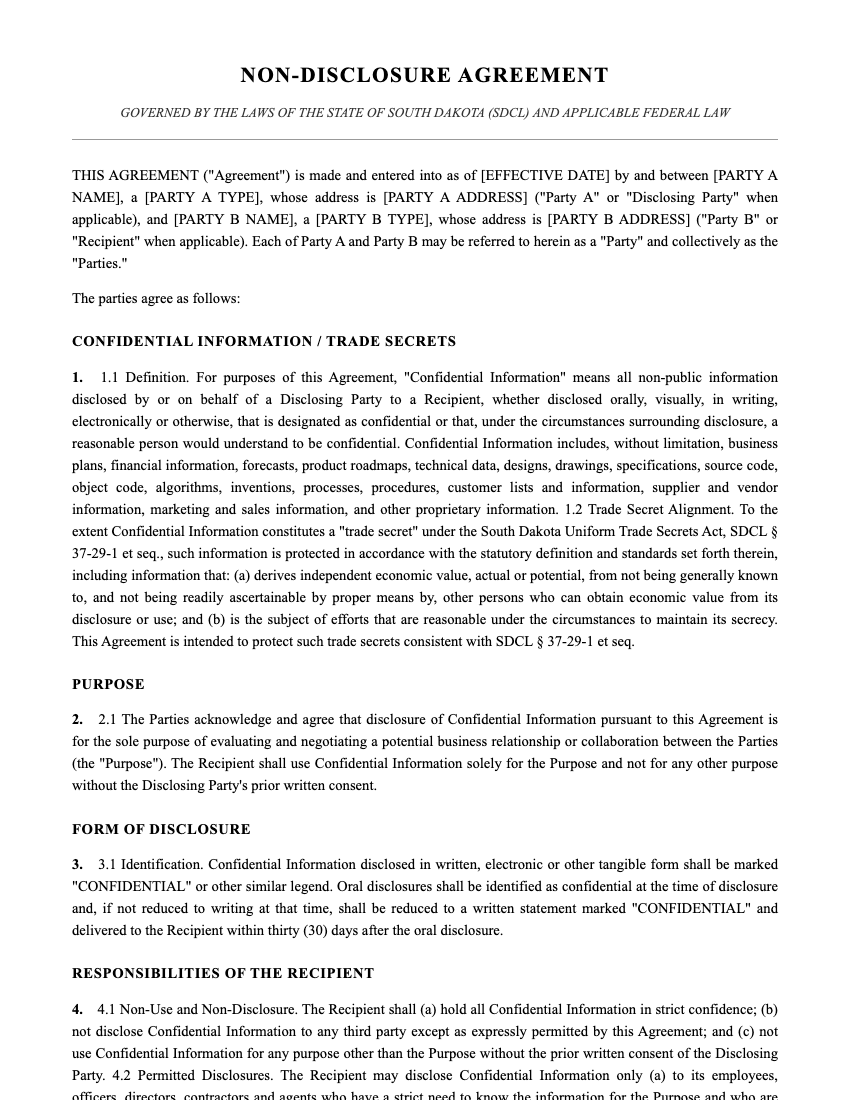
A South Dakota Non-Disclosure Agreement (NDA) is a contract that protects confidential business information and trade secrets under state contract law and applicable federal statutes. Unlike states that void most restraints on employment, South Dakota enforces reasonable restraints—so how you draft confidentiality provisions, carve-outs and any restraint-like language matters.
What Is a South Dakota NDA?
Definition: A South Dakota NDA is a binding agreement in which a receiving party promises to keep information confidential and to use it only for a stated purpose. NDAs in South Dakota are treated as ordinary contracts (enforced under state common law and SD statutes), subject to a 6-year statute of limitations for written contract claims (SDCL § 15-2-13).
NDAs are used to protect trade secrets (often pursued under federal Defend Trade Secrets Act, 18 U.S.C. § 1836, and corresponding state law), confidential business information, pricing, customer lists, source code, and technical data. Because South Dakota courts enforce restrictions that are reasonable in scope, duration, and geography, drafters have more freedom than in states that broadly ban covenants restricting employment—but that freedom creates traps if clauses are overbroad or vague.
For a complete guide to NDA terms, duration, and standard exclusions, see our NDA Agreement Guide.
Why Generic NDAs Are Dangerous in South Dakota
Most free NDA templates are written for jurisdictions with different approaches to restraints. In South Dakota, three local risks frequently bite companies that use off‑the‑shelf forms.
- Enforceable "Backdoor" Restraints
Paradigm-shifting insight: In South Dakota the real danger is not that non-competes are always void, but that NDAs can become enforceable restraints in their own right. Courts will enforce confidentiality provisions that effectively prevent competition if they are reasonable and tied to protecting legitimate business interests. A one-size-fits-all template that includes absolute prohibitions on competing, blanket non-solicitation wording, or unlimited duration may be enforced by a South Dakota court rather than struck down—resulting in a permanent injunction or long-term liability you didn't intend.
- Statute of Limitations and Damages Theory
Because written contract claims are governed by SDCL § 15-2-13 (six years), plaintiffs often bring contract breach claims alongside trade-secret claims. Drafting your remedies, limitation periods, and choice-of-law clauses carefully can affect whether you have a viable breach-of-contract claim years after disclosure.
- Missing DTSA Whistleblower Notice
Federal law: the Defend Trade Secrets Act (DTSA) conditions eligibility for enhanced damages and attorneys' fees on including a notice that the recipient may disclose trade secrets to government officials or in a court filing, under certain protections (18 U.S.C. § 1833(b)). NDAs that omit the DTSA notice may reduce federal remedies—even if the underlying contract would otherwise be enforceable in South Dakota.
Real-World Development
South Dakota follows the general Eighth Circuit approach: restrictive covenants and contract restraints are evaluated for reasonableness and legitimate business interest. Employers have successfully litigated to protect customer lists and trade secrets when confidentiality measures and limitations are tailored and reasonable. Because there is not a statewide ban on non-compete clauses, NDAs that mix confidentiality with restraint language are often litigated rather than automatically voided—making proper drafting and notice critical.
Key Clauses Adapted for South Dakota
- Purpose (narrowly drafted): Define the business purpose for disclosure. A narrowly tailored purpose reduces the risk that a court will read the NDA as a broad restraint.
- Definition of Confidential Information vs. Trade Secrets: Separate general confidential information (time-limited protection) from trade secrets (protected as long as secrecy is maintained). Tie trade-secret protection to federal DTSA/UDSA principles and describe the reasonable steps taken to keep secrecy.
- Use Restrictions: Limit use to the stated purpose. Avoid blanket "no competition" language unless you intend an enforceable restraint; if you include restriction language, apply a reasonableness test (duration, geography, scope).
- Non-Solicitation: If you include non-solicitation, limit it in time (commonly 6–24 months) and scope (employees/customers specifically identified), and justify it with legitimate business interests.
- Remedies & Limitation Periods: State that injunctive relief and contract remedies are available, and clarify that written contract claims are subject to SDCL § 15-2-13 timing.
- DTSA Whistleblower Notice: Include the DTSA notice to preserve eligibility for exemplary damages and attorneys' fees in federal trade secret actions (18 U.S.C. § 1833(b)).
- Exclusions: Public information, prior knowledge, independently developed info, and compelled disclosure carve-outs.
- Choice of Law & Forum: South Dakota courts will respect reasonable forum/choice-of-law clauses; but ensure the substantive provisions meet South Dakota reasonableness standards.
Who Needs This Document?
| User Persona | Usage Scenario | Key South Dakota Benefit |
|---|---|---|
| Agritech Startups (Sioux Falls/Rapid City) | Pitching to investors or partners | Protect IP while preserving enforceability under SD contract law |
| Professional Services | Sharing client data with contractors | Limits use to a specific purpose to protect client lists under South Dakota reasonableness standard |
| Manufacturing/Ag Suppliers | Sending specs to vendors | Separates trade-secret protection from ordinary confidentiality; preserves injunctive remedies |
| Employers | Hiring senior employees | Use carefully drafted non-solicit and confidentiality clauses to protect relationships without overreaching |
How to Execute a Valid South Dakota NDA
Step 1: Choose the Right Form
Decide whether you need a unilateral (one-way) NDA or a mutual NDA depending on who discloses confidential information.
Step 2: Define the Purpose and Scope
Be as specific as possible about the transaction or collaboration. A precise Purpose clause reduces the chance a court will treat the NDA as a disguised restraint.
Step 3: Mark and Protect Your Materials
Label documents "CONFIDENTIAL," maintain access controls, and document steps taken to preserve secrecy—courts look for "reasonable efforts" to guard trade secrets.
Step 4: Sign Before Sharing
Ensure the NDA is executed before confidential material is disclosed. In South Dakota, written execution provides a clear basis for breach-of-contract claims (subject to SDCL § 15-2-13).
When You Receive an NDA
If a client or vendor sends you an NDA to sign, review it for overbroad use restrictions, indefinite duration, missing DTSA notice, or ambiguous purpose language. Consider having counsel narrow overly broad non-solicit or restraint-like language into precise, time-limited, and geographically reasonable protections.
an AI contract review tool can scan incoming NDAs and flag clauses that may be enforceable in South Dakota or that risk turning confidentiality language into an unintended restraint.
Related NDA Templates
Get the Template
Sign up for our newsletter to receive the template.
Frequently Asked Questions

About Designer Content
Designer Content creates practical legal document resources for landlords, contractors, and small business owners. We simplify complex legal concepts into actionable guidance. Connect with us on LinkedIn.