
A South Korea Master Services Agreement (MSA) is a master contract used in Korea to set the baseline legal terms for repeated service projects, so you can add work via simple Statements of Work (SOWs) without re-negotiating everything each time.
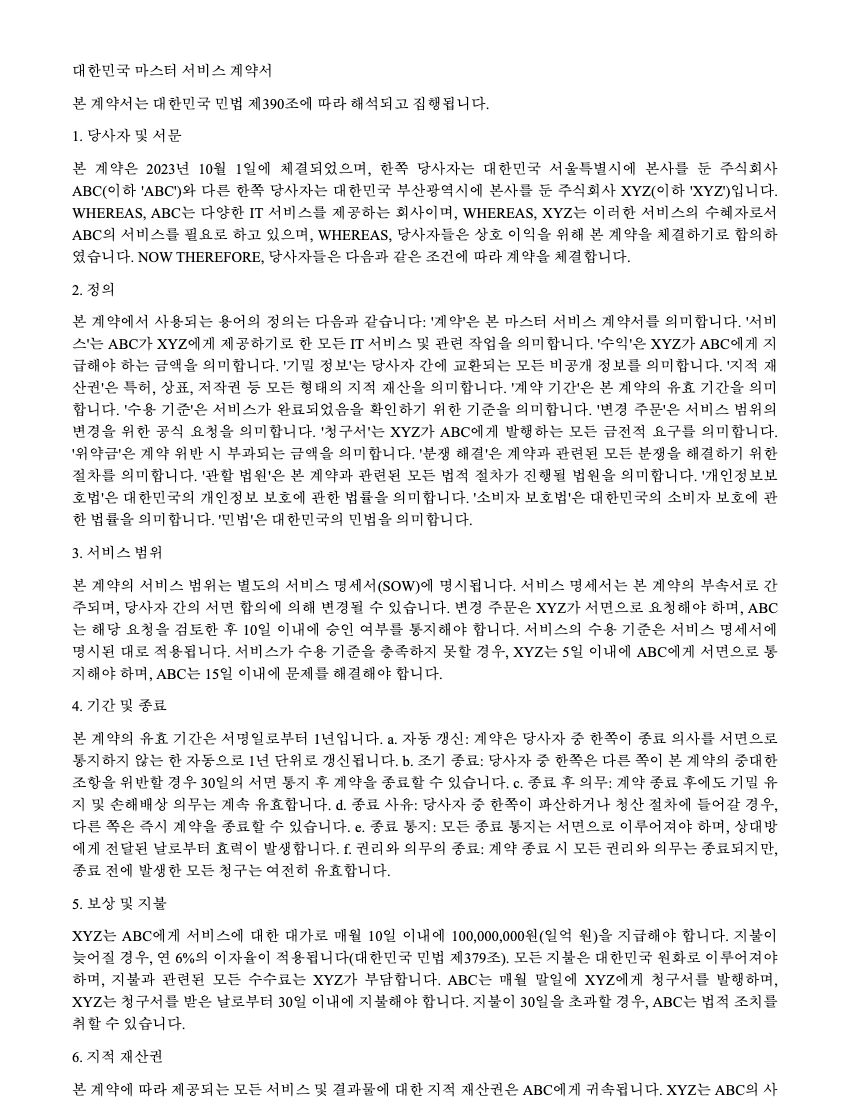
Opening
A South Korea MSA is a long-form “umbrella” services contract that governs ongoing B2B work in Korea under Korean law. For SMB owners, agencies, and freelancers, it’s the document that locks in payment terms, IP ownership, confidentiality, liability, and dispute handling once—then each project is ordered through a short SOW. In South Korea, you also need to align clauses with the Korean Civil Act’s contract-interpretation rules and local requirements around interest and personal data processing.
For a comprehensive guide to structuring MSAs and SOWs that protect your business, see our Freelancer Contracts Guide.
Definition Box
Definition: A South Korea Master Services Agreement (MSA) is a governing contract between a client and a service provider that sets standard terms—scope framework, fees, intellectual property, confidentiality, liability allocation, and dispute resolution—intended to apply to multiple future projects performed in South Korea. Individual projects are typically documented in separate Statements of Work (SOWs), which reference the MSA and define deliverables, timelines, acceptance criteria, and project-specific pricing. If a clause is ambiguous, Korean courts interpret the contract under the Korean Civil Act’s general interpretation principles (e.g., Civil Act Article 390 in practice for breach liability; and overall good-faith interpretation principles).
Why You Cannot Use a Generic MSA in South Korea
A “global” MSA template (often drafted for US/UK common-law assumptions) can create real risk in Korea because local enforceability depends on statutory rules, mandatory employee-protection norms, and data processing requirements. Korea’s civil-law structure also means judges rely heavily on statute and reasonableness, not just “whatever the contract says.” Below are three areas where generic MSAs regularly fail.
Worker Classification Rules
Korea does not use an “ABC test.” Instead, misclassification risk turns on whether the person is effectively a “worker” under Korean labor statutes based on substance over form—control, supervision, exclusivity, integration into the business, and who bears business risk. Even if you label someone an “independent contractor” in the MSA, authorities and courts can treat them as an employee-like worker in certain contexts.
Key legal anchors include the Labor Standards Act, Article 2(1) (definition of “worker”) and the Act on the Guarantee of Employees’ Retirement Benefits for retirement obligations if a relationship is deemed employment in practice. If misclassified, a hiring company may face liability for unpaid statutory benefits (overtime, severance where applicable), social insurance contributions, and administrative sanctions. Practically, your MSA template should include: (1) clear project-based deliverables via SOWs, (2) autonomy over working method/time, and (3) no “employee-like” policies (fixed hours, internal reporting lines) unless you intend employment.
Non-Compete Enforceability
Non-competes can be enforceable in South Korea, but only when they are reasonable and necessary to protect legitimate business interests (trade secrets, key customer relationships). Generic clauses that ban competition “anywhere in the world for two years” are a common reason Korean courts narrow or invalidate restrictions.
The statutory starting point is the Constitution of the Republic of Korea, Article 15 (freedom of occupation), which pushes courts to balance restrictions against a person’s right to work. When a non-compete is used with individuals, Korean courts typically look at factors such as: the employer/client’s protectable interest, the restricted person’s role and access to sensitive information, geographic scope, duration, and whether compensation is provided for the restriction.
For an MSA template, the safer approach is: keep non-competes narrow (specific industry, limited territory, short duration), tie them to confidential information exposure, and consider a separate compensation mechanism. If the business goal is simply “don’t take my clients,” a narrowly drafted non-solicitation plus confidentiality is often more defensible.
IP/Work-for-Hire Considerations
Korean IP rules differ from “work made for hire” assumptions. Under the Copyright Act, the default author is the creator, and ownership transfer generally requires a clear written assignment; vague “all rights belong to Client” language can be contested. For commissioned works, you should specify: what deliverables are being assigned, when assignment occurs (often upon full payment), and whether moral rights are waived to the extent permitted.
If software or content is created, also define pre-existing materials and “background IP” that remains with the provider, and grant the client a license as needed. A template should separate assignment (new deliverables) from licensing (tools, libraries).
What’s Included in This Template
Flexible SOW Structure
This MSA template keeps the master terms stable (legal boilerplate) and pushes project details into SOWs: scope, milestones, acceptance tests, and pricing. That prevents “scope creep” and makes renewals easy—sign the MSA once, then issue SOWs as you go.
South Korea-Specific Indemnification
The indemnity language is designed for Korea’s civil-law approach: it ties liability to breach and fault principles, and avoids overly punitive concepts that often don’t translate well. It also coordinates indemnity with limitation-of-liability caps and insurance expectations for B2B services.
Dispute Resolution and Venue
The template sets governing law as Korea and can designate exclusive jurisdiction in Seoul (commonly Seoul Central District Court) to avoid being dragged into a foreign forum. Clear venue language reduces litigation cost and uncertainty.
Additional Korea-focused provisions include:
- Contract interpretation and breach framework aligned with Korean Civil Act Article 390 (damages for non-performance).
- Late-payment interest aligned with Korean Civil Act Article 379 (interest) and agreed default interest language.
- Damages scope and foreseeability considerations referencing Korean Civil Act Article 398 (agreed damages/penalty-type clauses).
- Personal data handling and processor obligations referencing Personal Information Protection Act Article 24-2 (protection measures for resident registration numbers and related processing limits).
Who Needs This Document?
| User Type | Relationship | Key Benefit |
|---|---|---|
| Marketing/Design Agencies | Retainers + multiple campaigns | SOW-based scope control and clear IP handover upon payment |
| IT/SaaS Consultants | Ongoing implementation/support | Change-request process and liability caps for outages |
| Manufacturers/Distributors | Vendor services and audits | Confidentiality + limited non-solicitation tailored to B2B |
| Freelance Developers | Project milestones | Clear acceptance criteria and payment triggers to reduce disputes |
How to Use This MSA Template
Step 1: Identify the parties correctly
Use the exact Korean registered name (and business registration number if appropriate). Misnaming can complicate invoicing, tax handling, and enforcement.
Step 2: Set term, termination, and renewal
Choose a fixed term (e.g., 12 months) with renewal, or an evergreen term with notice-based termination. Make sure post-termination confidentiality and IP clauses survive.
Step 3: Attach your first SOW
Define deliverables, timeline, acceptance tests, and fees in the SOW. Keep operational details out of the MSA so future projects stay simple.
Step 4: Sign in Korean and keep an execution trail
Korean-language execution reduces ambiguity in disputes. Store signed PDFs, email approvals for SOWs, and change orders to prove agreement history.
Already Receiving Contracts from Clients?
If a client sends you their own MSA, treat it as a negotiation starting point—not a “standard form” you must accept. In Korea, watch for one-way IP assignment (including your background tools), unlimited indemnities, and foreign venue clauses that force you to litigate abroad. Also check whether their data clauses match what you actually process under PIPA. For a fast red-flag review workflow, use an AI contract review tool before you sign.
Download Options
Free PDF Version: Best for reviewing the structure and sharing internally before you commit. Use it as a checklist for negotiating a client’s draft.
Editable Word/Google Docs Version: Best for real deals—edit SOW fields, insert Korea-specific venue language, and tailor IP/licensing for software, creative work, or consulting.
Disclaimer
This template is general information for B2B use in South Korea, not legal advice. For regulated industries or disputes, consult Korean counsel.
Related MSA Templates
Get the Template
Sign up for our newsletter to receive the template.
Frequently Asked Questions

About Designer Content
Designer Content creates practical legal document resources for landlords, contractors, and small business owners. We simplify complex legal concepts into actionable guidance. Connect with us on LinkedIn.