
A South Korean Non-Disclosure Agreement (NDA) is a contract that protects confidential business information, trade secrets, and personal data shared between parties while complying with Korea’s statutory and case-law rules. In Korea, NDAs must be tailored to three overlapping regimes: the Act on the Protection of Trade Secrets (commonly referenced in English as the Trade Secrets Act), the Personal Information Protection Act (PIPA), and civil law principles under the Civil Act.
What is a South Korea NDA?
Definition: A South Korea NDA is a legally binding contract that: (1) identifies confidential information or trade secrets; (2) limits use and disclosure; (3) documents reasonable secrecy measures; and (4) meets statutory and public policy limits on post-employment restraints. Trade secret protection in Korea is governed primarily by the Act on the Protection of Trade Secrets (trade secret statute), which requires that the owner take "reasonable measures" to keep information secret and that the information have economic value from being secret.
Unlike some jurisdictions that flatly ban non-competes, Korea permits post-employment restraints (prohibition on engaging in competing business) only if they are reasonable in scope and — critically — if appropriate compensation or consideration is provided when the restriction extends beyond employment. Courts analyze necessity, duration, geographic scope, and compensation when enforcing such clauses.
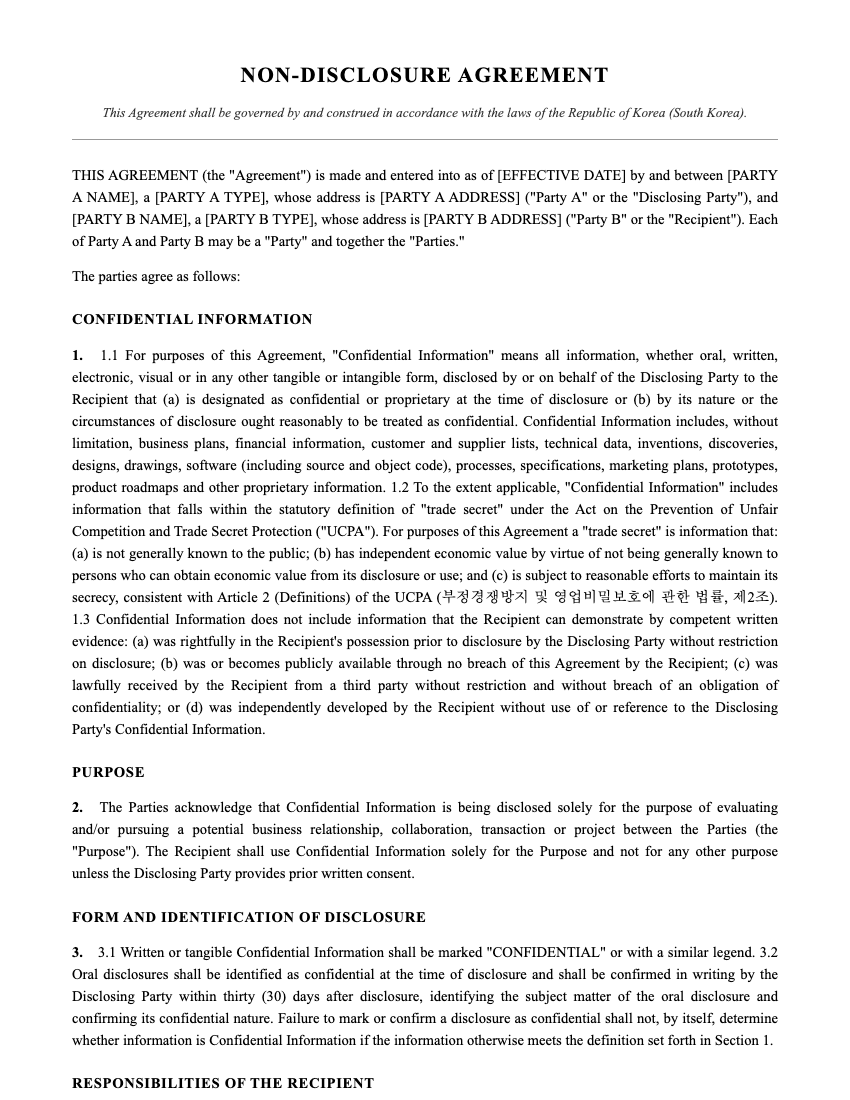
For a complete guide to NDA terms, duration, and standard exclusions, see our NDA Agreement Guide.
Why "Generic" NDAs Are Dangerous in South Korea
Using a one-size-fits-all template from another country (e.g., the U.S.) creates several Korea-specific traps:
- Trade Secret Formalities: The Trade Secrets Act demands that the information be subject to "reasonable secrecy measures." Vague clauses that fail to identify categories of protected information or lack procedures for marking/handling can defeat statutory remedies such as injunctive relief or criminal remedies for misappropriation.
- PIPA Compliance: If your NDA covers personal data, it must comply with PIPA. That means purpose limitation, lawful basis for processing (consent or statutory grounds), retention limits, and safeguards. A template that ignores PIPA can expose you to administrative fines from the Personal Information Protection Commission (PIPC).
- Wrong Kind of Restriction: Foreign templates often include broad non-compete or "no solicitation" language. In Korea, an overbroad post-employment restraint may be partially or wholly invalidated by courts unless reasonable compensation is provided or the scope is narrowly tailored. Employers who attempt to protect themselves by drafting sweeping prohibitions risk unenforceability and litigation costs.
Paradigm-shifting insight: In South Korea, the decisive enforcement factor for post-employment restrictions is not only reasonableness in time and territory but also whether the employer has provided sufficient consideration or compensation tied to the restriction. Courts will frequently balance the employer's protective need against the employee’s right to work; where the restraint imposes a substantial burden without commensurate compensation (especially for senior or technical staff), courts are likely to refuse enforcement or reduce damages. In practice, well-drafted NDAs in Korea either (a) avoid post-employment restraints entirely and rely on trade-secret and contract remedies, or (b) include narrowly tailored restraints plus clear post-termination compensation formulas.
A Real Case Study
Korean courts have repeatedly emphasized the need for reasonable measures and compensation. For example, appellate and Supreme Court decisions over the last decade have confirmed that courts will reduce or decline to enforce restraints that are overbroad or unaccompanied by compensation, and will require proof that trade secrets were actually subject to secrecy measures before awarding statutory remedies. (See sources below for primary legislation and commentary summaries.) These decisions have driven corporate practice: Korean employers now routinely document secrecy protocols and consider limited post-employment compensation clauses when protecting senior technical staff.
Key Clauses to Include (Korea-focused)
- Precise definition of Confidential Information and Trade Secrets: list categories (source code, customer lists, manufacturing processes) and state that trade secrets are protected under the Trade Secrets Act.
- Reasonable Secrecy Measures: describe physical, electronic, and administrative safeguards (e.g., access logs, watermarking, NDA labeling procedures). This supports statutory claims.
- Purpose Limitation and Use Restrictions: limit permitted uses by specific project or transaction.
- PIPA Compliance Clause: confirm lawful basis for processing any personal data, describe retention periods, cross-border transfer obligations, and data security measures.
- Narrow Post-Employment Restrictions (optional): if included, tie the restraint to a defined scope and explicit compensation or consideration; state the duration and geographical limits and a severability clause to allow courts to reduce overbroad terms.
- Remedial Provisions: injunctive relief, return/destruction obligations, and dispute resolution (Korean courts or arbitration, specify Seoul jurisdiction if courts).
- Electronic Signatures: confirm validity of electronic signing in accordance with Korean Electronic Signature/Digital Signature rules.
Who Needs This Document?
| User Persona | Usage Scenario (Korea) | Key Benefit |
|---|---|---|
| Tech Startups (Seoul) | Sharing source code with local R&D partners | Tailored trade-secret language and PIPA clauses protect IP and user data |
| Manufacturers | Sending designs to Korean contract factories | Enforceable secrecy measures reduce leak risk and preserve statutory remedies |
| Multinationals | Transferring personnel or data to Korea | Ensures PIPA compliance and clear handling of cross-border transfers |
| Recruiters/Agencies | Sharing candidate summaries | Limits reuse of candidate data and clarifies consent under PIPA |
How to Execute a Valid South Korea NDA
Step 1: Choose One-Way vs Mutual
Decide whether only one party discloses. Mutual NDAs are fine for joint development or M&A; use one-way for pitching or contracting.
Step 2: Define the Purpose and Categories
Be specific. State the project and enumerate categories of information (e.g., "manufacturing drawings, BOMs, algorithm source code"). This helps courts and regulators see the legitimate scope.
Step 3: Implement and Document Secrecy Measures
Mark documents "CONFIDENTIAL," restrict access, maintain access logs, watermark files, and keep a disclosure register. Courts and the Trade Secrets Act look for such reasonable measures.
Step 4: Sign Properly and Keep Evidence
Use Korean-recognized electronic signatures or wet ink. Retain signed copies, transmission logs, and evidence of delivery. For post-employment restraints, document any compensation formula or supplemental agreement.
Already Receiving NDAs from Korean Clients?
When a client sends you an NDA, check for: (1) overbroad non-compete or solicitation language; (2) missing PIPA compliance terms if personal data is included; (3) ambiguous definitions of trade secrets; and (4) inadequate specification of remedies. an AI contract review tool flags these issues instantly and compares clauses against Korean legal standards.
Related NDA Templates
Get the Template
Sign up for our newsletter to receive the template.
Frequently Asked Questions

About Designer Content
Designer Content creates practical legal document resources for landlords, contractors, and small business owners. We simplify complex legal concepts into actionable guidance. Connect with us on LinkedIn.