
A Spain Non‑Disclosure Agreement (NDA) is a confidentiality contract used to protect business secrets, sensitive data and proprietary know‑how shared between parties. In Spain, NDAs must be drafted with three legal frameworks in mind: the national trade secrets law (Ley 1/2019, de 20 de marzo, de Secretos Empresariales), privacy rules (EU GDPR and Spain’s LOPDGDD), and Spanish contract/employment law under the Código Civil and Estatuto de los Trabajadores. Getting these interactions wrong can make a nominal NDA unenforceable — or worse, expose you to penalties.
What is a Spain NDA?
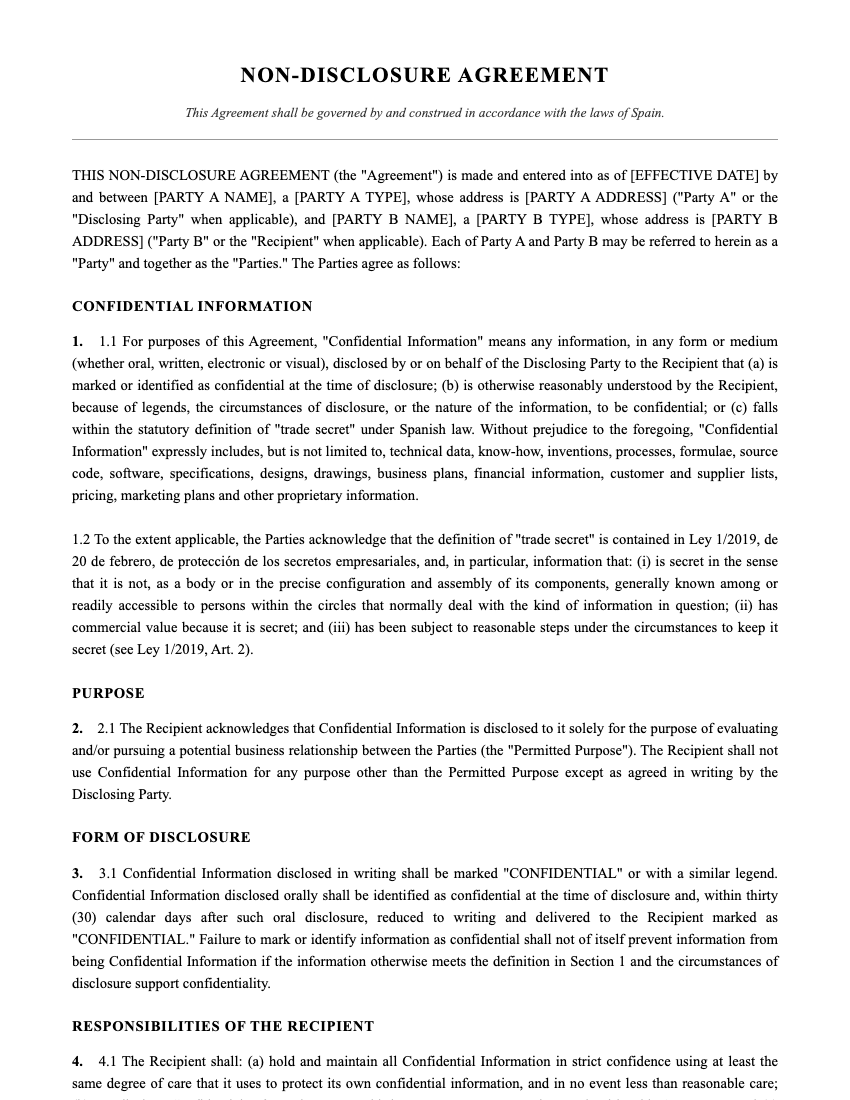
Definition: In Spain, an NDA is a contract that creates duties of confidentiality over “confidential information” and trade secrets (secretos empresariales). Trade secrets are protected under Ley 1/2019 and require that the information: (i) is secret in the sense that it is not generally known or easily accessible; (ii) has commercial value because it is secret; and (iii) has been subject to reasonable confidentiality measures by the holder (Ley 1/2019, arts. 1–2).
A valid Spanish NDA therefore distinguishes ordinary confidential information (time‑limited commercial data) from true trade secrets (potentially protected indefinitely so long as secrecy is maintained). NDAs must also respect data protection rules (GDPR and LOPDGDD) when personal data is involved.
For a complete guide to NDA terms, duration, and standard exclusions, see our NDA Agreement Guide.
Why "generic" NDAs are dangerous in Spain
Many off‑the‑shelf NDAs were drafted for common‑law jurisdictions and miss key Spanish legal traps.
- Post‑contractual non‑compete risk (the paradigm‑shifting insight)
Spain does not categorically ban post‑employment restraints the way some jurisdictions do. Instead, Spanish employment and contract law permits post‑contractual non‑compete clauses for employees only when they meet strict conditions: the restraint must be expressly agreed, limited in time and geography, and—critically—accompanied by adequate economic compensation for the restricted period. Employers who paste broad “no‑work” language into an NDA without compensation or reasonableness risk courts declaring the clause null and even invalidating related contractual terms. In practice, Spanish courts scrutinize duration, scope and the compensation offered; excessive or uncompensated restraints are routinely reduced or struck down.
- Privacy + secrecy: double compliance
If an NDA covers personal data, it must comply with the EU GDPR (Regulation (EU) 2016/679) and Spain’s Organic Law 3/2018 (LOPDGDD). Generic NDAs that ignore processing purposes, legal bases, retention limits, and data subject rights create regulatory risk and can be used by regulators (AEPD) as evidence of non‑compliance.
- Whistleblower and public interest carve‑outs
The trade secrets regime and Spanish public policy protect certain disclosures to public authorities and safeguarding public interest. NDAs that try to prohibit reporting to competent authorities (for example, labor inspectors, data protection authorities or criminal prosecutors) are unenforceable. Ley 1/2019 and data‑protection rules make it clear that confidentiality obligations cannot be used to cover up unlawful conduct.
- Vague definitions sink enforcement
If you label everything a “trade secret,” courts may refuse to give trade‑secret protection to any of it. Spanish practice favors precise definitions of scope, purpose, and duration.
Recent statutory development (real case study)
Spain transposed the EU Trade Secrets Directive through Ley 1/2019 (20 March 2019), which modernised remedies for misappropriation and clarified lawful exceptions. The law created clearer civil remedies and confirmed that confidentiality agreements cannot be used to bar reporting to authorities—an important legislative shift for NDAs drafted before 2019.
What’s included in this template? (Key clauses adapted for Spain)
- Clear definitions: Separates “Confidential Information” and “Trade Secrets” using Ley 1/2019 criteria.
- Purpose and limited use: A narrow Purpose clause aligned with Código Civil principles of contractual interpretation (freedom to contract but subject to good faith).
- Employee restraint clause (optional): A tailored post‑contractual restriction module that includes express compensation mechanics and reasonableness caps so employers can negotiate enforceable restraints where justified.
- Data protection addendum: GDPR/LOPDGDD compliant processing clauses, retention periods, security measures, and data‑subject rights procedure.
- Whistleblower/public authority carve‑out: Explicitly permits disclosures to authorities and to exercise labor rights.
- Remedies & limitation periods: Remedies under Ley 1/2019 and reminder of the Código Civil limitation period for personal actions (prescription 5 years — Art. 1964 Código Civil).
- Electronic signatures: Acknowledges eIDAS (Regulation (EU) No 910/2014) and Spain’s recognition of electronic signatures (Ley 59/2003) for execution.
Who needs this document?
- Tech startups (Madrid/Barcelona): Protect software, algorithms and customer lists when sharing with suppliers or investors.
- Manufacturers: NDAs with factories must limit use and include contractual audit rights.
- Employers: Use the optional, compensated restraint clause module if you need post‑contract protection for key employees.
- Professional services firms: Ensure GDPR clauses protect client personal data shared during diligence.
How to execute a valid Spain NDA (practical steps)
- Choose the right form: One‑way (discloser only) or Mutual (both sides share). Use One‑way when you are the only discloser.
- Define the Purpose precisely: e.g., “Evaluation of a potential supply agreement for Product X in Spain.”
- Label and secure: Mark documents as CONFIDENTIAL, maintain access logs, and implement technical controls—Ley 1/2019 looks to “reasonable measures.”
- Sign correctly: Use a qualified electronic signature where appropriate (eIDAS) or wet signatures. For employee post‑contract restrictions, record the agreed compensation mechanism in the contract.
Before you share, sign: Always get signatures (or qualified e‑signature) in place before disclosure. If you share first, you risk losing protection for that material.
When someone sends YOU an NDA
Review Spanish‑specific risks: Does it improperly restrain future employment without compensation? Does it ignore GDPR data obligations? Does it attempt to bar reporting to regulators? If yes, negotiate or decline.
an AI contract review tool can quickly flag Spanish legal risks, compare clauses to Ley 1/2019 and GDPR standards, and suggest negotiated language—saving time before you sign.
Related NDA Templates
Get the Template
Sign up for our newsletter to receive the template.
Frequently Asked Questions

About Designer Content
Designer Content creates practical legal document resources for landlords, contractors, and small business owners. We simplify complex legal concepts into actionable guidance. Connect with us on LinkedIn.