
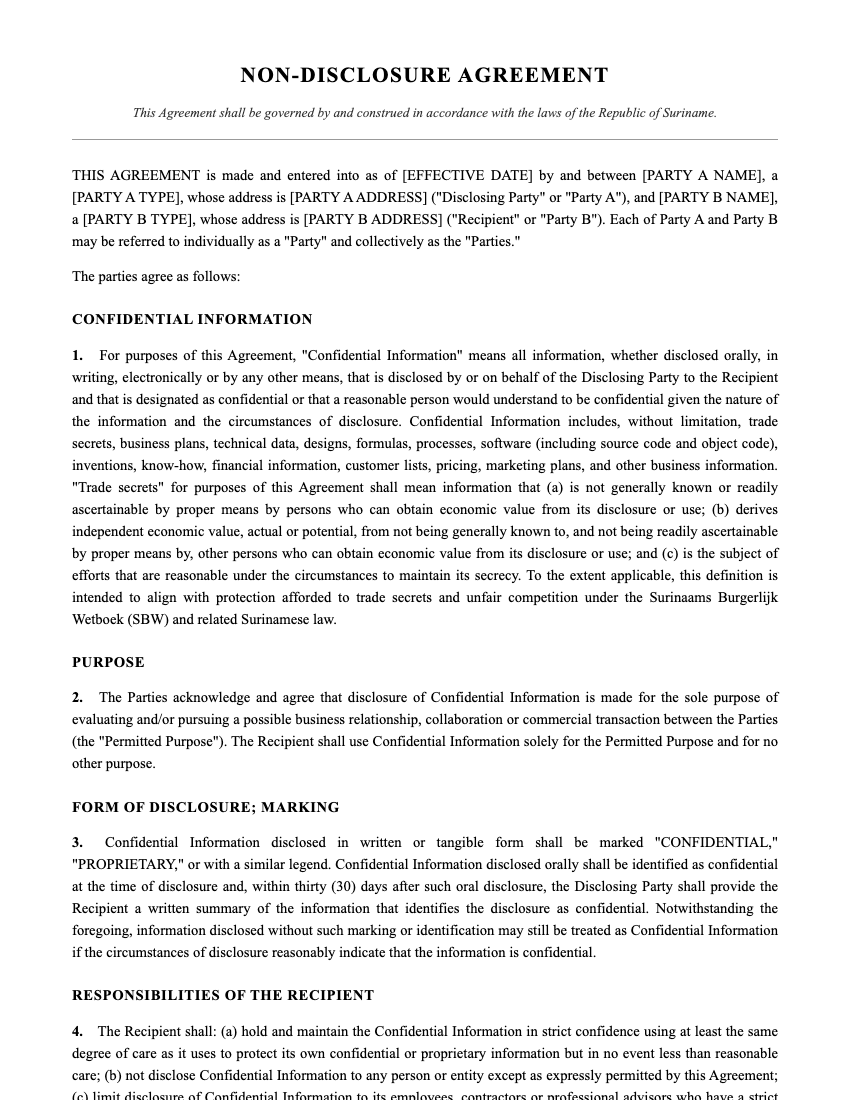
A Suriname Non-Disclosure Agreement (NDA) is a written contract that creates contractual and civil‑law protection for confidential business information, intellectual property and trade secrets under the Surinaams Burgerlijk Wetboek (SBW). Because Suriname follows a civil‑law tradition based on Dutch law, formalities (writing, signature, clear scope) and prescription periods (verjaring) are central—so a “one-size-fits-all” English or U.S. template can leave you exposed.
What is a Suriname NDA?
Definition: A Suriname NDA is a written confidentiality agreement between two or more parties that identifies confidential data, limits permitted uses, and creates contractual remedies (damages, specific performance/injunction) under the Surinaams Burgerlijk Wetboek. Where personal data are involved, compliance with the Wet Bescherming Persoonsgegevens (Data Protection Act) is required.
Unlike jurisdictions that rely on a separate trade‑secret statute, Suriname primarily protects business secrets and unfair competition through contract law, the SBW tort of unlawful act (onrechtmatige daad) and related remedies. That means an NDA is often the first and best line of defense.
For a complete guide to NDA terms, duration, and standard exclusions, see our NDA Agreement Guide.
Why generic NDAs are dangerous in Suriname
Most free templates are drafted for common‑law countries (U.S., UK). In Suriname those templates create four practical risks:
- Formality risk: Certain courts give greater weight to written and signed contracts. An oral or poorly documented confidentiality regime is hard to enforce.
- Prescription (verjaring): Civil claims are subject to definitive limitation periods under the SBW. If you delay enforcement, you may lose your remedy even if the information remains secret.
- Data protection mismatch: Templates that ignore the Wet Bescherming Persoonsgegevens can leave you non‑compliant when personal data are exchanged.
- Choice of law and enforcement: Broad forum‑selection clauses that point exclusively to foreign law (e.g., California) may hamper enforcement in Suriname. Conversely, a foreign forum clause may be useful for multinationals—only if carefully drafted.
Paradigm‑shifting insight for Suriname: the prescription trap
Because remedies for contractual breach and unlawful acts are governed by the SBW, trade secret enforcement can be barred by prescription (verjaring) much sooner than in some common‑law countries. That means indefinite “trade secret” language in an NDA is not enough—your agreement must include interim remedies (injunctive relief, preservation of evidence), notification obligations, and a clear governing‑law clause specifying how limitation periods operate. In practice, this means you must act quickly to enforce breaches and maintain contemporaneous evidence of secrecy and loss.
Real development to watch
Suriname has strengthened focus on personal data and confidentiality in recent years. Government sources and legal commentators emphasize written contractual protections and data safeguards under the Wet Bescherming Persoonsgegevens. While Suriname does not yet have a stand‑alone modern trade‑secrets statute, the combination of SBW contract/tort law and data protection rules has made robust NDAs commercially essential.
Key clauses adapted for Suriname practice
- Clear written form & signatures: Include a clause that the NDA must be in writing and signed by authorized representatives. Where possible obtain original signatures or notarized copies to prevent challenges based on formalities.
- Precise definition of Confidential Information: Separate categories—(a) Personal Data (subject to Wet Bescherming Persoonsgegevens), (b) Trade Secrets / Business Secrets, (c) General Confidential Info. For trade secrets limit to information with economic value from secrecy and reasonable protection measures.
- Purpose and limited use: Narrow purpose to avoid perpetual or vague restrictions that courts may view as disproportionate.
- Remedies and interim relief: Explicit right to seek injunctions in Surinamese courts, preservation of evidence (sequestration), and contractual damages. Add a clause preserving right to seek provisional measures under SBW rules.
- Duration and prescription: State the duration of confidentiality and add a clause addressing survival of obligations and the parties’ understanding about applicable limitation periods; include an obligation to notify breaches promptly to preserve rights.
- Data protection compliance: Commit the parties to comply with the Wet Bescherming Persoonsgegevens for processing of personal data and to implement technical and organizational safeguards.
- Choice of law/venue: Specify Suriname law for domestic deals; for cross‑border contracts, consider hybrid clauses that allow foreign forum for monetary claims but Suriname courts for emergency injunctive relief.
- Electronic signatures: If you permit electronic signatures, add language confirming consent to their legal effect; however, where certainty is crucial, request wet signatures or notarized originals.
Who needs this document?
| User Persona | Usage Scenario (Suriname) | Key Benefit |
|---|---|---|
| Local exporters | Sharing manufacturing specs with a foreign buyer | Protects know‑how and production processes under contract law |
| SMEs & startups | Pitching to investors in Paramaribo or Nickerie | Preserves confidentiality while complying with data protection law |
| Employers | Protecting salary, client lists and technical know‑how | Creates contractual basis for damages and injunctive relief under SBW |
| International partners | JV or supply talks with Surinamese counterpart | Ensures cross‑border structure and Suriname enforcement routes |
How to execute a valid Suriname NDA
Step 1: Choose the type
Decide between one‑way (unilateral) or mutual. Use unilateral when only one side discloses. Use mutual when both parties will exchange technical, commercial or personal data.
Step 2: Define the purpose and scope precisely
Describe exactly what will be shared and for what purpose. Ambiguity weakens enforcement and shortens the practical protection window under prescription rules.
Step 3: Mark and secure documents
Mark physical and electronic files "CONFIDENTIEEL" or "CONFIDENTIAL"; log disclosures and retention. For personal data, record lawful basis and security measures per the Wet Bescherming Persoonsgegevens.
Step 4: Sign and preserve originals
Obtain signed originals or notarized copies where possible. If you accept electronic signatures, include a written consent clause but keep an original wet signature for high‑risk disclosures.
Receiving NDAs from clients?
If a client sends you an NDA, review it for excessive duration, vague definitions, inconsistent choice of law, or clauses that force dispute resolution exclusively outside Suriname without a carve‑out for urgent local injunctive relief. an AI contract review tool can help flag risky clauses and compare them to Surinamese practice—saving negotiation time.
Related NDA Templates
Get the Template
Sign up for our newsletter to receive the template.
Frequently Asked Questions

About Designer Content
Designer Content creates practical legal document resources for landlords, contractors, and small business owners. We simplify complex legal concepts into actionable guidance. Connect with us on LinkedIn.