
A Swiss Master Services Agreement (MSA) (in French) is a services framework agreement that sets the basic legal rules between a provider and a client in Switzerland for all future engagements. Instead of renegotiating a full contract for each new project, you sign the framework agreement once and then add Statements of Work (SOW) describing each engagement (scope, deadlines, price). For SMEs, freelancers, and firms in French-speaking Switzerland, it is the most practical tool to secure payments, intellectual property, confidentiality, and liability—while keeping a fast commercial process.
Definition: A Swiss MSA (FR) is a B2B framework contract governed by Swiss law (mainly the Code des obligations) that structures a relationship involving recurring services. It defines the “stable” clauses (invoicing, late-payment interest, limitation of liability, confidentiality, intellectual property, data protection, termination, dispute resolution) that automatically apply to each SOW. Each SOW then specifies the deliverables, milestones, budget, and acceptance criteria, without rewriting all the legal terms. In Switzerland, this structure also helps clarify that the relationship remains an independent service arrangement (and not employment).
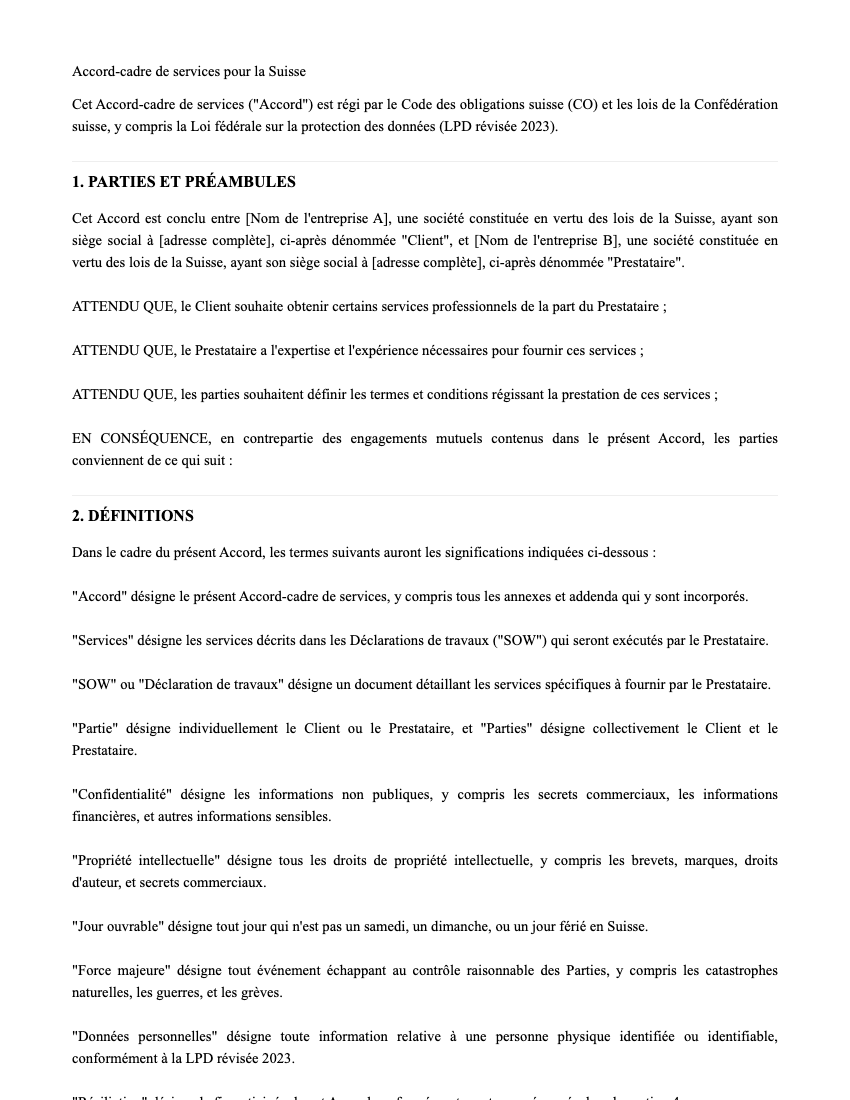
Why You Cannot Use a Generic MSA in Switzerland (French)
A generic “international” template is rarely compatible with Swiss practices and rules. Overloaded Anglo-Saxon contracts (very broad warranties, “work made for hire,” automatic penalties) create real risks: unenforceable clauses, ambiguities about intellectual property, or incorrect assumptions about employee vs. independent contractor status. In Switzerland, many issues hinge on different legal standards (proportionality, good faith, protection of personality rights, the mandate/contract for work structure) and on specific federal laws.
3a. Worker Classification Rules (Switzerland: independent vs employee)
Switzerland does not use the American “ABC test.” Classification depends on an overall assessment: subordination, integration into the client’s organization, entrepreneurial risk, freedom of schedule and organization, use of equipment, ability to have multiple clients, etc. In practice, this classification is decisive mainly for social insurance (AVS/AI/APG). The central legal basis is the Federal Act on Old Age and Survivors’ Insurance (LAVS), notably the obligation to contribute and the withholding at source on salary (see LAVS art. 12 on contributions). If a “freelancer” is reclassified as an employee, the client may have to pay social contributions retroactively (employer share) and regularize the situation; interest and fees may be added depending on the procedure of the compensation funds. On the contract side, classification also affects duties of protection (e.g., rules close to the employment contract) and liability. A well-drafted Swiss MSA must therefore document independence: freedom of performance, absence of hierarchical control, project-based invoicing, own equipment, and an explicit ability to work for other clients.
For a comprehensive guide to structuring MSAs and SOWs that protect your business, see our Freelancer Contracts Guide.
3b. Non-Compete Enforceability (non-compete clauses)
Unlike some U.S. states, non-competes are not “prohibited in principle” in Switzerland, but they are strictly regulated, especially in the context of the employment contract. The main rules are found in art. 340 et seq. of the Code des obligations (CO). To be valid in an employment context, the clause must be concluded in writing, concern a field/customer base effectively known thanks to the activity, and be appropriately limited as to place, time, and subject matter; otherwise the judge may reduce it (CO art. 340a). For a B2B MSA (independent provider), an overly broad “pure” non-compete clause can be challenged in light of economic freedom and proportionality; it is especially difficult to justify if it prevents a provider from working in their market.
The most robust solution in French-speaking Switzerland, for a services MSA, is to prefer targeted and more defensible alternatives: (1) strong confidentiality (including trade secrets, methods, pricing, client data), (2) a reasonable non-solicitation clause (clients/employees) limited in time, and (3) strict management of intellectual property and data rights. If a non-compete is nevertheless used, it must be narrowly defined (sector, type of services, territory), short, and justified by a legitimate interest of the client (e.g., access to a non-public commercial strategy). A good Swiss template will explain these limits and avoid “worldwide, 5 years, any similar service” wording typical of generic templates.
3c. IP/Work-for-Hire Considerations (intellectual property)
A frequent trap in Anglo-Saxon templates is “work made for hire,” a U.S. law concept that does not transpose as-is. In Switzerland, ownership of rights depends on the type of work and the contract; you need a clear assignment/transfer clause, often conditioned on full payment. For creations in a mandate relationship (CO art. 394 et ss.), you must provide who owns the deliverables, what licenses are granted, and what remains the provider’s “background IP” (tools, libraries, know-how). Without precise clauses, you end up with implicit usage rights that are hard to prove, especially for software, marketing content, or designs.
What's Included in This Template
Flexible SOW Structure
The template separates the framework agreement (MSA) and the SOWs. The MSA sets the stable rules: invoicing, acceptance, warranties, confidentiality, data, liability, termination. Each SOW describes the deliverables, milestones, pricing (fixed fee/time & materials), and acceptance criteria, which reduces scope creep and facilitates renewals.
Switzerland (French)-Specific Indemnification
Indemnification is adapted to Swiss law and B2B realities: allocation of risks, exclusions for gross negligence/intent, and a mechanism for notice/handling of claims. The template also addresses third-party claims related to IP (in connection with the mandatary’s obligations, CO art. 394) and clarifies what the warranty covers (e.g., infringement of third-party rights by elements provided by the client).
Dispute Resolution and Venue
The template sets a clear venue in Geneva (Switzerland) and provides for Swiss governing law, to avoid “Delaware” or “England & Wales” clauses incompatible with local enforcement. It also includes a waiver of trial by jury (useful mainly if a party tries to import U.S. reflexes; in Switzerland, there is no comparable civil jury).
Other included clauses (with references): late-payment interest at the legal rate of 5% (CO art. 104), ordinary limitation period of 10 years for contractual claims (CO art. 127), security measures for personal data (LPD art. 7) and rules on unlawful processing/violations (LPD art. 12), confidentiality surviving 5 years after termination (contractual clause), and deliverables acceptance conditions.
Who Needs This Document?
| User Type | Relationship | Key Benefit |
|---|---|---|
| Marketing agency (French-speaking Switzerland) | Recurring campaigns + monthly SOWs | Frames revisions, validation, and usage rights in the creations |
| IT / cybersecurity consultant | Recurring audits and interventions | Clarifies liability, confidentiality, and data security (LPD) |
| Freelance software developer | Milestone-based projects | Clear assignment/license of deliverables and protection of “background” code |
| Consulting firm (B2B) | Multi-entity (group) engagements | Standardized SOWs and uniform invoicing, venue in Geneva |
How to Use This MSA Template
Step 1: Correctly identify the parties
Enter the exact company name, legal form (Sàrl, SA, sole proprietorship) and address. Add an operational contact and a billing contact to limit delays.
Step 2: Set the financial framework
Define the currency (CHF), due dates, and the late-payment interest mechanism (CO art. 104). Specify reimbursable expenses and suspension conditions in case of non-payment.
Step 3: Attach a first precise SOW
Set out the scope, deliverables, acceptance criteria, schedule, client dependencies, and assumptions. The clearer the SOW, the fewer disputes you will have about “end of engagement.”
Step 4: Manage IP, data, and confidentiality
Choose between assignment, license, or a hybrid model (deliverables to the client, tools to the provider). If personal data is processed, describe the security measures (LPD art. 7) and roles.
Related MSA Templates
Get the Template
Sign up for our newsletter to receive the template.
Frequently Asked Questions

About Designer Content
Designer Content creates practical legal document resources for landlords, contractors, and small business owners. We simplify complex legal concepts into actionable guidance. Connect with us on LinkedIn.