
A Switzerland (French) Non‑Disclosure Agreement (NDA) is a written confidentiality contract that protects business secrets and sensitive data while fitting within Switzerland’s civil‑law framework — principally the Code des obligations (CO) and the revised Federal Act on Data Protection (LPD, 2023). Unlike many common‑law jurisdictions, Swiss practice emphasizes form, a legitimate business interest for restraints, proportionate scope and duration, and compliance with the new LPD when personal data is involved.
What is a Switzerland (French) NDA?
Definition: A Switzerland (French) Non‑Disclosure Agreement is a contract (contrat de confidentialité) by which parties undertake to keep specified information secret, to use it only for a stated purpose, and to return or destroy it on termination. Its scope is shaped by general contract rules in the Swiss Code of Obligations (Code des obligations, CO) and specific employment‑law limits on post‑contract restrictions (see CO Articles 321a (duty of loyalty) and 340–340c (post‑contractual non‑competition)).
Swiss courts and practitioners treat NDAs as ordinary contracts: clarity, written evidence and proportionality matter. If the NDA overlaps with employment restraints or personal data processing, the CO and the revised LPD (2023) control what is valid and how long information may be kept.
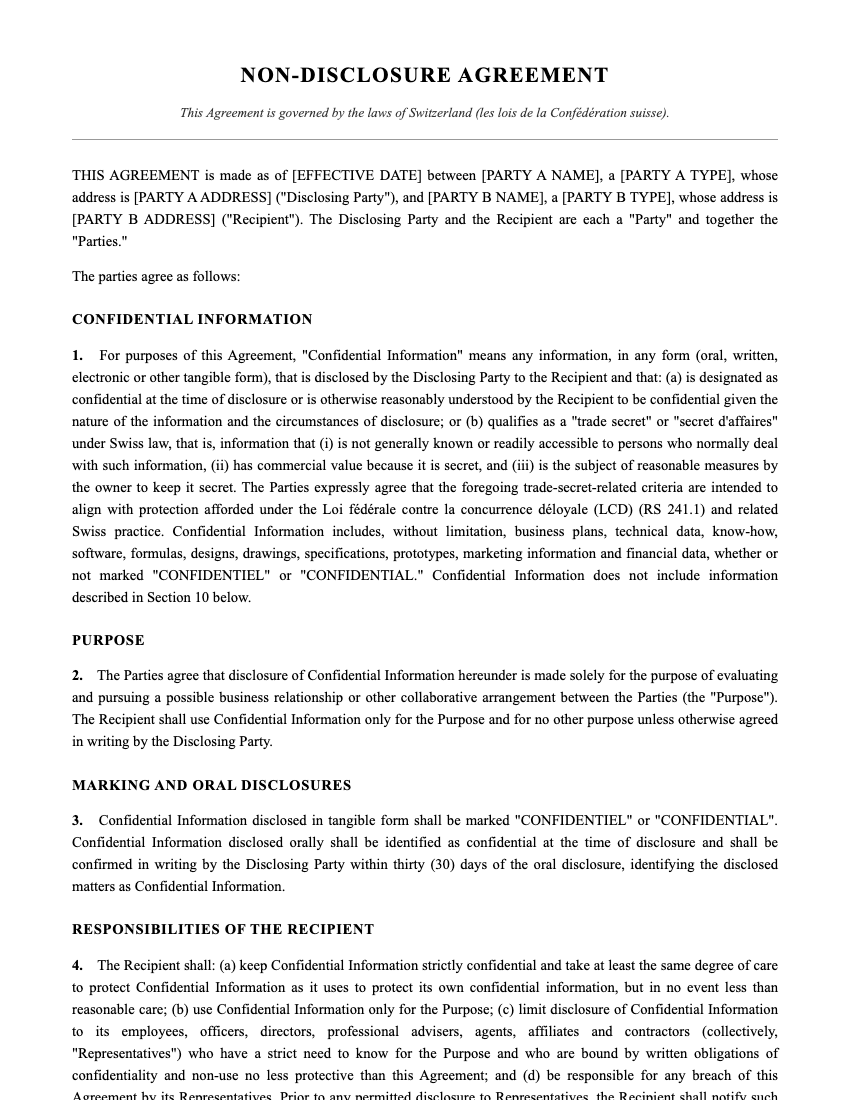
For a complete guide to NDA terms, duration, and standard exclusions, see our NDA Agreement Guide.
Why “Generic” NDAs Are Dangerous in Switzerland (French)
Using a template drafted for the U.S., UK or other civil codes can produce three Swiss‑specific traps.
- Backdoor restraints vs. legitimate business interest
Paradigm‑shifting insight: In Switzerland the fatal mistake is not only an overt non‑compete but any confidentiality clause that functions as an undue post‑termination restraint without a legitimate business interest. Swiss law requires that post‑contractual restraints (including clauses that effectively prevent a former employee from using industry knowledge) be proportionate in time (generally up to three years in employment contexts), geographic scope, and limited to protecting a demonstrable business interest — and they must be in writing (CO, Art. 340 et seq.). Overbroad “do not compete or solicit” language buried inside an NDA may be recharacterised as an unenforceable restraint.
- Personal data and the revised LPD (2023)
Switzerland’s revised Federal Act on Data Protection (LPD révisée) harmonised many rules with the EU. If your NDA contemplates processing employees’ or clients’ personal data (names, contact details, identification numbers), you must comply with the LPD’s transparency, purpose‑limitation and security obligations — and record or justify transfers outside Switzerland. A confidentiality promise cannot override data‑protection duties.
- Formal requirements and electronic signatures
Certain restraint clauses and employment‑related non‑competes must be clearly agreed and evidenced in writing. Switzerland recognises electronic signatures under the Federal Act on Electronic Signatures (ZertES), but parties should confirm the level of signature required for enforceability and evidence in court.
Real legal development: The revised Swiss Data Protection Act (LPD) entered into effect in 2023; organisations have updated their NDAs and confidentiality procedures to reflect new transparency duties and cross‑border transfer rules (FDPIC guidance, 2023). This change has real impact on NDAs that process personal data in diligence and hiring.
Key Clauses Adapted for Swiss Practice
- Clear definition of Confidential Information: carve out general know‑how and public domain material; specifically flag personal data and describe lawful bases under the LPD.
- Purpose limitation: restrict use to a narrowly defined purpose (e.g., "evaluation of a joint venture regarding Project X"). Swiss courts insist on a concrete purpose to limit scope.
- Duration: separate treatment for ordinary confidential business information (2–5 years typical) and trade secrets (protected as long as secrecy maintained). For employment‑related restraints, respect the statutory limits (generally up to three years unless special rules apply).
- Exclusions: information already known, independently developed, or lawfully received from third parties; required disclosures (court, regulator) with notice obligations.
- Residuals: Swiss practice is cautious. If included, residuals clauses should permit unaided memory use while avoiding language that functions as a post‑employment restraint.
- Whistleblowing and mandatory reporting: carve‑outs that allow disclosure to competent authorities and protect lawful whistleblowing; align with public‑interest exceptions under Swiss law and company policies.
- Data protection clause: specify controller/processor roles, lawful basis, security measures, retention rules and cross‑border transfer mechanisms per the LPD.
- Electronic signature and language: state which signature methods are acceptable (ZertES‑level, advanced or simple) and provide a French version for Swiss (French‑speaking) counterparts.
Who Needs This Document?
| User Persona | Usage Scenario | Key Swiss Benefit |
|---|---|---|
| Startups (Lausanne/Geneva) | Pitching to investors | Protects pitch content while respecting Swiss investor diligence norms and LPD privacy requirements |
| Employers | Hiring senior staff | Limits what is confidential without creating an unenforceable post‑employment restraint under CO Art. 340 |
| Manufacturers | Sharing blueprints with Swiss suppliers | Ensures trade‑secret protections plus contractual remedies under CO |
| M&A advisors | Due diligence for target companies | Adds purpose limits and data‑transfer safeguards required by the LPD |
How to Execute a Valid Switzerland (French) NDA
Step 1: Choose the right form (One‑way vs Mutual)
Decide if only one party discloses (one‑way) or both (mutual). For employment relationships, make sure confidentiality obligations aren’t disguised non‑competes.
Step 2: Be precise about purpose and scope
Limit use to a stated project and define categories of confidential information. Include explicit treatment of personal data under the LPD.
Step 3: Mark and secure documents
Label physical and electronic files “CONFIDENTIEL / CONFIDENTIEL — soumis à NDA en date du [DATE]” and implement reasonable technical measures (encryption, access logs) to meet LPD security obligations.
Step 4: Sign before sharing and keep written evidence
Get signatures (French version for French‑speaking parties). Use ZertES‑compliant electronic signatures if practical; preserve audit trails for Swiss courts.
Already Receiving NDAs from Clients?
Review incoming NDAs for hidden restraints, disproportionate duration, or contradictory data‑protection obligations. Our an AI contract review tool tool flags Swiss‑specific risks (recharacterisation as a restraint, LPD non‑compliance, and inadequate data transfer clauses) to speed negotiation.
Related NDA Templates
Get the Template
Sign up for our newsletter to receive the template.
Frequently Asked Questions

About Designer Content
Designer Content creates practical legal document resources for landlords, contractors, and small business owners. We simplify complex legal concepts into actionable guidance. Connect with us on LinkedIn.