
Opening
A Switzerland (German) Master Services Agreement (MSA) is a framework contract under Swiss law that sets out the basic rules for recurring services between the provider and the client. Rather than negotiating each project from scratch, the parties sign the MSA once and agree on individual projects via Statements of Work (SOW). For Swiss SMEs, agencies, and consultants, this is particularly useful because core OR topics such as delays, liability and statute of limitations, as well as data protection under DSG (rev. 2023), are cleanly pre-structured.
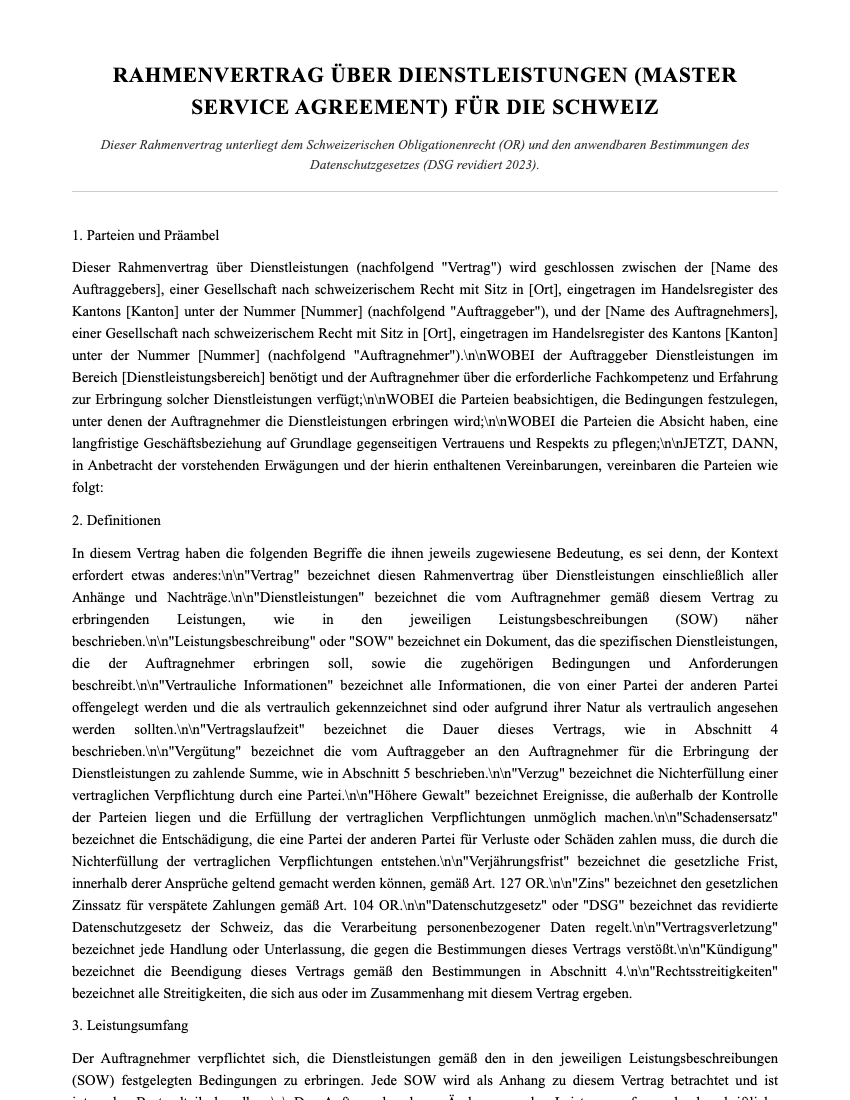
For a comprehensive guide to structuring MSAs and SOWs that protect your business, see our Freelancer Contracts Guide.
Definition Box
Definition: A Master Services Agreement (MSA) for Switzerland (German) is a superior service framework agreement that governs the general contractual terms (e.g., remuneration, payment deadlines, liability, confidentiality, data protection, place of jurisdiction) for an ongoing business relationship. The specific services, milestones, and prices are not “nailed down” in the MSA itself, but documented in separate Statements of Work (SOW). Legally, an MSA in Switzerland often ties into the rules of mandate law (OR Art. 394 ff.) or into elements similar to a contract for work and services—depending on the type of service.
Section 3: Why You Cannot Use a Generic MSA in Switzerland (German)
A generic MSA template from the USA or the EU may look “professional” at first glance, but in Switzerland it often fails for three reasons: (1) the classification of the collaboration (employee vs. self-employed), (2) the enforceability of non-compete clauses, and (3) IP logic around copyright and software rights. Add to that: Swiss contracts are typically interpreted against the backdrop of the Obligationenrecht (OR), including mandatory or non-waivable rules, and since 2023 data-protection obligations under the revised DSG in day-to-day B2B have to be documented much more thoroughly.
Worker Classification Rules
Switzerland uses no ABC-test system like California. What matters is a holistic assessment of the actual circumstances (subordination/obedience to instructions, organizational integration, entrepreneurial risk, market presence). For practical purposes: if the collaboration is effectively conducted like an employment relationship, social security authorities may perform a retrospective classification. In labor law, among other things, notice periods and non-compete periods are mandatory (e.g., OR Art. 337 on termination without notice for cause as a guiding norm for escalation cases). In the case of sham self-employment, there can be back payments of AHV/IV/EO/ALV contributions, default interest, and administrative procedures. A Switzerland-specific MSA should therefore include clear B2B elements: own work tools, flexible time scheduling, no exclusive directive regime, billing by service/SOW rather than “salary,” and documentation that an employment contract is not desired—without ignoring the actual delivery.
Non-Compete Enforceability
Unlike California, non-compete clauses in Switzerland are generally possible but only under strict conditions—typically in an employment relationship under OR Art. 340 ff. (Non-Competition). For pure B2B MSAs these rules are not directly 1:1 applicable, but they shape the reasonableness review: a too-broad “Non-Compete” can be deemed disproportionate or unconscionable and lead to disputes in practice. If your service provider is effectively engaged as an employee, the risk rises that a non-compete will be judged under employment-law standards: written, time-limited, and geographically limited, only to the extent necessary to protect trade secrets/customers. A good Swiss MSA therefore focuses more on enforceable alternatives: strong confidentiality (trade secrets), targeted customer-protection / non-solicitation clauses (narrowly tailored), and clear rules on the use of know-how, rather than blanket prohibitions on competition “across the entire industry.”
IP/Work-for-Hire Considerations
US “work made for hire” logic often does not fit in Switzerland. For software, texts, designs, or concepts, what matters is which rights are transferred and when. Swiss standard: rights remain with the author/creator unless effectively assigned or licensed. Therefore, a Switzerland MSA should provide an IP assignment or license per SOW (e.g., exclusive/non-exclusive, worldwide, perpetual) and define payment as a condition for the grant of rights. In addition, Open Source and third-party components should be expressly addressed.
What's Included in This Template
Flexible SOW Structure. The MSA is the “umbrella,” with each service being specified in a SOW: deliverables, acceptance criteria, timings, daily rates/fixed prices, and change requests. This helps you avoid scope creep and enables new projects to start without renegotiating liability, data protection, and payment logic each time.
Switzerland (German)-Specific Indemnification. The template includes balanced indemnities (e.g., for IP infringement or data protection violations) and clear liability caps including exclusion of consequential damages, where permissible. In addition, liability for agents/subcontractors is addressed so that risks do not slip in through the back door.
Dispute Resolution and Venue. The forum of dispute resolution and governing law are clearly set to Switzerland. This reduces costs and prevents a generic contract from forcing you into foreign forums. For payment delays, late payment consequences are clearly mapped out pursuant to the OR.
Additional Provisions (with Swiss legal anchoring):
- Late payment interest for payment delays under OR Art. 104.
- Limitation period of claims in principle under OR Art. 127 (10 years, unless a shorter special period applies).
- Data protection / confidentiality including role clarification and TOMs under DSG (rev. 2023).
- Contractual framework for service-oriented activities under OR Art. 394 ff.
Who Needs This Document?
| User Type | Relationship | Key Benefit |
|---|---|---|
| IT and software agencies | Ongoing development and maintenance engagements | IP rights and acceptance per SOW, fewer disputes over scope |
| Management consultants / coaches | Retainers, workshops, advisory | Clear compensation, expenses, liability cap and confidentiality |
| Marketing/design freelancers | Recurring campaigns | Usage rights only after payment, simple SOWs per project |
| Managed Service Providers (MSP) | Operations/support for SMEs | Structured SLA logic, escalation, liability and data protection |
How to Use This MSA Template
Step 1: Correctly capture the parties
Enter the exact company names, legal form, UID (if available), and service addresses. This prevents later objections about who is actually a contracting party.
Step 2: Set the core rules in the MSA
Define payment terms, late payment interest, liability caps, confidentiality, and data protection roles. Keep the limitation period/ statute of limitations logic and documentation obligations transparent.
Step 3: Attach the first SOW
Describe the service, timeline, price, acceptance, and change-request process. The more precise the SOW, the less risk of additional charges or misunderstandings.
Step 4: Signature and project start
Sign the MSA and the SOW (also electronically, if accepted). After that: new projects = new SOW, without renegotiating the MSA.
Already Receiving Contracts from Clients?
Many service providers do not work with their own template but are presented with a client MSA. In particular, you should check Swiss-specific risk areas: foreign forum/jurisdiction, unlimited liability, blanket IP transfer, data privacy clauses without DSG logic, or unfair payment terms. If you regularly receive third-party contracts, a structured review can save time and reveal red flags: an AI contract review tool.
Download Options
Free PDF Version: Ideal for reading, internal alignment, and as a checklist for negotiations.
Editable Word/Google Docs Version: Fully editable, with placeholders for Swiss party details, SOW attachments, and DSG-compliant data protection components. This lets you tailor liability, IP, and payment logic quickly to your offer.
Disclaimer
This article provides general information and is not legal advice. For your specific case, please consult a lawyer licensed to practice in Switzerland.
Related MSA Templates
Get the Template
Sign up for our newsletter to receive the template.
Frequently Asked Questions

About Designer Content
Designer Content creates practical legal document resources for landlords, contractors, and small business owners. We simplify complex legal concepts into actionable guidance. Connect with us on LinkedIn.