
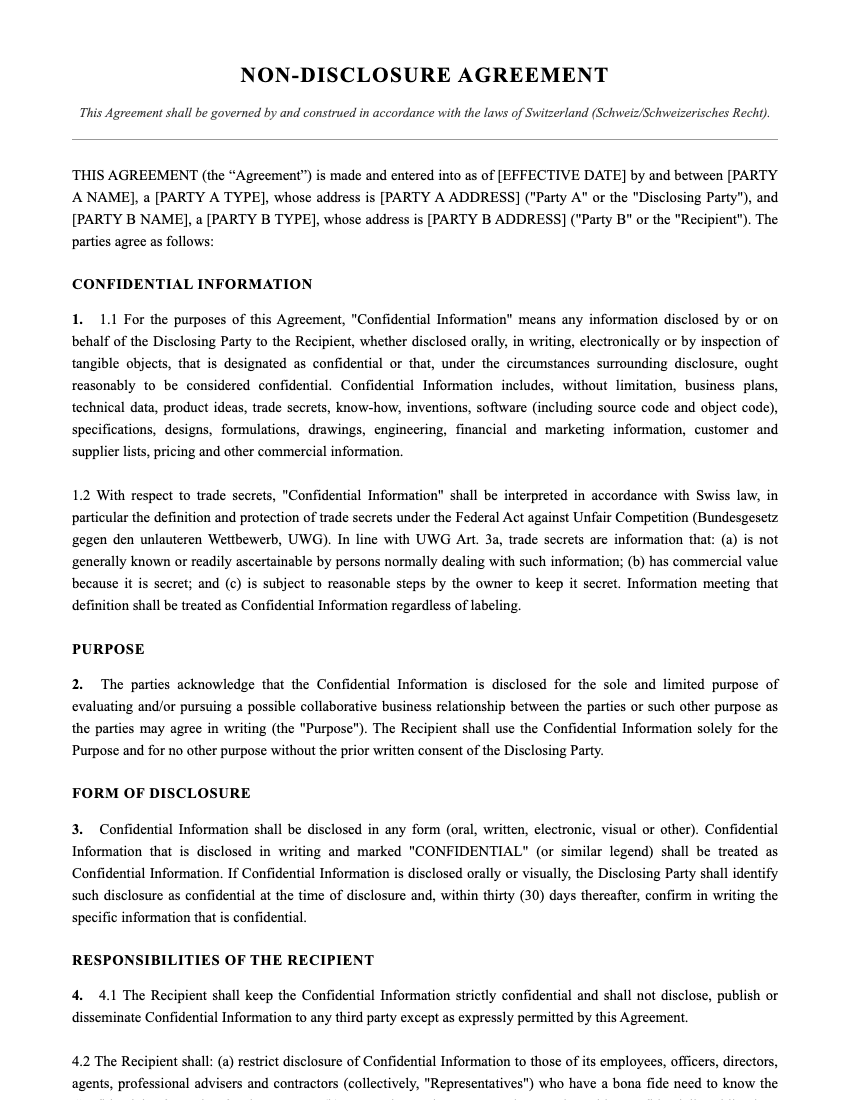
A Switzerland (German) Non-Disclosure Agreement (NDA) is a confidentiality contract drafted to fit Swiss civil‑law requirements—protecting trade secrets and confidential information while avoiding provisions that Swiss courts will treat as unlawful or unenforceable restraints on trade.
What is a Switzerland (German) NDA?
Definition: In Switzerland an NDA is a private contract that limits the receiving party's use and disclosure of confidential information. It must be framed in light of the Swiss Code of Obligations (Obligationenrecht, OR), the Federal Act against Unfair Competition (UWG), and the revised Federal Data Protection Act (DSG, in force Sept. 2023).
Important statutory anchors:
- Post-contractual non‑competition and related restraints are governed by OR (see Art. 340 et seq.). Non‑compete clauses are enforceable only if they meet statutory formalities (written form) and substantive limits (legitimate interest, reasonable scope and duration).
- Misuse of trade secrets can be remedied under the UWG and civil claims for unfair competition; preservation of secrecy and proportional measures are decisive.
- Processing of personal data shared under an NDA must comply with the DSG.
For a complete guide to NDA terms, duration, and standard exclusions, see our NDA Agreement Guide.
Why "generic" NDAs are dangerous in Switzerland
Templates copied from other jurisdictions often create three Swiss‑specific traps.
- Disguised restraints: Swiss law allows post‑contractual non‑competes but only when strict requirements are met. A broadly worded confidentiality clause that effectively prevents a former employee from working in the same sector may be recharacterised as a non‑compete and invalidated under OR Art. 340. The paradigm‑shifting insight here: unlike jurisdictions that broadly prohibit all non‑competes (e.g., California), Switzerland enforces narrow, formal non‑competes — so a careless NDA can either be voided or treated as a hidden, unenforceable restraint.
- Written‑form and reasonableness requirement: OR requires certain restraints to be in writing. For employment relationships, duration, geographic and subject‑matter limits must be reasonable (employee non‑competes are typically limited to short post‑termination periods; multi‑year blanket bans are likely void). If you rely on an oral or e‑mail interchange without meeting Swiss form requirements for restraints, you risk unenforceability.
- Data and secrecy compliance: Since the revised DSG (in force 2023), NDAs that transfer or permit access to personal data must reflect lawful processing bases, security measures and cross‑border transfer rules. Generic NDAs that ignore data obligations expose parties to regulatory fines and civil claims.
Real case study / development: Swiss courts and commentators have repeatedly refused to enforce overbroad confidentiality clauses when they amounted to disguised non‑competes; Swiss law firms have tracked a trend where judges scrutinise NDAs for substantive limitations (see law‑firm analyses cited below). The DSG revision (2020; entered into force 2023) is a material change — NDAs must now explicitly address personal data responsibilities.
Key clauses adapted for Swiss practice
- Purpose clause: Narrow, specific purpose language limits permitted uses to what Swiss courts will enforce (e.g., "for evaluation of a possible technology licensing agreement for Product X").
- Definition of Confidential Information vs. Trade Secrets: Distinguish general confidential information (time‑limited, e.g., 2–5 years) from trade secrets that derive economic value from secrecy (protected as long as secrecy is maintained and under UWG). Labeling everything a "trade secret" is ineffective.
- Non‑compete carve‑outs and form compliance: Avoid blanket employment restraints in an NDA. If a post‑termination non‑compete is required, include a separate clause complying with OR Art. 340 et seq. — written signature and reasonable temporal/geographic/scope limits.
- Data protection clause: Specify processing purposes, legal basis under DSG, security measures and cross‑border transfer rules. Reference the FDPIC guidance when personal data is involved.
- Residuals clause (optional): Permits unaided memory of general skills but carves out protected secrets. In Switzerland, courts will limit any "residuals" wording that functions as a hidden non‑compete.
- Carve‑outs: Ordinary exclusions such as prior knowledge, public domain, independent development, and compelled disclosure to authorities or courts (whistleblowing/public interest exceptions).
Who needs this document?
| User Persona | Usage Scenario | Key Swiss Benefit |
|---|---|---|
| Swiss start‑ups | Pitching to investors in Zurich/Basel | Protects technical know‑how and investor diligence materials while avoiding disguised non‑competes |
| Software vendors | Engaging Swiss contractors | Tailors source‑code protection and DSG compliance for personal data in logs |
| SMEs selling to Swiss buyers | M&A due diligence | Limits disclosure during negotiations and preserves UWG remedies for trade‑secret theft |
| Manufacturers | Overseas production deals | Ensures secrecy measures and cross‑border data provisions match DSG and commercial practice |
How to execute a valid Swiss NDA (practical steps)
- Choose the right form: One‑way (unilateral) for a single discloser; mutual when both parties exchange sensitive information.
- Be specific about Purpose and Duration: Define precise purpose and a reasonable time horizon. Use separate, written non‑compete provisions where needed (OR Art. 340 et seq.).
- Mark and protect materials: Stamps, watermarking and restricted access demonstrate "reasonable secrecy measures" for UWG trade‑secret protection.
- Sign before sharing: Ensure signatures comply with Swiss law — for higher certainty use an advanced electronic signature under ZertES or a handwritten signature for restraint clauses.
Cross‑sell: an AI contract review tool flags disguised restraints, checks whether wording meets OR and UWG standards, and highlights DSG‑related risks — saving expensive litigation down the line.
Related NDA Templates
Get the Template
Sign up for our newsletter to receive the template.
Frequently Asked Questions

About Designer Content
Designer Content creates practical legal document resources for landlords, contractors, and small business owners. We simplify complex legal concepts into actionable guidance. Connect with us on LinkedIn.