
Section 1: Opening (75 words)
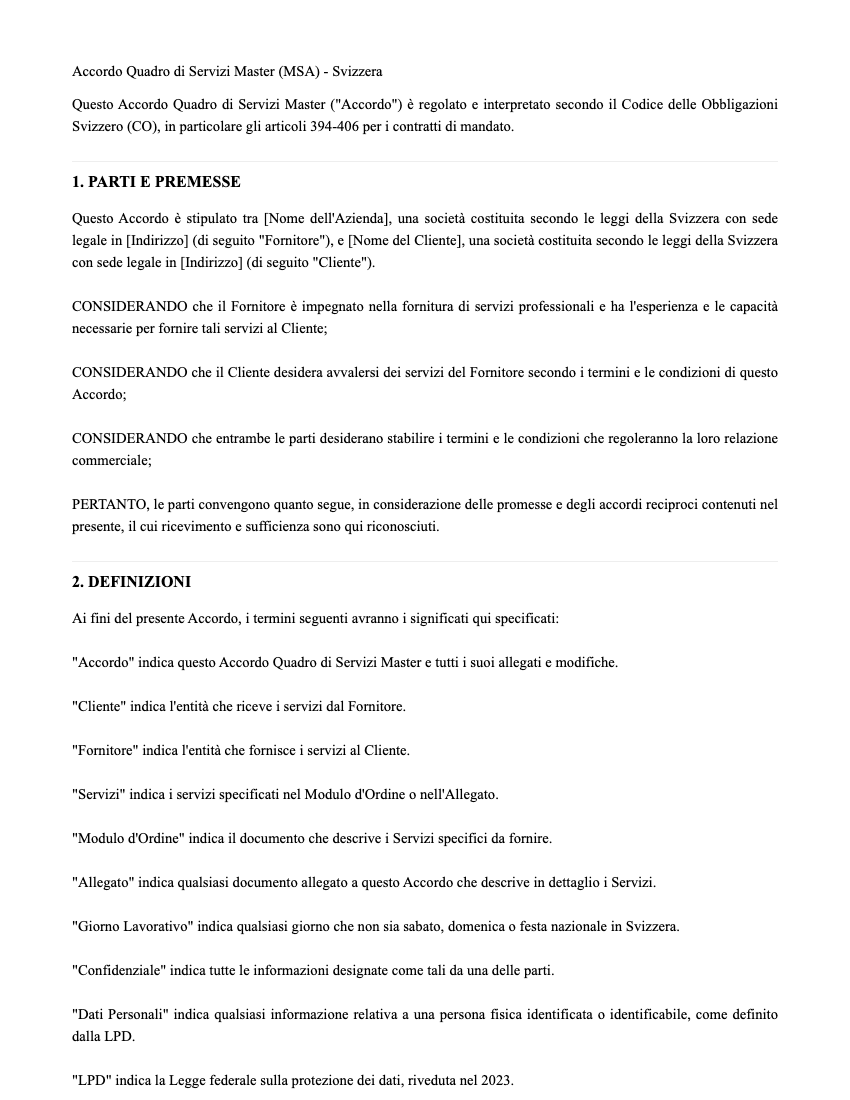
A Swiss Master Services Agreement (MSA) in Italian is a framework agreement that sets the baseline rules for all future engagements between a service provider and a client in Switzerland, leaving the individual Statement of Work (SOW) only to detail activities, timelines, and prices. It is particularly useful for SMEs, consultants, and freelancers because it reduces repetitive negotiations and makes payments, liabilities, IP, and data management more predictable.
For a comprehensive guide to structuring MSAs and SOWs that protect your business, see our Freelancer Contracts Guide.
Section 2: Definition Box (100 words)
Definition: A Swiss Master Services Agreement (MSA) in Italian is an umbrella B2B contract that governs in a stable manner the relationship between a client and a service provider, while individual projects are described in one or more attached Statement of Work (SOW). In the Swiss context, many services fall under the logic of the mandate contract (Code of Obligations, artt. 394–406 CO), for which elements such as diligence, instructions, accounting, and the possibility of termination matter. A good MSA also coordinates payment defaults, liabilities, confidentiality, and data protection under the LPD.
Section 3: Why You Cannot Use a Generic MSA in Switzerland (English)
Section 3a: Worker Classification Rules (150 words)
Switzerland does not apply an “ABC test” as some US jurisdictions do: the key distinction is between employee work and independent activity, assessed on a case-by-case basis based on substantial criteria (integration into the client's organization, subjection to instructions, entrepreneurial risk, use of the client's infrastructure). If, in practice, the “consultant” operates as an employee, a generic MSA labeling them as an “independent contractor” is not enough.
For clients, the main risk is the requalification with consequences for social security contributions and ancillary obligations (AVS/AI/IPG and insurances), as well as potential claims typical of an employment relationship (e.g., holidays or protection against dismissal) when the prerequisites apply. In a Swiss MSA it pays to include operative clauses: autonomy over hours and location, ability to be replaced (if compatible), use of own means, and no hierarchical integration.
3a. Worker Classification Rules (150 words)
Switzerland does not apply an “ABC test” as some US jurisdictions do: the key distinction is between employee work and independent activity, assessed on a case-by-case basis based on substantial criteria (integration into the client’s organization, subjection to instructions, entrepreneurial risk, use of the client’s infrastructure). If, in practice, the “consultant” operates as an employee, a generic MSA that labels them an “independent contractor” is not enough.
For clients, the main risk is the requalification with consequences for social security contributions and ancillary obligations (AVS/AI/IPG and insurances), as well as potential claims typical of an employment relationship (e.g., holidays or protection against dismissal) when the prerequisites apply. In a Swiss MSA it is advisable to include operative clauses: autonomy over hours and location, ability to be replaced (if compatible), use of own means and no hierarchical integration.
3b. Non-Compete Enforceability (150 words)
In Switzerland, non-compete agreements are primarily typical of employment law and are allowed, but with strict limits: they must be in writing and are binding only if the worker has access to clients or secrets and the use of such knowledge could seriously harm the employer (Code of Obligations, art. 340 CO). They must also be reasonable in duration, territory, and scope; as a general rule the duration should not exceed three years unless special circumstances (art. 340a CO).
For a B2B relationship governed by an MSA (between two companies or professionals), dropping in a copy-paste non-compete can be counterproductive because it risks being challenged as excessive or, if the relationship is recharacterized as employment, of not meeting formal and substantive requirements. More robust Swiss MSA alternatives: confidentiality obligations, targeted prohibitions on soliciting clients/personnel, and IP clauses that prevent unauthorized use of client materials.
3c. IP/Work-for-Hire Considerations (100 words)
A generic MSA often presumes that “everything is work-made-for-hire.” In Switzerland this formula is not a universal mechanism: it is advisable to expressly address ownership and assignment/licensing of rights. For software, for example, a practical approach is: the supplier retains ownership of pre-existing tools and reusable components, while the client obtains an explicit assignment or broad license to the paid outputs (with terms tied to full payment). Additionally, the MSA should clarify what happens to drafts, materials, and know-how, to avoid IP remaining ambiguous and causing operational blocks.
Section 4: What this template includes
Flexible SOW Structure (50 words)
The template clearly separates the MSA (general rules) from the SOWs (scope, deliverables, milestones, and fees). This way you sign the MSA once and, for each new project, approve only a short SOW. It’s ideal for ongoing consultancies and phased projects.
Switzerland-specific Indemnity Clauses (50 words)
Indemnity and liability clauses are calibrated to Swiss rules: insert limitations consistent with the CO art. 100 (prohibition of excluding liability for wilful misconduct/gross negligence) and define clear carve-outs for breaches of confidentiality, IP, and data protection.
Dispute Resolution and Forum (50 words)
The template lets you choose applicable law and forum in Switzerland (e.g., client’s or supplier’s headquarters), avoiding foreign clauses that raise costs and uncertainty. For ongoing relationships, the duration/resolution section is coordinated with the mandate logic (CO artt. 394–406).
Additional clauses included (with citations):
- Duration and termination/rescission in line with the mandate: CO artt. 394–406
- Interest on arrears for late payments: CO art. 104
- Limitation of liability with statutory limits: CO art. 100
- Warranties and liabilities for quality/defects and buyer knowledge (useful for deliverables “as is”): CO art. 199
- Security and technical/organizational measures and data access/information rights: LPD artt. 7 and 8
Section 5: Who Needs This Document? (75 words)
| User Type | Relationship | Key Benefit |
|---|---|---|
| Consultants (strategy/finance) | Ongoing advisory with SMEs | Reduces scope creep and clarifies compensation and SOW |
| Marketing/design agencies | Recurring campaigns | IP and approvals streamlined, payments and mora clear |
| Software houses / IT freelancers | Milestone development | Rules on code, component reuse, and deliverable acceptance |
| Managed services providers (MSP) | Support and maintenance | SLAs in SOW and liability limits aligned with CO |
Section 6: How to Use This MSA Template (100 words)
Step 1: Correctly fill in the parts
Provide the full legal name, legal form (AG/Sagl/sole proprietorship) and registered office. Use registered details (e.g., IDE/UID) to reduce disputes over who is bound.
Step 2: Define duration and exit
Choose a fixed term or “evergreen” with notice. If the relationship resembles a mandate, avoid clauses that make termination impossible and govern final deliverables and outcomes.
Step 3: Attach the first SOW
Include in the SOW the deliverables, timelines, fees, expenses, and acceptance criteria. Explicitly reference the MSA to avoid conflicts between documents.
Step 4: Sign and manage changes
Have the MSA signed once and use “change order” forms for variations. Documenting changes protects both parties and minimizes disputes over extras.
Section 7: Are You Already Receiving Contracts from Clients? (75 words)
If you are a supplier, often you will not be the one sending the MSA: the client will send you their master contract. In that case, the risk is signing clauses covering unlimited liability, overly broad IP, foreign forum, or disproportionate data obligations. Before accepting, compare the text with Swiss rules on mandate, mora, and liability limitation. For a quick and structured check you can use: an AI contract review tool.
Section 8: Download Options (50 words)
Free PDF Version: useful for reference and internal sharing, with a ready-to-use MSA + SOW structure.
Editable Word/Google Docs Version: ideal if you need to customize clauses (IP, liability, data) and tailor the SOWs for multiple projects. Includes fillable fields and optional sections.
Section 9: Disclaimer (25 words)
Informational template for B2B relationships in Switzerland. It is not legal advice. For complex or regulated matters, consult a Swiss lawyer.
Legal Sources & References
- Codice delle Obbligazioni (CO) – Text SR 220 (incl. artt. 394–406, 100, 104, 199) — Swiss Federal Council (Fedlex)
- Legge federale sulla protezione dei dati (LPD) – Text SR 235.1 (artt. 7 and 8) — Swiss Federal Council (Fedlex)
- Incaricato federale della protezione dei dati e della trasparenza (IFPDT/EDÖB) – New LPD: information and guide — IFPDT/EDÖB
- SECO – Information on labor law: non-compete prohibition (overview, CO art. 340 et seq.) — Swiss State Secretariat for Economic Affairs (SECO)
- UST/UID – Register and use of the UID (business identification for contracts and invoicing) — Federal Statistical Office (UST)
Related MSA Templates
Get the Template
Sign up for our newsletter to receive the template.
Frequently Asked Questions

About Designer Content
Designer Content creates practical legal document resources for landlords, contractors, and small business owners. We simplify complex legal concepts into actionable guidance. Connect with us on LinkedIn.