
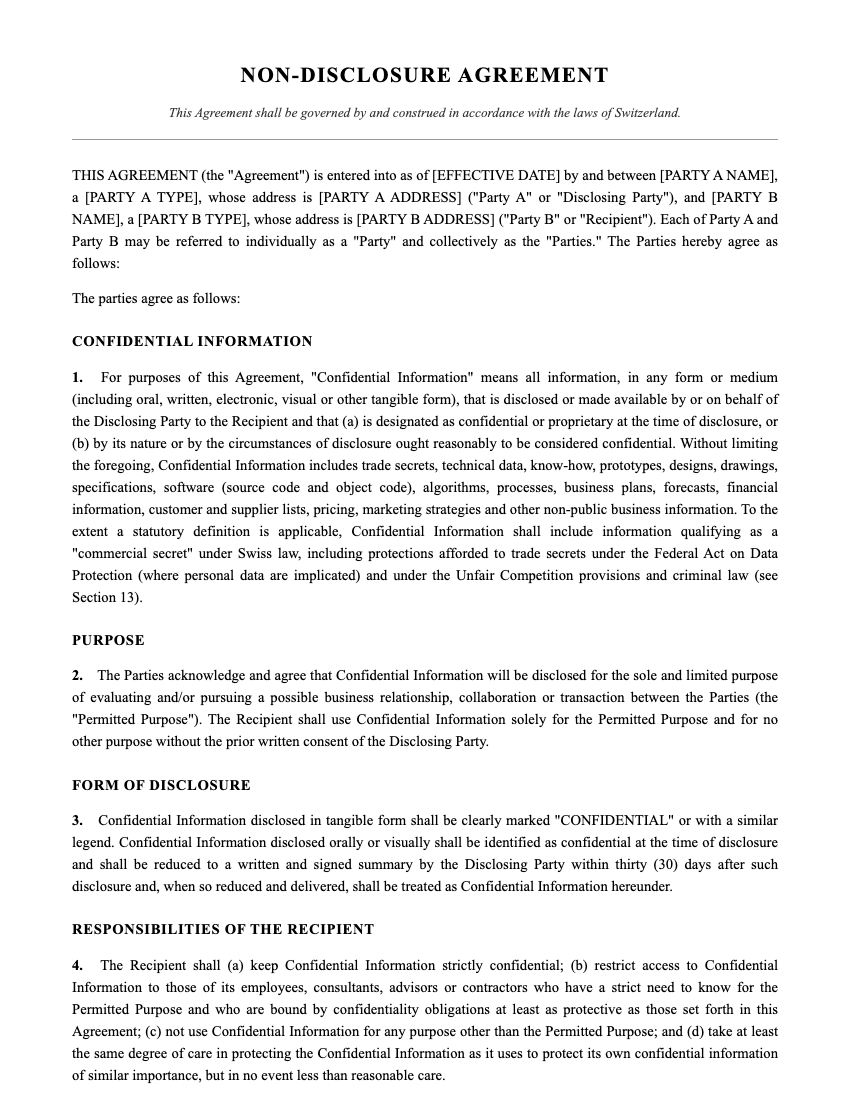
A Switzerland (Italian) Non-Disclosure Agreement (NDA) is a contractual tool to protect trade secrets and confidential information while complying with Swiss mandatory rules under the Codice delle obbligazioni (CO), the Federal Act on Data Protection (LPD, revised 2020, in force Sept 1, 2023) and the Federal Act against Unfair Competition (UWG). Unlike many generic templates, a Switzerland-focused NDA must respect formal requirements for post‑employment restraints, Swiss data‑protection obligations, and the ten‑year limitation period that applies to many claims under Swiss law.
What Is a Switzerland (Italian) NDA?
Definition: In Switzerland an NDA is a private-law contract by which the receiving party undertakes to keep certain information secret and not to use it except for a defined purpose. Key statutory anchors are the Codice delle obbligazioni (CO) for contract form and enforceability (see Art. 340 on post‑contractual restraints), the UWG for remedies against unlawful appropriation of secrets, and the revised LPD for any processing of personal data within the disclosed material.
Swiss law treats NDAs as ordinary contracts governed by the CO; their enforceability depends on classical contract principles (consent, clarity of scope, proportionality). For restraints that look like non‑compete clauses, CO Art. 340 requires particular attention: post‑contractual restraints must be in writing and justified by the employer's legitimate interest.
For a complete guide to NDA terms, duration, and standard exclusions, see our NDA Agreement Guide.
Why Generic NDAs Are Dangerous in Switzerland (Italian)
Most online templates are drafted for common-law jurisdictions and miss Swiss-specific traps. Three local issues cause the most problems:
- Written-form and legitimacy trap for non-competes (Art. 340 CO)
Swiss law is permissive of post‑contractual restraints in principle, but only if they meet formal and substantive tests. Art. 340 requires the restraint to be evidenced in writing. More importantly, the restraint must protect a legitimate business interest and be proportionate in duration, geographic scope, and subject matter. A generic “no competition” sentence buried inside an NDA — not in a written, separately negotiated clause — risks unenforceability.
Paradigm-shifting insight: In Switzerland the single biggest drafting mistake is trying to turn an NDA into a back‑door non‑compete without satisfying CO Art. 340. Even if a non‑compete fails for form or proportionality, civil and criminal remedies under the UWG and other statutory protections for trade secrets often remain available. So the most effective Swiss NDAs emphasize precise trade‑secret definitions and documented secrecy measures rather than broad employment restraints.
- Data-protection compliance under the revised LPD (2023)
If the disclosed material contains personal data (contact lists, employee records), the revised LPD imposes transparency, purpose limitation, and often cross‑border transfer rules. An NDA that ignores processing obligations (or that purports to circumvent data‑subject rights) can create regulatory risk and evidence problems in court.
- Limitation periods and urgent injunction practice
Swiss limitation law (CO Art. 127 et seq.) commonly gives a ten‑year prescription for many claims; however, interim measures (injunctions) are often the primary Swiss remedy for threatened disclosure. An NDA should therefore include prompt notice and injunctive-relief clauses and record the parties’ secrecy measures to make emergency relief workable.
Real legal development to know
The revised Federal Act on Data Protection (LPD), which entered into force on 1 September 2023, raised obligations for controllers and processors and introduced heavier fines and supervisory powers for the Federal Data Protection and Information Commissioner (FDPIC). NDAs that involve personal data must therefore capture lawful processing grounds and cross‑border transfer safeguards.
Sources: the revised LPD and FDPIC guidance (links below).
Key Clauses — Swiss (Italian) Focus
- Precise definition: separate "Trade Secrets" and "Confidential Information" buckets. Trade secrets (those that have economic value from secrecy and subject to reasonable confidentiality measures) get indefinite protection; ordinary business information usually gets a limited term (e.g., 2–5 years).
- Purpose and use limitation: narrow, specified purpose (e.g., "evaluation of a supply agreement for Product X"). Swiss courts demand clarity.
- Non‑compete / restraint: if you want a post‑termination restraint, put it in writing, label it clearly as a restrictive covenant, and ensure it meets CO Art. 340 proportionality tests (time, territory, scope). If you only need secrecy, avoid restraint language entirely.
- Remedies and interim relief: immediate injunctive relief, preservation of evidence, costs allocation for wrongful disclosure.
- Data protection clause: identify controller/processor roles, legal basis for processing, security measures, and cross‑border transfer rules consistent with the revised LPD.
- Marking and secrecy measures: how documents must be labeled and stored — essential to show "reasonable steps" to keep a trade secret.
Who Needs This Document?
- Swiss SMEs (manufacturing/exports): protect drawings, formulas, supplier lists when working with overseas partners.
- Startups (Zurich/Lugano): pitch decks to investors while preserving IP and Swiss data‑compliance.
- Law firms / consultants: protect client information when outsourcing projects across cantons or borders.
- Employers: protect customer relationships and proprietary processes — but use distinct written non‑compete clauses if you need post‑employment restraints.
How to Execute a Valid Swiss NDA (short practical guide)
- Choose the right type: One‑Way when only one party discloses; Mutual when both sides exchange secrets.
- Define the Purpose: be narrow. "Discussions regarding a licensing arrangement for Product X" beats "Business discussions."
- Label and record secrecy measures: watermark, access logs, and centralized storage to evidence "reasonable steps" for trade‑secret status.
- Sign properly: use written form for any restrictive covenant (see CO Art. 340). Switzerland recognises qualified electronic signatures under ZertES for high‑assurance needs; ordinary electronic signatures are widely accepted for NDAs.
Do not share confidential material before the NDA is fully executed; Swiss courts treat pre‑execution disclosure as unprotected.
Receiving an NDA from a Swiss Counterparty?
Check for: (i) hidden restraint language that should meet Art. 340 form/limit tests; (ii) unrealistic confidentiality durations; (iii) clauses that attempt to waive statutory data subject rights under the LPD (unenforceable). Use an AI contract review tool to flag problematic clauses against Swiss law instantly.
Related NDA Templates
Get the Template
Sign up for our newsletter to receive the template.
Frequently Asked Questions

About Designer Content
Designer Content creates practical legal document resources for landlords, contractors, and small business owners. We simplify complex legal concepts into actionable guidance. Connect with us on LinkedIn.