
A Tennessee Master Services Agreement (MSA) is a reusable contract that sets the “base rules” for a client–service provider relationship in Tennessee, so future projects can be added quickly using Statements of Work (SOWs). Instead of renegotiating payment terms, IP rights, confidentiality, and dispute resolution every time, you sign one master agreement and then attach short SOWs for each new engagement. For Tennessee SMBs and freelancers, a state-specific MSA matters because contract timelines, interest on late payments, and enforceability of restrictive covenants are handled differently than in other states.
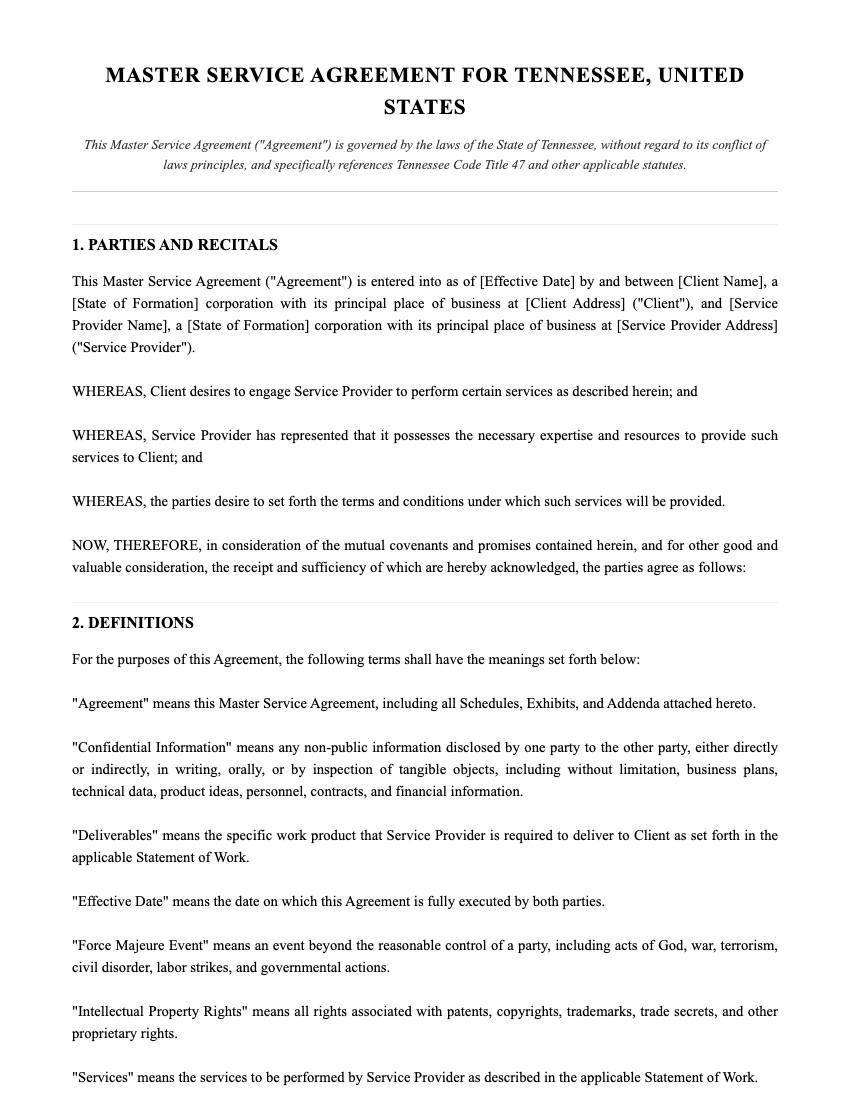
Definition: A Tennessee Master Services Agreement is a written, overarching contract governed by Tennessee law that defines the ongoing legal terms between a service provider (agency, consultant, developer, contractor) and a client for multiple projects. The MSA typically covers payment and invoicing, confidentiality and data handling, intellectual property ownership or licensing, warranties, indemnification, limitation of liability, termination, and how disputes will be handled in Tennessee courts. Individual projects are documented in separate SOWs that incorporate the MSA by reference, letting the parties start new work without rewriting the full contract each time.
Why You Cannot Use a Generic MSA in Tennessee
A generic MSA often fails in Tennessee for three practical reasons: (1) worker classification is heavily fact-based and can trigger tax and employment-law exposure if your “independent contractor” language doesn’t match reality; (2) non-compete and other restrictive covenants are generally enforceable when reasonably drafted, so boilerplate from non-enforcement states can either under-protect you or overreach and become unenforceable; and (3) IP ownership and “work made for hire” assumptions can break down if your template doesn’t clearly assign rights and tie payment to delivery and transfer.
Tennessee also has baseline contract rules you should draft around. For example, many business claims for breach of a written contract must be brought within six years under Tenn. Code Ann. § 28-3-109. A template that doesn’t preserve records, define when a claim “accrues,” or require prompt notice can create unnecessary exposure years later. And if you charge interest for late invoices, Tennessee’s interest statutes matter: Tenn. Code Ann. § 47-14-121 addresses interest in certain commercial contexts and is commonly referenced when drafting late-payment and interest provisions.
For a comprehensive guide to structuring MSAs and SOWs that protect your business, see our Freelancer Contracts Guide.
Finally, if your services touch marketing, sales claims, or representations to customers, Tennessee’s unfair or deceptive acts rules can surface in disputes. Even in B2B settings, allegations sometimes reference the Tennessee Consumer Protection Act (TCPA), Tenn. Code Ann. § 47-18-101 et seq. A Tennessee-specific MSA should control who approves public claims, disclaim unauthorized promises, and allocate responsibility for client-provided content.
3a. Worker Classification Rules
Tennessee does not use California’s ABC test as a general, all-purpose rule for service contracts. Instead, classification typically turns on a right-to-control analysis and multi-factor standards that appear in Tennessee employment and workers’ compensation administration. A key statute for many businesses is the workers’ compensation “construction services provider” framework in Tenn. Code Ann. § 50-6-102, which defines when certain individuals/entities are treated as independent contractors versus employees in construction-related contexts. Tennessee agencies also publish guidance using common-law style factors (who controls the manner and means of work, who provides tools, opportunity for profit/loss, and whether the worker is in an independent business).
Why your MSA template must be careful: calling someone an “independent contractor” is not enough. If the contract gives the client day-to-day control, requires set hours, or treats the worker like staff, Tennessee regulators or courts may recharacterize the relationship. Misclassification can trigger back taxes, wage issues, benefit exposure, and workers’ compensation consequences. In a Tennessee MSA, you should include (1) an independent contractor clause consistent with actual practices, (2) a clear scope and deliverables approach (results-focused, not process-controlled), and (3) responsibility for taxes and insurance. For construction-related services, consider aligning the contract and onboarding with the statutory framework in Tenn. Code Ann. § 50-6-102 and maintaining documentation supporting independent business status.
3b. Non-Compete Enforceability
Unlike states that broadly ban non-competes, Tennessee generally enforces non-compete agreements when they are reasonable and protect a legitimate business interest. Tennessee’s enforceability rules largely come from common law (judge-made law) rather than a single “non-compete statute.” Courts focus on whether the restriction is no broader than necessary as to time, geographic scope, and activities, and whether the employer/business has a protectable interest such as trade secrets, confidential information, or customer relationships.
A well-known Tennessee Supreme Court decision is H&R Block Eastern Tax Services, Inc. v. Morris, 606 S.W.2d 303 (Tenn. 1980), which explains that restrictive covenants are disfavored but can be enforced if reasonable under the circumstances. For SMB contracts, this means generic templates can fail in either direction: a Delaware/Texas-style clause might be overly broad (and risk being struck or narrowed), while a California-style template might omit enforceable protections entirely.
For an MSA between businesses (for example, a client and a consulting firm), consider whether you actually need a “non-compete” at all. Many Tennessee service providers are better protected with narrower, more defensible clauses: (1) confidentiality and trade secret protections; (2) non-solicitation of the other party’s employees/contractors; and (3) non-solicitation of active customers tied to the specific project. If you do include a non-compete, draft it narrowly: define the competitive services, set a reasonable duration, and limit geography to where you genuinely operate or have customers.
3c. IP/Work-for-Hire Considerations
Tennessee MSAs often involve deliverables like software, marketing assets, designs, reports, or data. Federal copyright law controls “work made for hire,” and many service relationships will not qualify unless the creator is an employee or the work fits a statutory category with a signed written agreement. So a Tennessee MSA should not rely on “work made for hire” language alone. Instead, include a clear IP assignment (or a license) that activates upon payment, and specify pre-existing tools remain the provider’s property. Also address moral rights waivers where applicable, and clarify ownership of client data. This prevents disputes when the client assumes it “owns everything” but the contract doesn’t precisely transfer rights.
What's Included in This Template
Flexible SOW Structure. The template separates “legal infrastructure” from project specifics. You sign the Tennessee MSA once, then add one-page SOWs for each new engagement with scope, milestones, fees, and timelines. This structure reduces negotiation time and helps prevent scope creep by requiring written change orders.
Tennessee-Specific Indemnification. Indemnity is drafted for typical Tennessee B2B risk allocation: third-party claims, IP infringement claims tied to provider deliverables, and client-content carveouts. It also aligns with Tennessee contract enforceability norms by clearly stating duty-to-defend triggers, notice requirements, and caps tied to fees when appropriate.
Dispute Resolution and Venue. The template includes Tennessee governing law and a venue framework designed to keep disputes in Tennessee courts. It references the parties’ ability to choose governing law for transactions under Tenn. Code Ann. § 47-1-301 (UCC choice-of-law), and it sets expectations for where claims will be filed.
Additional Tennessee provisions included (with citations):
- Written-contract claim timing awareness (six-year limitations period): Tenn. Code Ann. § 28-3-109
- Late-payment interest drafting reference: Tenn. Code Ann. § 47-14-121
- TCPA risk controls for advertising/representations: Tenn. Code Ann. § 47-18-101 et seq.
- Governing law selection framework (UCC transactions): Tenn. Code Ann. § 47-1-301
- Release/waiver drafting reference: Tenn. Code Ann. § 29-11-104
Who Needs This Document?
| User Type | Relationship | Key Benefit |
|---|---|---|
| Marketing agencies | Retainers + monthly campaigns | SOW-based scope control and approval rules to reduce TCPA-style “misrepresentation” disputes |
| Software developers | Build + maintenance | Clear IP assignment/licensing and payment-gated delivery terms |
| Consultants | Advisory + implementation | Clean change-order process and predictable invoicing/late-fee structure |
| IT/MSP providers | Ongoing services | Standardized confidentiality, security expectations, and Tennessee venue terms |
How to Use This MSA Template
Step 1: Identify the parties correctly
Use the exact legal names (LLC/Inc.) and principal addresses. For Tennessee entities, match the names used in Secretary of State filings to avoid enforceability fights over “who signed.”
Step 2: Choose the term and termination model
Decide between a fixed term (e.g., 12 months) or evergreen renewal. Include a clean termination-for-convenience notice period and specify what happens to in-progress SOWs.
Step 3: Attach your first SOW and make it measurable
Put deliverables, timelines, acceptance criteria, and fees in the SOW—not the MSA. If scope changes, require a written change order so you can bill for additions without arguing about “implied” tasks.
Step 4: Align payment, interest, and records
State invoicing cadence, due dates, and any interest/late charges with Tennessee law in mind (see Tenn. Code Ann. § 47-14-121). Keep SOWs, approvals, and key communications archived because written-contract disputes can linger up to six years (Tenn. Code Ann. § 28-3-109).
Related MSA Templates
Get the Template
Sign up for our newsletter to receive the template.
Frequently Asked Questions

About Designer Content
Designer Content creates practical legal document resources for landlords, contractors, and small business owners. We simplify complex legal concepts into actionable guidance. Connect with us on LinkedIn.