
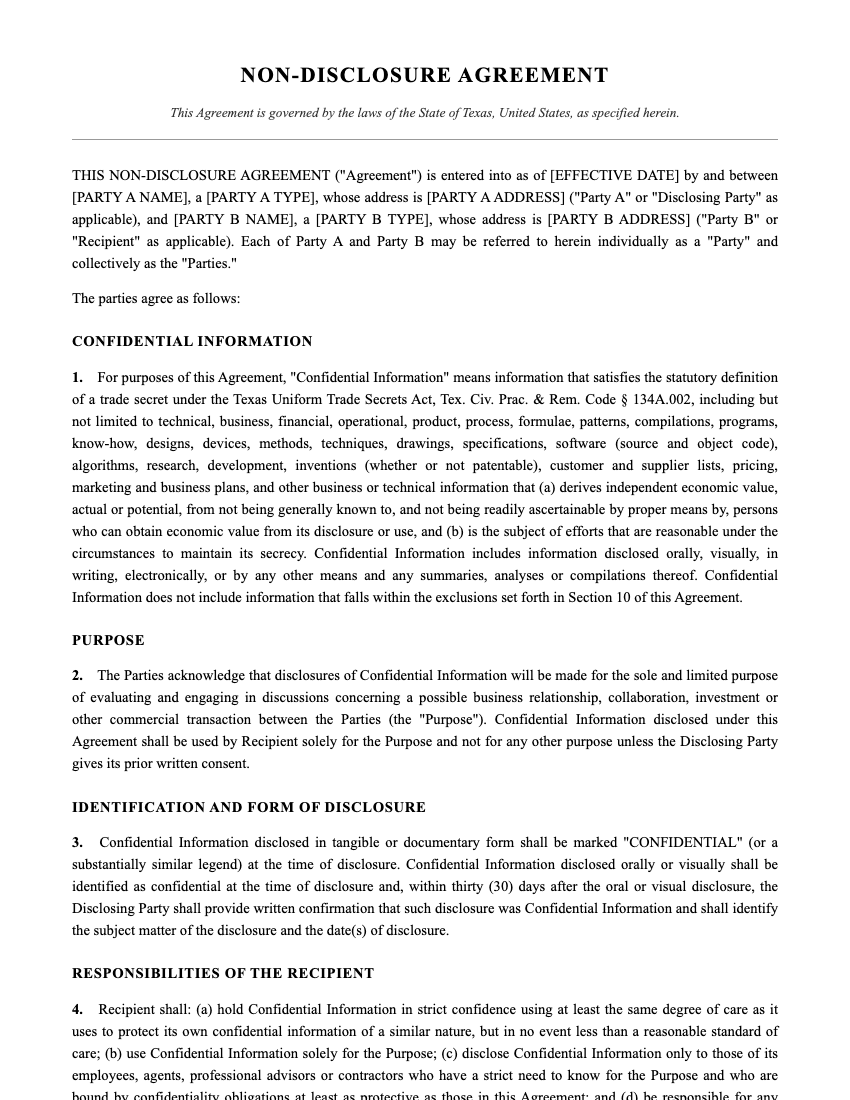
A Texas Non-Disclosure Agreement (NDA) is a contractual tool to preserve confidentiality and protect trade secrets under Texas law. Unlike jurisdictions that broadly prohibit restraints on trade, Texas enforces reasonable confidentiality and non-compete obligations—when they meet statutory requirements. This template is drafted to align with Tex. Bus. & Com. Code § 15.50 (non-competes ancillary to an enforceable agreement) and the Texas Uniform Trade Secrets Act (Tex. Civ. Prac. & Rem. Code § 134A). It also includes the federal Defend Trade Secrets Act (DTSA) whistleblower notice required to seek enhanced damages in federal claims.
What Is a Texas NDA?
Definition: A Texas NDA is a contract in which one or both parties agree to keep specified information confidential and to limit its use. Under Texas law, confidentiality provisions and ancillary restraints are valid where reasonable and connected to an otherwise enforceable agreement (see Tex. Bus. & Com. Code § 15.50). Trade secrets receive statutory protection under Tex. Civ. Prac. & Rem. Code § 134A.001 et seq.
In practical terms: Texas gives parties freedom to contract, but courts will refuse or reform provisions that are broader than necessary to protect a legitimate business interest.
For a complete guide to NDA terms, duration, and standard exclusions, see our NDA Agreement Guide.
Why "Generic" NDAs Are Dangerous in Texas
Generic NDA templates often overlook three Texas-specific traps that can cost you enforceability or damages.
- The Ancillary/Consideration Trap (Paradigm-Shifting Insight)
Texas requires that restrictive covenants (including any non-compete language within an NDA) be ancillary to or part of an otherwise enforceable agreement and supported by adequate consideration (Tex. Bus. & Com. Code § 15.50). That means a standalone NDA that attempts to function as a de facto non-compete without separate consideration or evidentiary connection to an underlying transaction risks being recharacterized or struck down. In Texas, continuing employment can constitute consideration if the restraint is signed at the outset of employment; but retroactive restraints or vague “no-competition” catch-alls invite litigation.
- Overbroad Scope, Duration, or Geography
Texas courts apply a reasonableness standard. Overbroad definitions of confidential information ("all information forever") or indefinite non-compete periods will be narrowed or invalidated. Draft narrowly: define the purpose, categories of protected information, time-limited confidentiality for general material, and indefinite protection only for true trade secrets (per Tex. Civ. Prac. & Rem. Code § 134A).
- Missing DTSA Whistleblower Notice
If you plan to assert trade-secret claims in federal court under the DTSA, include the DTSA whistleblower immunity notice (18 U.S.C. § 1833(b)). Without that notice, plaintiffs cannot recover exemplary damages and attorney's fees under the DTSA. Many off-the-shelf NDAs omit this, which can materially reduce remedies in a federal action.
Real-world illustration: Texas courts have repeatedly enforced tailored restraints when properly supported and narrowed, but struck or reformed overbroad provisions. See the Texas Supreme Court’s guidance treating ancillary/non-compete requirements as gatekeepers for enforceability (see Sheshunoff v. Sheshunoff Management Servs., L.P., summarized in local practice resources).
Key Clauses in this Template
- Parties and Purpose: Precise statement of the business purpose limits permissible uses.
- Definition of Confidential Information: Tiered definitions — (a) general confidential information (time-limited protection, typically 2–5 years) and (b) trade secrets (protected as long as secrecy is maintained) per Tex. Civ. Prac. & Rem. Code § 134A.
- Use and Non-Disclosure Obligations: Narrow, purpose-limited duties to avoid being characterized as a non-compete absent ancillary support.
- DTSA Whistleblower Immunity Notice: Required language so federal remedies remain available (18 U.S.C. § 1833(b)).
- Return/Destruction and Residuals: Optional residuals carve-out for unaided memory; clear instructions for return/delete of materials.
- Remedies and Limitations: Injunctive relief, statutory remedies for trade-secret misappropriation, and a statement about prevailing party fees where appropriate.
- Choice of Law & Venue: Texas choice-of-law and forum-selection clauses are generally enforceable; still be reasonable and linked to the parties’ contacts.
Mutual vs. Unilateral
- Unilateral (One-Way): Use when only one party discloses (investor pitches, contractor engagements where only the company shares).
- Mutual (Two-Way): Use when both sides will exchange sensitive material (joint ventures, M&A diligence).
Choosing the wrong form can create unnecessary exposure—pick the one that matches the transaction.
Who Needs This Document?
| User Persona | Usage Scenario | Texas-Specific Benefit |
|---|---|---|
| Startups (Austin/Dallas) | Pitching to investors | Protects pitch decks without creating enforceability issues around employee mobility |
| Employers | Hiring developers or sales staff | Allows narrowly tailored confidentiality and, where appropriate, ancillary restraints supported by consideration |
| Buyers/Sellers (M&A) | Due diligence exchanges | Mutual NDA with carve-outs for advisors and deal purpose limits liability and preserves trade-secret claims |
| Manufacturers | Sharing prototypes with vendors | Preserves trade-secret protection and provides injunctive remedies under Tex. Civ. Prac. & Rem. Code § 134A |
How to Execute a Valid Texas NDA
- Choose the Right Form: Unilateral vs. Mutual based on who discloses.
- Tie Restraints to Consideration: If you include non-compete or non-solicit language, ensure the restraint is ancillary to an enforceable agreement and supported by consideration (e.g., new employment, severance, or a sale of business).
- Limit Scope, Time & Geography: Draft narrowly to protect legitimate interests and reduce risk of judicial reformation.
- Include DTSA Notice: Insert the federal whistleblower immunity language to preserve federal remedies.
Practical tips: Label documents CONFIDENTIAL; require signatures before disclosure; retain audit trail for electronic signatures (DocuSign or similar). Electronic signatures and records are recognized under the U.S. E-SIGN Act and Texas practice — preserve the certificate of completion.
Already Receiving NDAs from Clients?
Use caution. Review incoming NDAs for overly broad non-compete-like provisions, vague definitions that sweep in your preexisting knowledge, or indemnities shifting all risk to you. an AI contract review tool can automatically flag risky clauses, compare terms against Texas statutes (§ 15.50, Tex. Civ. Prac. & Rem. Code § 134A), and recommend edits—saving hours of manual review.
Related NDA Templates
Get the Template
Sign up for our newsletter to receive the template.
Frequently Asked Questions

About Designer Content
Designer Content creates practical legal document resources for landlords, contractors, and small business owners. We simplify complex legal concepts into actionable guidance. Connect with us on LinkedIn.