
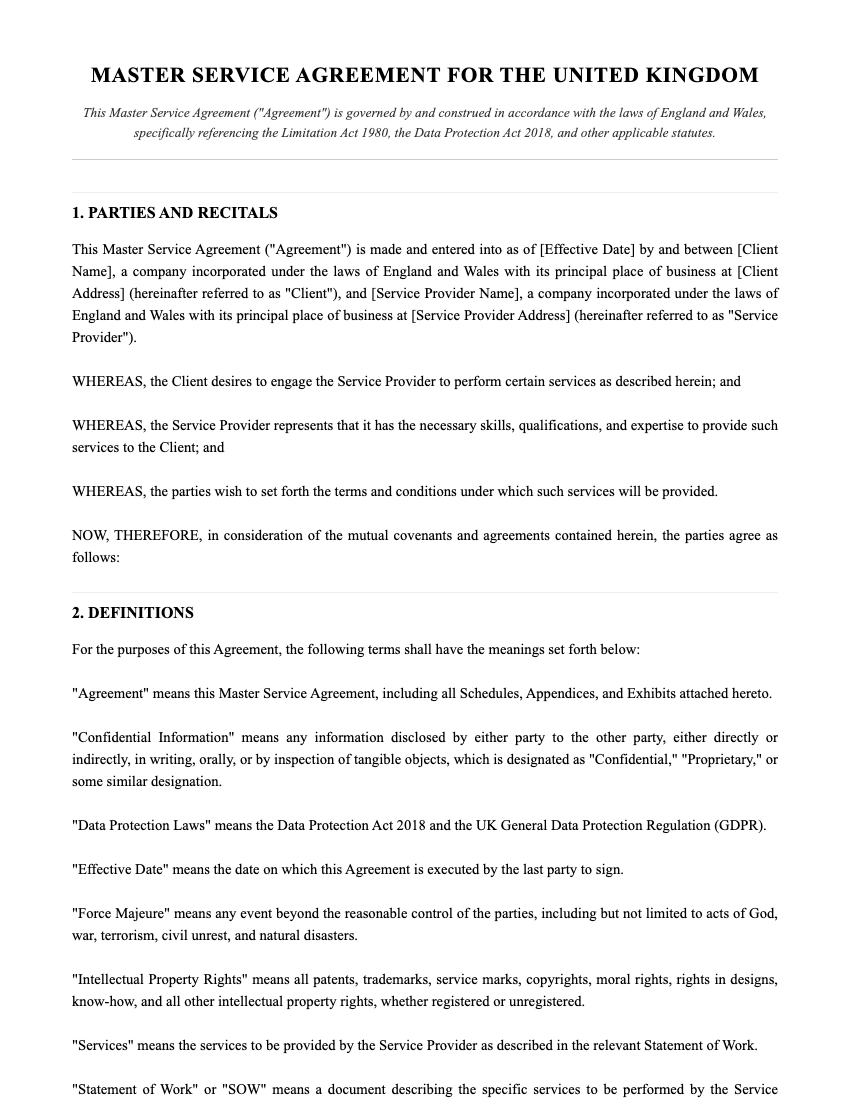
A United Kingdom Master Services Agreement (MSA) is a framework contract that sets the core legal and commercial terms for ongoing services under English law, with each project then documented in a shorter Statement of Work (SOW). It is designed for B2B relationships where you expect repeat work, change requests, or multiple deliverables over time. For UK freelancers, consultancies, and agencies, a properly drafted MSA reduces negotiation time and protects cashflow, IP ownership, and liability positions.
Definition: A United Kingdom Master Services Agreement is a contract governed by UK law (often the laws of England and Wales) that establishes the “umbrella” terms—payment, deliverables process, acceptance, confidentiality, data protection, intellectual property, liability limits, and dispute resolution—that will apply to multiple future engagements between the same parties. Individual jobs are then scoped through SOWs that reference the MSA and add project-specific details like timelines, milestones, rates, and deliverables. This structure helps avoid rewriting full legal terms each time and keeps changes in scope clearly billable.
Why You Cannot Use a Generic MSA in United Kingdom
A generic “global” MSA often fails in the UK because enforceability turns on UK-specific rules around employment status, restraint of trade, and ownership of work product. The practical risk is not just an unenforceable clause; it can be a commercially damaging dispute about fees, IP, and liability that is harder to settle because the contract language doesn’t match UK legal tests. A UK-facing template should also reflect statutory controls on limitation/exclusion clauses and real-world compliance needs like UK GDPR security measures.
3a. Worker Classification Rules
The UK does not use the US-style “ABC test.” Instead, employment status is primarily assessed using common-law tests developed by courts (control, personal service, mutuality of obligation, and overall reality of the relationship). Key statutory hooks also matter. For example, “worker” status (a category between employee and self-employed) is defined in section 230 of the Employment Rights Act 1996, and “employment” for PAYE/tax purposes is assessed under HMRC principles and case law. In an MSA, generic independent-contractor wording is not enough if your day-to-day arrangements point the other way.
For a comprehensive guide to structuring MSAs and SOWs that protect your business, see our Freelancer Contracts Guide.
A UK-specific template should: (1) avoid terms that imply control over how the provider works; (2) make deliverables-based obligations clearer than hours-based direction; and (3) document that the provider can substitute personnel (where genuinely workable), because personal service is a key indicator. Misclassification risk can lead to tax exposure, including PAYE/NIC liabilities and interest/penalties (particularly relevant where IR35 applies for off-payroll working). If the relationship looks like employment, the “client” may also face claims for holiday pay and other statutory rights associated with worker/employee status. The MSA should align the written contract with operational reality.
3b. Non-Compete Enforceability
Non-compete clauses can be enforceable in the UK, but only if they are reasonable and go no further than necessary to protect a legitimate business interest. UK law treats overbroad restraints as void for being in restraint of trade. For businesses, this means a generic “12-month worldwide non-compete” often fails. A UK-compliant MSA template should use narrowly tailored restrictions (if any), focusing on confidentiality, trade secrets, and non-solicitation rather than blanket bans.
The statutory baseline is reinforced by the Unfair Contract Terms Act 1977 (UCTA), which controls exclusion/limitation of liability and interacts with how risk is allocated; while UCTA is not “the” non-compete statute, it matters because UK MSAs often pair restrictions with sweeping disclaimers that can be struck down if unreasonable. For actual restraint enforceability, the key is common law: define the legitimate interest (e.g., protecting confidential information or client relationships), keep duration short (often 3–6 months is more defensible than 12), limit geography to where business is actually done, and limit scope to specific services or clients the provider had contact with. Practical alternatives a UK template should include are robust confidentiality clauses, narrowly drafted non-solicitation of customers and staff, and clear return/deletion of information obligations upon termination.
3c. IP/Work-for-Hire Considerations
UK IP ownership rules differ from many generic templates. Under the Copyright, Designs and Patents Act 1988, the author is generally the first owner of copyright, but where a work is made by an employee in the course of employment, the employer is the first owner (subject to agreement). Most consultants and freelancers are not employees, so a client does not automatically own the deliverables. A UK MSA should include an express IP assignment (or at minimum a suitable licence) and address moral rights waivers/consents where appropriate. For software and creative outputs, clarity on pre-existing materials, open-source components, and re-usable know-how prevents disputes about what is being transferred and what stays with the provider.
What's Included in This Template
Flexible SOW Structure. The template uses a two-layer structure: the MSA sets the stable legal terms, while each SOW defines scope, milestones, acceptance criteria, fees, and assumptions. This makes “scope creep” easier to manage because changes can be handled via a written change order under the SOW without reopening the whole contract.
United Kingdom-Specific Indemnification. The indemnities are drafted to fit UK limitation rules and statutory controls, including explicit carve-outs for fraud and non-excludable liabilities, and a reasonableness mindset consistent with UCTA. Where data is involved, the template links indemnity triggers to documented security obligations aligned with UK GDPR Article 32.
Dispute Resolution and Venue. The template is set up for exclusive jurisdiction of the courts of England and Wales, which helps avoid being dragged into unfamiliar forums. It also encourages pre-action resolution steps (notice and escalation) so SMBs can solve payment or scope disputes quickly without immediately litigating.
Additional UK-specific provisions (with statute citations):
- Late payment interest and recovery costs aligned to the Late Payment of Commercial Debts (Interest) Act 1998 § 2.
- Data protection and security obligations reflecting Data Protection Act 2018 § 1 and UK GDPR Article 32.
- Contract limitation period awareness consistent with Limitation Act 1980 § 5 (six years for simple contract claims).
- Liability exclusions/limitations drafted with Unfair Contract Terms Act 1977 § 2 in mind.
Who Needs This Document?
| User Type | Relationship | Key Benefit |
|---|---|---|
| IT managed service providers | Ongoing support + projects | Clear SOWs and acceptance reduce disputes over “included” work |
| Marketing agencies | Retainers + campaigns | Change control and IP terms protect margins and deliverables |
| Software development consultancies | Build + maintenance | IP assignment/licensing clarity and a workable liability cap |
| Independent consultants | Advisory engagements | Payment terms + late interest support stronger collection |
How to Use This MSA Template
Step 1: Identify the Parties Correctly
Use the full registered legal names, company numbers (if applicable), and service addresses. If you trade under a brand name, still contract in your legal entity name.
Step 2: Set the Term and Termination Mechanics
Choose an initial term and decide whether it auto-renews. Include a clean termination right for convenience with notice, plus immediate termination triggers for material breach or non-payment.
Step 3: Attach Your First Statement of Work (SOW)
Put deliverables, timelines, assumptions, and acceptance criteria in the SOW, not in the MSA body. Make sure the SOW states whether fees are fixed, milestone-based, or time-and-materials, and how change requests are priced.
Step 4: Sign, Then Run Changes Through SOW Change Control
Once signed, treat the MSA as the rulebook. Use SOWs (and change orders) to add work, extend schedules, or adjust fees so you avoid informal “please just do this too” scope expansion.
Related MSA Templates
Get the Template
Sign up for our newsletter to receive the template.
Frequently Asked Questions

About Designer Content
Designer Content creates practical legal document resources for landlords, contractors, and small business owners. We simplify complex legal concepts into actionable guidance. Connect with us on LinkedIn.