
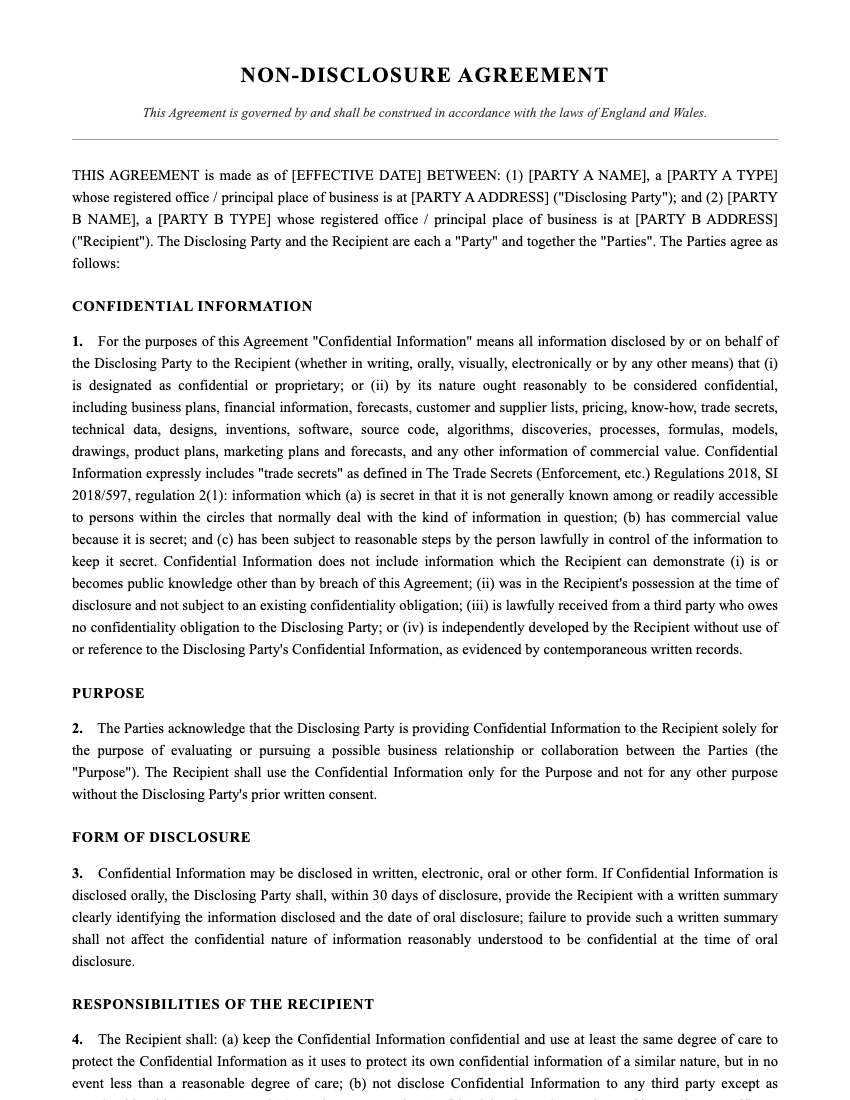
A United Kingdom Non-Disclosure Agreement (NDA) is a contract between parties that protects confidential information and trade secrets while conforming to UK law—notably the Trade Secrets (Enforcement, etc.) Regulations 2018 (SI 2018/597), UK GDPR and the common-law restraint of trade doctrine. A properly drafted UK NDA balances strong protection for business secrets with the courts’ expectation that any post‑employment restrictions be reasonable and proportionate.
What is a United Kingdom NDA?
Definition: A UK NDA is a contractual promise to keep specified information confidential. It protects information that qualifies as a trade secret under the Trade Secrets (Enforcement, etc.) Regulations 2018 and personal data under the UK GDPR/Data Protection Act 2018. NDAs must also respect statutory rights such as protected disclosures under the Employment Rights Act 1996.
The UK legal framework is a hybrid: statutory protection for trade secrets (the Regulations) sits alongside established common-law principles of confidentiality and restraint of trade. Unlike some jurisdictions with bright-line non-compete bans, English courts enforce post‑employment restrictions only if they are reasonable in scope, time and territory.
For a complete guide to NDA terms, duration, and standard exclusions, see our NDA Agreement Guide.
Why "Generic" NDAs Are Dangerous in the UK
Using a one-size-fits-all NDA drafted for another legal system creates three common traps for UK users.
- Overbroad post‑termination restraints
English courts apply the restraint of trade doctrine: a clause that prevents someone from working will be enforced only if it is reasonable and no wider than necessary to protect a legitimate business interest (clients, confidential information, goodwill). If your NDA slips in wording that functions as an overly broad non‑compete (for example, an indefinite or worldwide prohibition), it risks being struck down in whole or in part.
Paradigm-shifting insight: in the UK, garden leave is often the employer’s most reliable alternative to a long non‑compete. A well-drafted garden‑leave clause (paid notice period during which the employee is isolated from clients and systems) can protect secrets without triggering restraint scrutiny; however, employers must still pay and avoid turning garden leave into an unreasonable bar to work.
- Silencing lawful whistleblowers and regulator disclosures
Attempting to use an NDA to prevent protected disclosures is unlawful. The Employment Rights Act 1996 (as amended) protects ‘‘protected disclosures’’ (whistleblowing). NDAs must include carve-outs permitting disclosures to regulators (e.g., the FCA), legal advisers and communications protected by employment law. Courts and regulators will treat any NDA wording that purports to prevent lawful whistleblowing as unenforceable and may expose a company to reputational or regulatory sanctions.
- Forgetting data-protection obligations
Confidential information often includes personal data. The UK GDPR and Data Protection Act 2018 require legal bases for processing and impose transparency obligations. A confidentiality clause that instructs an employee to handle personal data without addressing lawful processing, retention periods or data‑subject rights can create regulatory risk.
Real case study
Tillman v Egon Zehnder Ltd [2019] UKSC 32 is a recent Supreme Court authority emphasising that post‑termination clauses will be scrutinised for reasonableness. The decision highlights that courts will not enforce punitive restrictions disguised as contractual terms; instead, they assess whether the restriction is a legitimate and proportionate means of protecting a business interest. For confidentiality duties, classic authority such as Faccenda Chicken Ltd v. Fowler (1986) still guides the distinction between information that is truly confidential and information that is not.
What’s Included in this Template? (Key Clauses)
- Scope of Confidential Information: clear, specific categories (technical, commercial, customer lists) with examples and thresholds so courts can identify legitimate trade secrets under the Trade Secrets Regulations 2018.
- Exclusions: public domain, independently developed, prior knowledge, compelled disclosure, and permitted regulator/whistleblower disclosures (Employment Rights Act 1996 carve-out).
- Duration: two-tier approach — limited term for general commercial information (e.g., 2 years) and indefinite protection for trade secrets so long as secrecy is maintained (consistent with the Regulations).
- Use limitation and purpose: narrow purpose clause limiting use to evaluating a transaction or performing a contract.
- Residuals clause (optional): narrowly tailored language addressing unaided memory to avoid unreasonable restraints on future work.
- Garden leave: a paid notice‑period mechanism to secure systems and client access that is practical in the UK and usually enforceable when reasonable.
- Remedies and injunctive relief: express acknowledgment that equitable relief (injunction) is available for trade-secret breaches under the Regulations.
- Data protection and processing: short annex explaining lawful processing, retention, and secure handling of personal data, referencing the UK GDPR and Data Protection Act 2018.
- Severability and blue‑pencil: severability clause drafted to reflect the limited power of English courts to sever obnoxious terms without rewriting the contract.
Who Needs This Document?
| User Persona | Usage Scenario | Key Benefit |
|---|---|---|
| Tech startups | Pitching investors or sharing prototypes | Protects code and IP while allowing founders to hire talent in the UK market |
| Consultancies & law firms | Onboarding contractors or during M&A due diligence | Uses garden leave and limited post‑term covenants to protect clients |
| Financial services | Sharing sensitive models with third parties | Cleansly carves out regulator disclosures (FCA/PRA) and GDPR compliance |
| Manufacturers | Engaging overseas suppliers | Trade secret language aligned to Trade Secrets Regs 2018 for cross‑border enforcement |
How to execute a valid UK NDA
Step 1: Choose One‑Way or Mutual
Pick unilateral when only you disclose information (investor pitch, vendor demos). Pick mutual when both sides exchange information (joint ventures, M&A).
Step 2: Define the Purpose Narrowly
Specify the commercial purpose in a single sentence. Courts disfavour vague purposes like “general business discussions.”
Step 3: Mark and Control Access
Label documents “CONFIDENTIAL,” restrict electronic access, use secure file sharing, and keep a disclosure log. These measures help satisfy "reasonable steps" under the Trade Secrets Regulations 2018.
Step 4: Sign (and consider garden leave) Before Sharing
Get the agreement signed before disclosure. For employees, consider a garden‑leave clause on termination rather than a long post‑term ban: it gives immediate protection while paying contractual salary and avoids excessive restraint risks.
Receiving an NDA from a client?
If you are asked to sign a client’s NDA, watch for overly broad non‑compete language, gag provisions that attempt to block whistleblowing or regulatory reporting, and vague trade‑secret definitions. Use this template to compare terms and negotiate carve‑outs.
an AI contract review tool can instantly flag UK‑specific red flags (unreasonable restraints, missing whistleblower carve-outs, GDPR exposure) and generate suggested replacements consistent with UK law—saving hours of manual review.
Related NDA Templates
Get the Template
Sign up for our newsletter to receive the template.
Frequently Asked Questions

About Designer Content
Designer Content creates practical legal document resources for landlords, contractors, and small business owners. We simplify complex legal concepts into actionable guidance. Connect with us on LinkedIn.