
A Utah Master Services Agreement (MSA) is a long-form contract used in Utah to set the baseline legal rules—payment, IP, confidentiality, liability, and dispute handling—for ongoing service work between a provider and a client. Instead of renegotiating legal terms every time you start a new project, you sign one MSA and then issue short Statements of Work (SOWs) for each specific job. For Utah SMBs, consultants, and agencies, the MSA/SOW structure reduces back-and-forth and helps you avoid “scope creep” while keeping disputes and enforcement tied to Utah law.
Definition: A Utah Master Services Agreement (MSA) is a governing contract between a service provider and a client where the parties agree once on core legal terms that will apply to multiple future projects performed in Utah. Individual projects are then documented in separate Statements of Work (SOWs) that list deliverables, timelines, and pricing. This setup is especially useful for repeat engagements because it creates a consistent framework for invoicing, intellectual property ownership, confidentiality, warranties, indemnities, and dispute resolution. In Utah, a well-drafted MSA should also reflect state-specific rules on written-contract time limits (Utah Code § 78B-2-309), late-payment interest (Utah Code § 15-1-1), and enforceability of certain restrictive covenants.
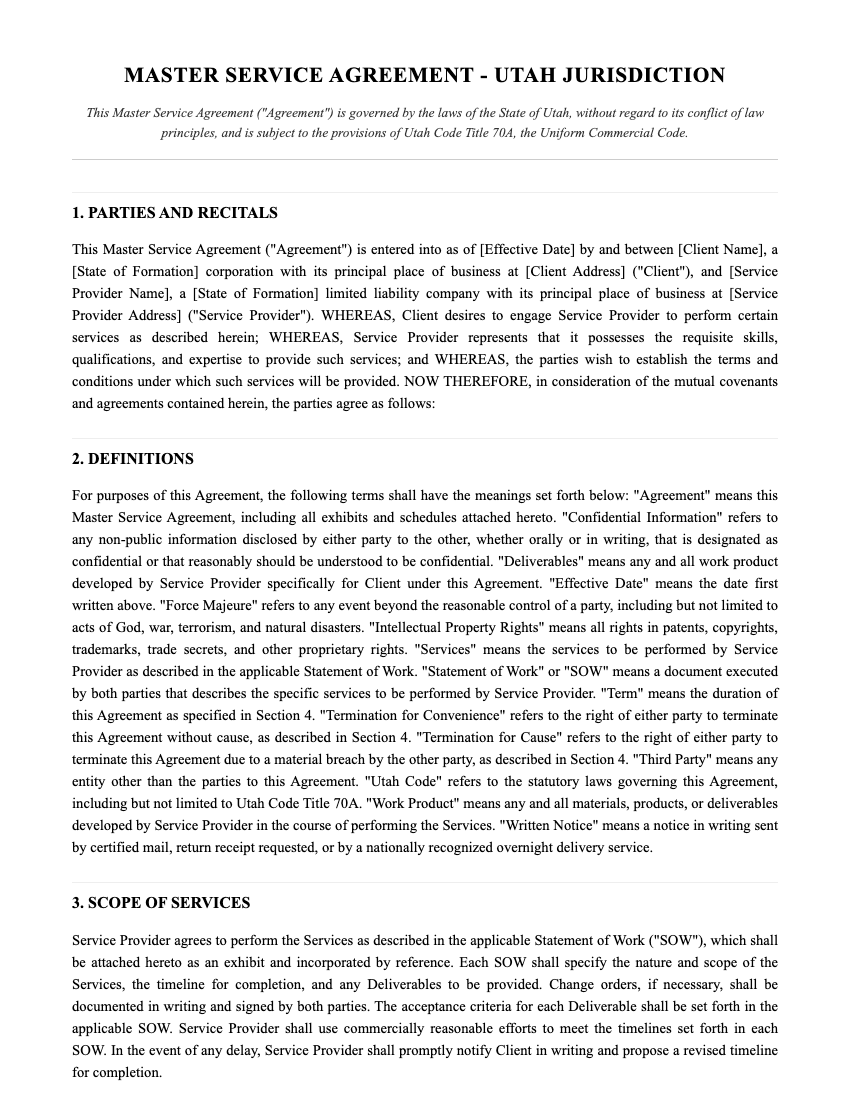
Why You Cannot Use a Generic MSA in Utah
A generic MSA often looks “professional,” but it can quietly create Utah-specific problems: wrong assumptions about worker status, unenforceable (or overly aggressive) non-compete language, and IP clauses that don’t match how copyright ownership actually transfers. Utah courts generally enforce contracts as written, but they also apply Utah statutes and public policy. If your template is drafted for another state, you may end up with (1) a clause you can’t enforce, (2) a clause that triggers extra liability, or (3) a missing clause that you needed to collect money or protect your work.
Just as important, Utah has specific default rules that show up when your contract is silent. For example, Utah’s statute of limitations for an action on a written contract is typically six years (Utah Code § 78B-2-309). If you do not document changes via SOWs or written amendments, you may later fight about which “version” of scope or price controls. And for late payments, Utah’s interest rule can become relevant: absent a different lawful agreement, interest is set by statute at 10% per year (Utah Code § 15-1-1). A Utah-ready template uses these defaults intentionally—either by aligning with them or clearly contracting around them.
For a comprehensive guide to structuring MSAs and SOWs that protect your business, see our Freelancer Contracts Guide.
3a. Worker Classification Rules
Utah does not use California’s AB 5-style ABC test as the general rule for all service contracts. Instead, worker classification in Utah is typically determined using a right-to-control/common-law style analysis in many contexts, and Utah has specific statutory criteria for when a worker can be treated as an independent contractor under the Utah Employment Security Act. In particular, Utah law describes conditions tied to an “independent contractor” relationship for unemployment insurance purposes (see Utah Code § 35A-4-204).
Why it matters in an MSA: if your “contractor” is legally an employee, the client can face wage, tax, and benefits exposure, and the provider may lose the business protections that independent status usually implies. Utah also authorizes enforcement tools for unemployment insurance compliance, including assessments and collection processes (see generally Utah Code Title 35A, Chapter 4). A Utah-specific MSA template should include clear independent contractor language, responsibility for taxes and insurance, and a structure that supports independence (e.g., SOW-based deliverables, provider control over methods, no employee-like supervision).
3b. Non-Compete Enforceability
Unlike states that broadly ban non-competes, Utah allows non-compete agreements in employment, but with strict statutory limits. For employees, Utah’s Post-Employment Restrictions Act provides that a post-employment non-compete is unenforceable if it extends beyond one year from the day employment ends (Utah Code § 34-51-201). That rule is often missed by generic templates that default to two years.
For B2B MSAs (client–vendor), the analysis can differ from employment, but overreaching restrictive covenants still create risk—especially if the relationship is later argued to be employment-like. Practically, if you are contracting with an individual (rather than a business entity) and your contract reads like an employment agreement, a “vendor non-compete” may be attacked as an employment non-compete and run into Utah’s one-year limit.
A Utah-appropriate template should (1) avoid automatic non-competes for ordinary service relationships, (2) use narrower, more defensible protections like confidentiality and trade-secret protections, and (3) if any restrictive covenant is used, tailor it to a legitimate business interest with reasonable scope, geography, and duration. In many Utah service relationships, a non-solicitation clause (limited to active customers or employees) plus a strong confidentiality clause is a more enforceable and commercially acceptable substitute than a broad non-compete.
3c. IP/Work-for-Hire Considerations
Utah contract law generally enforces clear IP allocation clauses, but copyright ownership is primarily federal. “Work made for hire” is a federal concept under the Copyright Act (17 U.S.C. § 101) and applies only in limited categories or where the creator is an employee. That means a Utah MSA that casually declares everything “work for hire” may fail if the relationship is contractor-based and the work does not fit a statutory category.
A safer Utah practice is: (1) include an IP assignment clause that transfers rights upon payment (or upon creation, depending on your leverage), (2) reserve pre-existing tools and know-how to the provider, and (3) include a license back to the provider if needed for portfolios or reusable components. This prevents surprises when a client later demands ownership of underlying templates, code libraries, or methodologies.
What’s Included in This Template
Flexible SOW Structure: The MSA acts as your umbrella agreement, and each SOW defines the project-specific scope, milestones, acceptance criteria, and fees. This reduces renegotiation and makes it easier to add new projects while keeping the legal backbone consistent.
Utah-Specific Indemnification: The template includes balanced indemnity language that ties risk to control: each party covers third-party claims arising from its own negligence, misconduct, or IP infringement. It also coordinates with Utah’s commercial contracting norms under Utah Code Title 70A (Uniform Commercial Code provisions that may be relevant when transactions include goods, licenses, or mixed contracts).
Dispute Resolution and Venue: To avoid fighting in another state, the template uses arbitration seated in Salt Lake City, Utah, and includes Utah governing law language. It also sets expectations for written notice and documentation, which matters when enforcing the six-year written-contract limitations period (Utah Code § 78B-2-309).
Additional Utah-ready provisions include:
- Late-payment interest aligned to Utah Code § 15-1-1 (10% per annum unless the contract lawfully specifies otherwise)
- Written-contract limitations awareness under Utah Code § 78B-2-309
- Commercial transaction framing consistent with Utah Code Title 70A where applicable
- Consumer-facing caution and compliance where a transaction could implicate the Utah Consumer Sales Practices Act (Utah Code § 13-11-1 et seq.)
- Anti-bribery compliance language referencing the Foreign Corrupt Practices Act (15 U.S.C. § 78dd-1 et seq.) for companies selling across borders
Who Needs This Document?
| User Type | Relationship | Key Benefit |
|---|---|---|
| Marketing agencies | Ongoing campaigns and retainers | Standardizes scope changes through SOWs and protects creative assets |
| Software/dev shops | Multiple builds or sprints | Clarifies IP ownership, licenses, and acceptance testing |
| Consultants | Advisory over months/years | Sets clear billing, expenses, and confidentiality expectations |
| IT/MSP providers | Recurring support services | Defines SLAs in SOWs and limits liability for downtime claims |
How to Use This MSA Template
Step 1: Identify the parties correctly
Use the exact legal names, entity types, and addresses. If you contract with a DBA, list the underlying LLC or corporation to avoid collection and enforcement problems.
Step 2: Set the term and termination rules
Pick an initial term (often 12 months) and a termination mechanism (for convenience with notice, or for cause). Make sure the survival clause keeps confidentiality, IP, and payment obligations alive after termination.
Step 3: Attach an SOW for each project
Keep deliverables, timelines, and fees out of the main MSA. Put them into SOWs so changes don’t require rewriting the whole agreement.
Step 4: Sign once, then reuse
Sign the MSA one time and treat each SOW as the “order form” for a new project. Save all SOWs and change orders in writing to support enforceability and reduce disputes.
Related MSA Templates
Get the Template
Sign up for our newsletter to receive the template.
Frequently Asked Questions

About Designer Content
Designer Content creates practical legal document resources for landlords, contractors, and small business owners. We simplify complex legal concepts into actionable guidance. Connect with us on LinkedIn.