
A Utah Non-Disclosure Agreement (NDA) is a contractual tool used to protect trade secrets and other confidential business information in a state that generally enforces reasonable restrictive covenants. Unlike jurisdictions that broadly invalidate non-competes, Utah courts apply a reasonableness standard—so NDAs must be carefully tailored to avoid becoming an unenforceable restraint.
What Is a Utah NDA?
Definition: A Utah NDA is a written agreement that limits disclosure and use of confidential information, including trade secrets protected under the Utah Uniform Trade Secrets Act (UUTSA), codified at Utah Code §13-24-1 et seq. Successful claims require proof that the information (1) derives independent economic value from not being generally known and (2) was subject to reasonable efforts to maintain its secrecy.
Utah treats NDAs as ordinary contracts. The state enforces valid confidentiality and reasonable non-solicitation or non-compete clauses, but it will strike or narrow provisions that are overbroad in scope, geography, or duration.
For a complete guide to NDA terms, duration, and standard exclusions, see our NDA Agreement Guide.
Why Generic NDAs Are Dangerous in Utah
Most free NDA templates are written for either permissive non-compete states or for general use and therefore include boilerplate that can create three major pitfalls in Utah:
- Backdoor restrictive covenants. Because Utah enforces reasonable restraints, overly broad language like “not to compete” or “not to solicit any customer, anywhere” can be enforced—if reasonable—but can also doom the entire agreement if a court finds the restraint unreasonable.
- Lack of trade-secret hygiene. Under UUTSA, plaintiffs must show reasonable secrecy measures. Generic templates that don’t require document marking, limited access, or recordkeeping leave your trade secrets vulnerable.
- Evidence and timing traps. Utah’s six-year statute of limitations for written contracts (Utah Code §78B-2-309) and the standard for injunctive relief mean you should preserve evidence and act promptly. An employer that waits years may forfeit remedies other than money damages.
Paradigm-shifting insight for Utah: Utah’s legal environment makes NDAs both powerful and precarious. Because courts will enforce reasonable post-employment restrictions, a poorly drafted NDA can accidentally create a de facto non-compete that a court will either strictly enforce (if narrow) or invalidate entirely (if overbroad). The practical result: in Utah, precision matters more than boilerplate. Narrow definitions, clear temporal limits, and documented consideration/role-specificity are your best protection.
Real case study / development
Recent practitioner guidance and firm analyses (see sources) reflect a trend: Utah courts continue to apply the reasonableness standard to restrictive covenants and emphasize proof of protectable interest and narrow tailoring. That means businesses that rely on NDAs should document secrecy practices and be ready to justify time and geographic limits if enforcement is necessary.
What’s Included in This Template? (Key Clauses)
- Purpose clause: narrowly defines the legitimate business reason for disclosure (e.g., evaluating a licensing opportunity for Product X).
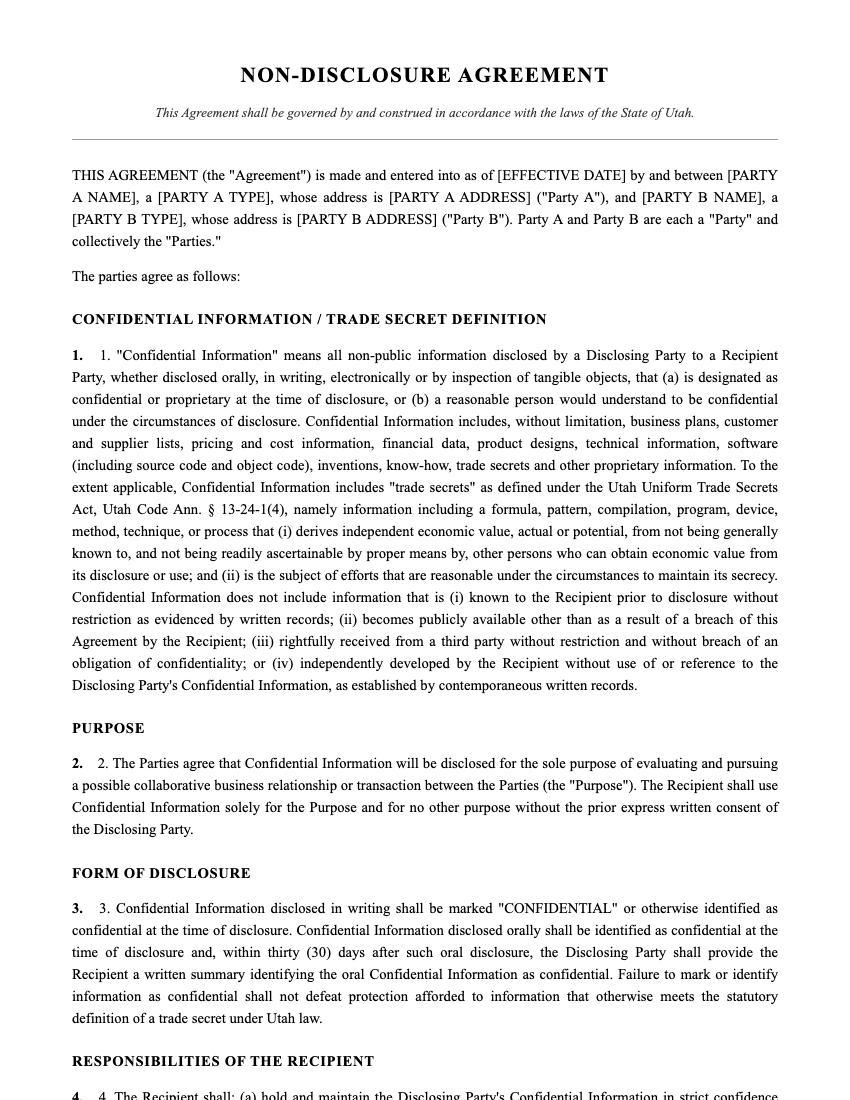
- Definitions: clear separation between "Confidential Information" and "Trade Secrets" to match UUTSA (Utah Code §13-24).
- Duration: two-tier approach—a fixed term (commonly 2–5 years) for general confidential information and indefinite protection for qualifying trade secrets as long as secrecy is maintained.
- Use limitations: restrict use to the stated Purpose; avoid generic “cannot compete” language unless you intend a narrowly tailored non-compete and have provided consideration.
- Non-solicitation add-on (optional): careful geographic and temporal limits; commonly enforceable in Utah if reasonable and supported by business interest.
- Carve-outs: public domain, pre-existing knowledge, independent development, and compelled disclosure (with notice requirement).
- Recordkeeping & marking: requirements to mark confidential documents and log disclosures—supports UUTSA claims.
- Remedies: injunctive relief, damages, and a provision noting federal DTSA whistleblower notice (18 U.S.C. §1833(b)) to protect enhanced remedies in federal trade secret suits.
Who Needs This Document?
| User Persona | Usage Scenario | Key Utah Benefit |
|---|---|---|
| Tech Startups | Fundraising, investor pitches | Protects source code and product roadmaps while allowing mobility in Utah's competitive tech market |
| Software Consultancies | Hiring devs and contractors | Tailors protections to Utah’s reasonableness standard and documents secrecy practices |
| Manufacturers | Sharing drawings with vendors | Preserves trade-secret protection under UUTSA and supports injunctive remedies |
| Small Businesses | M&A due diligence | Enables secure information exchange and preserves contractual remedies under Utah law |
How to Execute a Valid Utah NDA
Step 1: Choose the Type
Decide whether you need a One-Way (Unilateral) NDA or a Mutual NDA. Use One-Way when only one party discloses sensitive details; use Mutual when both sides will share proprietary material.
Step 2: Define the Purpose and Scope
Be specific. A Utah court will scrutinize broad purposes. Instead of "Business discussions," write "Evaluation of potential license of Disclosing Party’s proprietary lithium-ion cell design."
Step 3: Mark & Limit Disclosures
Require physical and electronic marking of confidential materials, limit recipients to "need to know," and document access logs. These steps substantiate the "reasonable efforts" element of UUTSA claims.
Step 4: Sign, Preserve, and Act Promptly
Have the NDA signed before disclosure. Utah recognizes electronic signatures under the Utah Uniform Electronic Transactions Act (UETA). Preserve communications and access logs—Utah’s six-year statute of limitations for written contracts (Utah Code §78B-2-309) gives time, but early action preserves injunctive remedies.
Already Receiving NDAs from Clients?
When presented with a third-party NDA in Utah, look for overbroad non-compete or non-solicitation language, missing carve-outs, or lack of notice provisions to support federal DTSA relief (18 U.S.C. §1833(b)). Use an AI contract review tool to flag risky clauses and compare terms against Utah law quickly.
Related NDA Templates
Get the Template
Sign up for our newsletter to receive the template.
Frequently Asked Questions

About Designer Content
Designer Content creates practical legal document resources for landlords, contractors, and small business owners. We simplify complex legal concepts into actionable guidance. Connect with us on LinkedIn.