
A Venezuela Non-Disclosure Agreement (NDA) is a contract that creates enforceable duties of confidentiality under Venezuela’s civil-law framework (Código Civil) and related statutes. Unlike common‑law U.S. templates that assume federal trade‑secret statutes and distinct state non‑compete doctrines, Venezuelan NDAs must be drafted to reflect civil‑code contract principles, consumer‑protection limits, the country’s currency‑control realities, and the 10‑year prescriptive period (prescripción decenal) that often governs civil claims.
What is a Venezuela NDA?
Definition: Under Venezuelan law, confidentiality obligations arise from agreement between parties and are governed by general contract and obligation rules in the Código Civil (Civil Code) and Código de Comercio (Commercial Code) where applicable. There is no single national "Trade Secrets Act" in the Anglo‑sense; instead, misappropriation claims rely on contractual breach, civil liability (obligaciones y contratos), and — in some cases — criminal provisions for fraud or industrial espionage.
Practically, a valid Venezuelan NDA: (1) identifies the confidential information with sufficient specificity; (2) sets a clear lawful purpose for disclosure; (3) describes permitted uses and recipients; and (4) includes reasonable temporal and geographic limits where restraints are involved. Because Venezuela is a civil‑law jurisdiction, courts give significant weight to good faith (buena fe), fairness, and public policy when interpreting restrictive clauses.
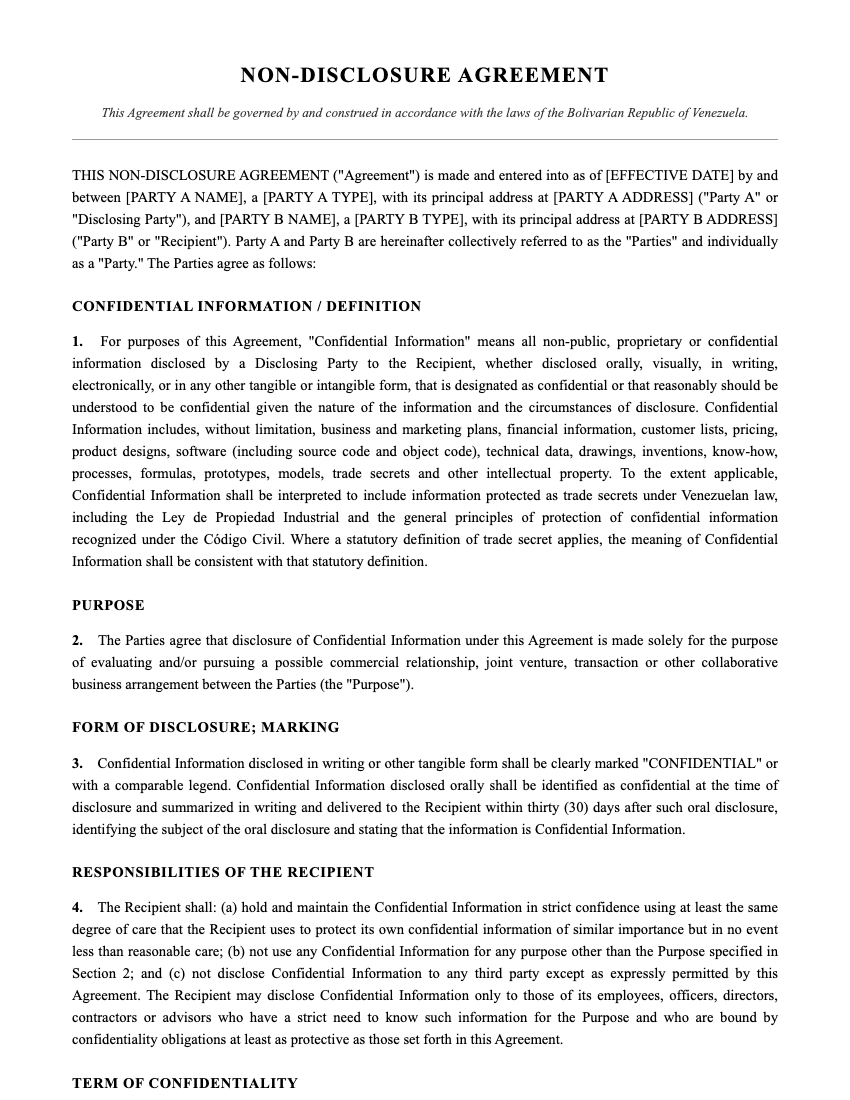
For a complete guide to NDA terms, duration, and standard exclusions, see our NDA Agreement Guide.
Why generic NDA templates are dangerous in Venezuela
Many online NDA templates were drafted for U.S. or common‑law systems. Using them in Venezuela creates specific hazards:
- Lack of statutory trade‑secret framework: Venezuela has no single federal statute mirroring the U.S. Defend Trade Secrets Act. Trade‑secret protection is built from contract law and civil liability principles (Código Civil). Labeling every disclosure a "trade secret" without showing the confidentiality measures and economic value weakens enforcement.
- Consumer‑protection and unfair terms: The Ley para la Protección del Consumidor y el Usuario (consumer protection rules) limits contractual clauses that are abusive versus consumers. If an NDA is presented to or used with consumers or users, overly broad confidentiality terms may be void as abusive clauses.
- Currency‑control and damages enforcement: Venezuela’s history of exchange controls and hyperinflation creates a practical trap: damages or liquidated‑damages clauses denominated in foreign currency, or penalties that are disproportionate, can be difficult to collect or declared contrary to ordre public. You should draft remedies with mechanisms for local currency conversion and reference to enforceable forms of security.
Paradigm‑shifting insight: In Venezuela, the real risk is not a statutory non‑compete ban — it’s enforcement uncertainty caused by public‑policy review, currency controls, and the prescripción decenal. NDAs that (a) try to be unlimited in scope, (b) impose large foreign‑currency penalties, or (c) ignore evidentiary formalities (e.g., notarization, clear designation of documents) are the ones courts will strike down or treat as unenforceable. In short: the drafting trap in Venezuela is economic‑and‑procedural, not doctrinal.
Real case study: Venezuelan courts routinely apply Civil Code principles of buena fe and proportionality when reviewing contractual restraints. For example, decisions of civil tribunals have nullified contractual penalties deemed manifestly excessive or contrary to public order (orden público contractual). Although decisions vary by court, practitioners rely on those precedents to negotiate reasonable limits, not absolute prohibitions. (See sources below for tribunal and legislative texts.)
Key clauses to adapt for Venezuela
- Precise Definition of Confidential Information: Tie protected categories to examples and require identification (e.g., "confidential information which is designated in writing as CONFIDENTIAL within X days"). This evidence‑focused approach aligns with civil‑law proof expectations.
- Purpose and Use Limitations: State a narrow objective (e.g., "evaluating Project X procurement cooperation") to avoid being labeled an unlawful restraint on trade.
- Duration: Use a two‑tier approach. Non‑secret confidential information: 2–5 years. Genuine trade secrets (demonstrable economic value and secrecy measures): indefinite protection while secrecy is maintained. Avoid blanket, unlimited durations without justification.
- Exclusions: Ordinary carve‑outs (public domain, prior known, independently developed, compelled disclosure) are essential and expected by Venezuelan courts.
- Remedies and Damages: Prefer liquidated damages clause with a capped amount, expressed in local currency with an agreed conversion method to foreign currency if required. Include mitigation obligations and specify jurisdiction (Venezuelan courts or arbitration) and competent forum.
- Evidence and Formalities: Add clauses about marking documents, contemporaneous logs, and optionally notarized signatures or authenticated copies — these improve evidence in civil proceedings.
Who needs this document?
| User Persona | Usage in Venezuela | Key benefit |
|---|---|---|
| Local SMEs | Selling local know‑how to suppliers | Protects processes while addressing currency/damages enforcement |
| Tech startups | Sharing software, algorithms with contractors | Focuses on concrete secrecy measures rather than broad "trade secret" labels |
| Foreign investors | Due diligence on Venezuelan target | Ensures confidentiality while negotiating repatriation/currency clauses |
| Manufacturers | Sharing designs with local subcontractors | Provides evidentiary steps (marking, notarization) to prove misappropriation |
How to execute a valid Venezuela NDA (practical 4 steps)
- Choose the right type: One‑way (unilateral) when only you disclose; mutual when both parties exchange sensitive information (M&A, partnerships).
- Narrow the Purpose: Avoid vague labels. Write a specific commercial purpose tied to the project or transaction to limit scope and make enforcement credible.
- Take documentary steps: Mark documents, keep distribution logs, require returning or destroying copies. Consider notarizing signature pages for high‑value disclosures to strengthen evidence.
- Agree remedies sensibly: Cap liquidated damages, choose local currency or an agreed conversion method, and select forum (Venezuelan courts or binding arbitration) — remember prescripción decenal may limit brought claims after 10 years.
Receiving an NDA from a client?
If someone sends you an NDA, look for abusive terms, foreign‑currency penalty traps, overly broad perpetual confidentiality, or clauses attempting to waive consumer or statutory protections. Negotiate specificity, reasonable durations, and practical evidence steps.
an AI contract review tool: Our an AI contract review tool tool flags risky clauses against Venezuela’s civil‑law norms — it highlights vague definitions, disproportionate penalties, and missing evidence formalities so you can negotiate from a position of knowledge.
Related NDA Templates
Get the Template
Sign up for our newsletter to receive the template.
Frequently Asked Questions

About Designer Content
Designer Content creates practical legal document resources for landlords, contractors, and small business owners. We simplify complex legal concepts into actionable guidance. Connect with us on LinkedIn.