
A Vermont Master Services Agreement (MSA) is a reusable contract that sets the baseline legal terms for ongoing services in Vermont, so you can issue quick Statements of Work (SOWs) for each project without renegotiating the entire deal. If you sell services—consulting, marketing, software development, IT support, or agency retainers—an MSA helps you control scope creep, speed up approvals, and keep payment and IP terms consistent. Vermont-specific details matter: worker classification rules, venue in Vermont Superior Court, late-payment interest standards, and consumer protection compliance can all make a “generic” template risky. This post explains what to include and why.
Definition: A Vermont Master Services Agreement (MSA) is a governing contract between a service provider and a client that establishes the core legal terms—such as payment, confidentiality, intellectual property ownership, liability limits, and dispute resolution—under Vermont law. Individual projects are then described in separate Statements of Work (SOWs) that reference the MSA. In practice, the MSA acts as the umbrella document: you sign it once, then attach new SOWs as your relationship evolves. A Vermont-focused MSA also anticipates state-specific issues like worker classification, enforceability limits on restrictive covenants, and the forum and timing rules that affect how disputes are handled.
Why You Cannot Use a Generic MSA in Vermont
Many online MSAs are written for “any U.S. state.” That sounds convenient, but Vermont has its own rules that change what is enforceable, what creates risk, and what you should document up front. A template that defaults to Delaware law, includes broad non-competes, or misstates independent-contractor status can create expensive problems—especially if you are a small business without in-house counsel.
3a. Worker Classification Rules
Vermont does not treat “independent contractor” as a label you can choose just because your contract says so. For unemployment insurance purposes, Vermont uses an ABC-style test in 21 V.S.A. § 1301(6) (employment for unemployment compensation), which generally presumes a worker is an employee unless the hiring entity can satisfy required factors (including freedom from control and an independently established trade/business). Vermont also has wage-and-hour enforcement mechanisms through the Department of Labor under 21 V.S.A. Chapter 5 (wages), and misclassification can trigger investigations, back wages, and other administrative consequences.
For a comprehensive guide to structuring MSAs and SOWs that protect your business, see our Freelancer Contracts Guide.
Why it matters for an MSA: a generic template often includes heavy “control” language (set hours, mandatory daily check-ins, required tools/processes) that undermines contractor status. A Vermont-ready MSA should clearly state the contractor’s independence, allow discretion over manner and means, and push project specifics into an SOW focused on deliverables rather than supervision. It should also require the contractor to handle their own taxes and insurance and to represent that they maintain an independent business. Even if you do everything right, classification is fact-driven; the contract is evidence, not a shield.
3b. Non-Compete Enforceability
Unlike some states with sweeping statutory bans, Vermont generally evaluates non-competes under a reasonableness framework developed in case law. Vermont courts have enforced restrictive covenants when they are narrowly tailored to protect legitimate business interests (like confidential information, customer relationships, or specialized training) and are reasonable in duration, geography, and scope of restricted activity. However, overly broad restrictions can be narrowed or rejected, and courts will scrutinize whether the restraint is greater than necessary.
A “generic” MSA often inserts a one-size-fits-all non-compete that prohibits competing “anywhere in the United States for two years.” That is the type of clause that invites a fight—and in practice can poison negotiations with sophisticated clients and contractors. A Vermont-appropriate approach for most service providers is to avoid broad non-competes and instead use enforceable alternatives: (1) a strong confidentiality and trade secret clause, (2) a narrow non-solicitation clause focused on active customers you worked with, and (3) an IP and work product clause that prevents reuse of proprietary deliverables. If you do need a restrictive covenant (for example, a sale-of-business context or truly sensitive client access), keep it narrow, time-limited, and tied to a documented legitimate interest. In Vermont, the drafting is the strategy.
3c. IP/Work-for-Hire Considerations
Most Vermont MSAs should treat intellectual property using federal copyright concepts plus clear contractual assignment language. Under the U.S. Copyright Act, “work made for hire” is limited to employees within scope of employment or certain commissioned works that meet statutory categories and require a signed written agreement. Many service relationships won’t qualify, so relying on “work for hire” language alone can leave the client without ownership. A Vermont-specific template should use a belt-and-suspenders approach: confidentiality + a present-tense assignment of deliverables/IP upon payment, plus a license back (if needed) for the provider’s pre-existing tools. This also helps avoid disputes years later when a client wants to reuse materials or sell a product.
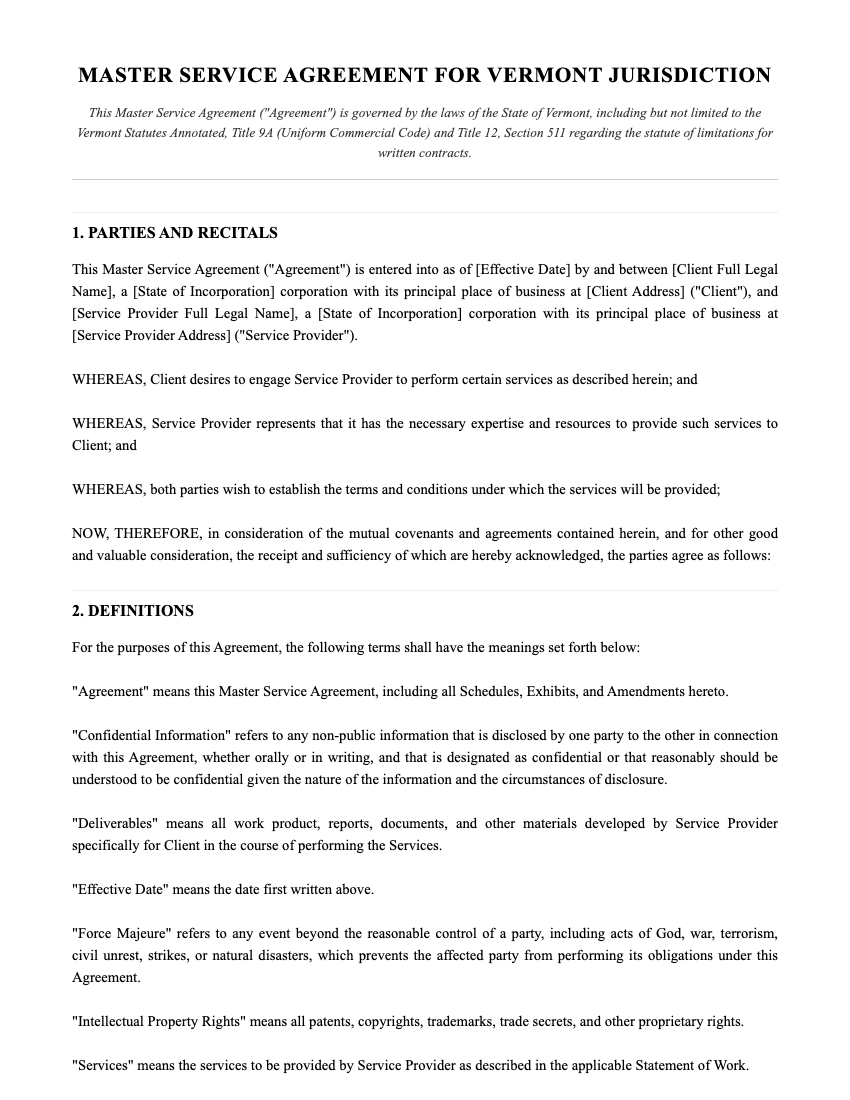
What's Included in This Template
Flexible SOW Structure. The template is built to separate “legal framework” from “project details.” Your MSA handles confidentiality, payment defaults, IP, liability, and dispute resolution, while each SOW lists scope, milestones, acceptance criteria, and pricing. This reduces renegotiation and prevents scope creep.
Vermont-Specific Indemnification. The indemnity section is balanced for typical B2B services and includes common carve-outs (for example, client-provided materials, third-party instructions, and the other party’s negligence). It also pairs indemnity with a realistic limitation-of-liability clause to keep risk proportional to fees.
Dispute Resolution and Venue. The template sets governing law as Vermont and venue in the Superior Court of Vermont, helping you avoid being dragged into an out-of-state forum buried in a client’s paper. It also includes notice-and-cure and escalation steps to encourage early resolution.
Additional Vermont-focused provisions include:
- Statute of limitations awareness for written contracts (12 V.S.A. § 511) so parties understand timing expectations for claims.
- Late-payment interest aligned to Vermont’s legal interest rate framework (9 V.S.A. § 41a) and clear invoicing/payment timelines.
- Consumer protection guardrails where a transaction could implicate the Vermont Consumer Protection Act (9 V.S.A. Chapter 63) (even if you are primarily B2B).
- Data privacy and security clause referencing Vermont’s privacy and security expectations (see Vermont’s Data Privacy and related security breach requirements) and allocating responsibilities.
- Anti-corruption compliance representations tied to the U.S. Foreign Corrupt Practices Act for cross-border or government-adjacent work.
Who Needs This Document?
| User Type | Relationship | Key Benefit |
|---|---|---|
| Marketing agencies | Ongoing retainer + periodic campaigns | Faster SOW approvals and consistent scope-change rules |
| IT/MSP providers | Monthly support with add-on projects | Clear service boundaries, SLAs in SOWs, and liability caps |
| Software developers | Milestone projects and maintenance | IP assignment upon payment and acceptance criteria |
| Consultants/freelancers | Repeated advisory engagements | Clean payment terms, expenses policy, and dispute venue in Vermont |
How to Use This MSA Template
Step 1: Identify the parties correctly
Use exact legal names (LLC/corporation/individual) and Vermont business addresses. If a client is out-of-state, list the registered entity name and state of formation to avoid enforcement problems later.
Step 2: Set the term and termination mechanics
Choose a fixed term (e.g., 12 months) or an evergreen term with notice. The termination clause should address what happens to in-flight SOWs, outstanding invoices, and return/destruction of confidential information.
Step 3: Attach your first Statement of Work (SOW)
Put deliverables, deadlines, acceptance tests, and pricing in the SOW—not the MSA. This keeps your MSA stable over time and makes it easy to start new projects without rewriting legal terms.
Step 4: Sign once, then reuse
After execution, treat the MSA as your standard terms for that client. Each new project should be a new SOW referencing the MSA, so changes are limited to business points rather than legal boilerplate.
Related MSA Templates
Get the Template
Sign up for our newsletter to receive the template.
Frequently Asked Questions

About Designer Content
Designer Content creates practical legal document resources for landlords, contractors, and small business owners. We simplify complex legal concepts into actionable guidance. Connect with us on LinkedIn.