
A Vermont Non-Disclosure Agreement (NDA) is a contract used to protect confidential business information, trade secrets, and proprietary know‑how while fitting Vermont’s contract and consumer-protection framework. NDAs in Vermont are enforced under general contract principles; certain local traps—like statute of limitations rules, consumer-protection limits, and federal DTSA requirements—are easy to miss if you use a generic template.
What Is a Vermont NDA?
Definition: A Vermont NDA is a contract in which a Disclosing Party defines Confidential Information and obliges a Receiving Party to limit use and disclosure. Unlike some states that ban or heavily regulate non-competes, Vermont enforces restrictive covenants under a reasonableness standard, but NDAs are primarily about confidentiality, trade-secret protection, and permitted disclosures.
Key legal touchpoints for Vermont NDAs:
- Statute of limitations for written contracts: 12 V.S.A. § 511 provides a six‑year limitations period for written contract claims (important for breach-of-contract damages).
- Consumer protections: The Vermont Consumer Protection Act (9 V.S.A. § 2451 et seq.) can make an NDA unenforceable against consumers or employees when it attempts to conceal unlawful conduct or limits statutory rights.
- Federal trade secrets: The Defend Trade Secrets Act (18 U.S.C. § 1836) provides a federal cause of action and requires a whistleblower‑notice clause to preserve entitlement to exemplary damages and attorneys’ fees in some cases.
For a complete guide to NDA terms, duration, and standard exclusions, see our NDA Agreement Guide.
Why Generic NDAs Are Dangerous in Vermont
Most off‑the‑shelf NDA forms were drafted with national “one‑size‑fits‑all” language. In Vermont that creates three specific risks:
- Statute-of-limitations mismatch. Many templates assume shorter tort limitations or rely only on oral-contract rules. For written NDAs, Vermont’s six‑year rule (12 V.S.A. § 511) governs breach claims—affecting damages windows and practical litigation strategy.
- Consumer‑protection exposure. The Vermont Attorney General enforces the Vermont Consumer Protection Act. NDAs that attempt to silence consumers, victims of fraud, or restrict reporting of unfair or deceptive practices may be found unconscionable or unenforceable under 9 V.S.A. § 2451 et seq.
- Missing DTSA notice. If you ever plan to assert trade secret claims in federal court, the Defend Trade Secrets Act rewards plaintiffs with enhanced damages and fee-shifting only where confidentiality agreements include notice of whistleblower rights (18 U.S.C. § 1833(b)). A standard template often omits that notice and can materially reduce recoverable remedies.
Paradigm‑shifting insight for Vermont: the “six‑year window” trap. Many lawyers and startups budget around three‑year tort limitations or look to federal statutes; in Vermont, written‑contract claims for NDA breaches sit on a six‑year clock under 12 V.S.A. § 511. That affects how you draft survival periods, remedy clauses, and limitation-of-damages provisions: claiming an overly short survival period or forcing disputes into a short contract window can unintentionally waive your longer statutory protection.
Real case study: While Vermont does not have a single landmark NDA decision like some larger states, national trends affect Vermont practice. Practitioners routinely rely on federal DTSA rulings for trade‑secret procedure and remedies, and Vermont courts apply standard reasonableness analysis to restrictive covenants and confidentiality obligations. For state enforcement trends, national compendia (e.g., NCSL summaries) confirm Vermont enforces non‑competes under a reasonableness test—so confidentiality provisions that function like a restraint on trade should be separately negotiated and narrowly tailored.
What’s Included in This Template (Key Clauses)
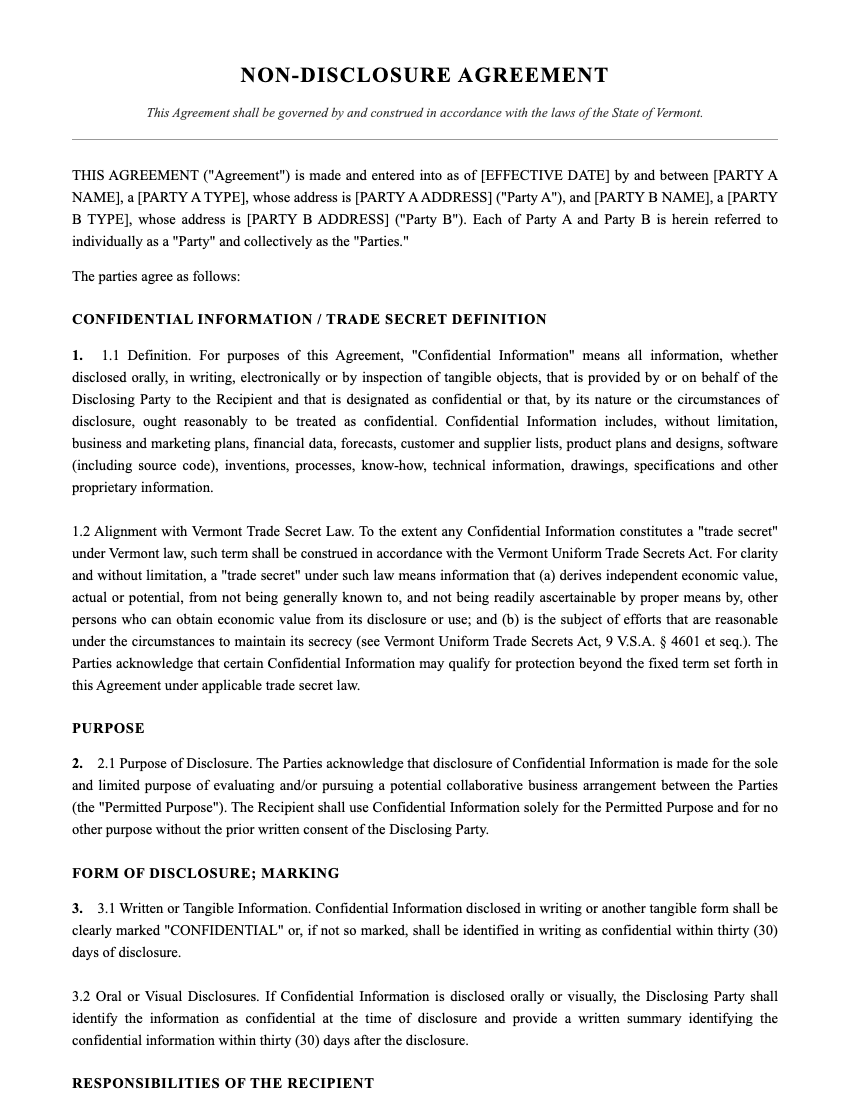
- Clear definition of "Confidential Information" with trade‑secret carve‑outs and examples (source code, customer lists, pricing models).
- Two-tier protection periods: a fixed term for ordinary confidential information (customizable 2–5 years) and an indefinite survival for bona fide trade secrets (as long as they remain secret).
- DTSA whistleblower notice language to preserve federal remedies (18 U.S.C. § 1833(b)).
- Exclusions: publicly known information, prior knowledge, independently developed materials, and compelled disclosures.
- Purpose limitation: narrow permitted use (e.g., "evaluation of a strategic partnership concerning Project X").
- Remedies and limitations: injunctive relief, damages, and an explicit statement about the six‑year written‑contract statute of limitations (12 V.S.A. § 511) for clarity.
- Optional mutual vs. unilateral formats and an optional residuals clause (ideas retained in unaided memory).
Who Needs This Document?
| User Persona | Usage Scenario | Key Vermont Benefit |
|---|---|---|
| Vermont startups | Pitching to investors or contractors | Keeps investor diligence confidential while clarifying survival tied to 12 V.S.A. § 511 |
| Manufacturing & craft businesses | Sharing designs with local factories | Protects trade secrets indefinitely while fitting Vermont contract law |
| Professional service firms | Onboarding contractors and consultants | Limits reuse of client lists, with narrowly tailored restraints if needed |
| Consumer‑facing companies | Settling consumer disputes or collecting feedback | Avoids overbroad consumer silencing that may violate 9 V.S.A. § 2451 et seq. |
How to Execute a Valid Vermont NDA
Step 1: Choose mutual or unilateral. Pick unilateral if only you disclose; choose mutual for two‑way exchanges.
Step 2: Be precise about Purpose and Confidential Information. Vagueness invites litigation; courts favor specific, reasonable definitions.
Step 3: Include DTSA notice and survival language. Add the federal whistleblower notice (18 U.S.C. § 1833(b)) and expressly state survival tied to trade‑secret status and Vermont’s six‑year written‑contract limitations (12 V.S.A. § 511).
Step 4: Sign before sharing and use clear evidence. Vermont enforces electronic signatures; use e‑signatures or signed PDFs and retain email evidence showing dates and recipients.
Receiving an NDA from Someone Else?
When a client or partner sends you an NDA, watch for clauses that: (a) attempt to prevent reporting illegal or deceptive conduct (potentially unenforceable under 9 V.S.A. § 2451 et seq.); (b) slip in broad non‑compete language; or (c) omit DTSA notice. Use an AI contract review tool to automatically flag risky Vermont‑relevant provisions, compare terms to local law, and accelerate negotiation.
Related NDA Templates
Get the Template
Sign up for our newsletter to receive the template.
Frequently Asked Questions

About Designer Content
Designer Content creates practical legal document resources for landlords, contractors, and small business owners. We simplify complex legal concepts into actionable guidance. Connect with us on LinkedIn.