
A Virginia Master Services Agreement (MSA) is a reusable contract that sets the baseline legal terms for ongoing B2B services in Virginia, so you can add projects later using short Statements of Work (SOWs). For SMB owners, consultants, and agencies, an MSA is the “umbrella” document that controls billing, intellectual property, confidentiality, and dispute resolution—without renegotiating everything each time. A Virginia-ready MSA should also reflect the Commonwealth’s rules on independent contractor classification, non-competes (especially for low-wage workers), and state privacy/security requirements.
Definition: A Virginia Master Services Agreement is a governing contract between a service provider and a client that establishes standard terms—scope framework, fees, ownership of work product, confidentiality, liability allocation, and dispute resolution—under Virginia law. Individual projects are then documented in separate Statements of Work (SOWs) that incorporate the MSA by reference. This structure speeds up sales cycles because you negotiate the “legal backbone” once and only update business details (deliverables, milestones, pricing) in each SOW. For Virginia parties, a strong MSA also anticipates Virginia’s contract enforcement rules, including the statute of limitations for written contracts (Va. Code § 8.01-246).
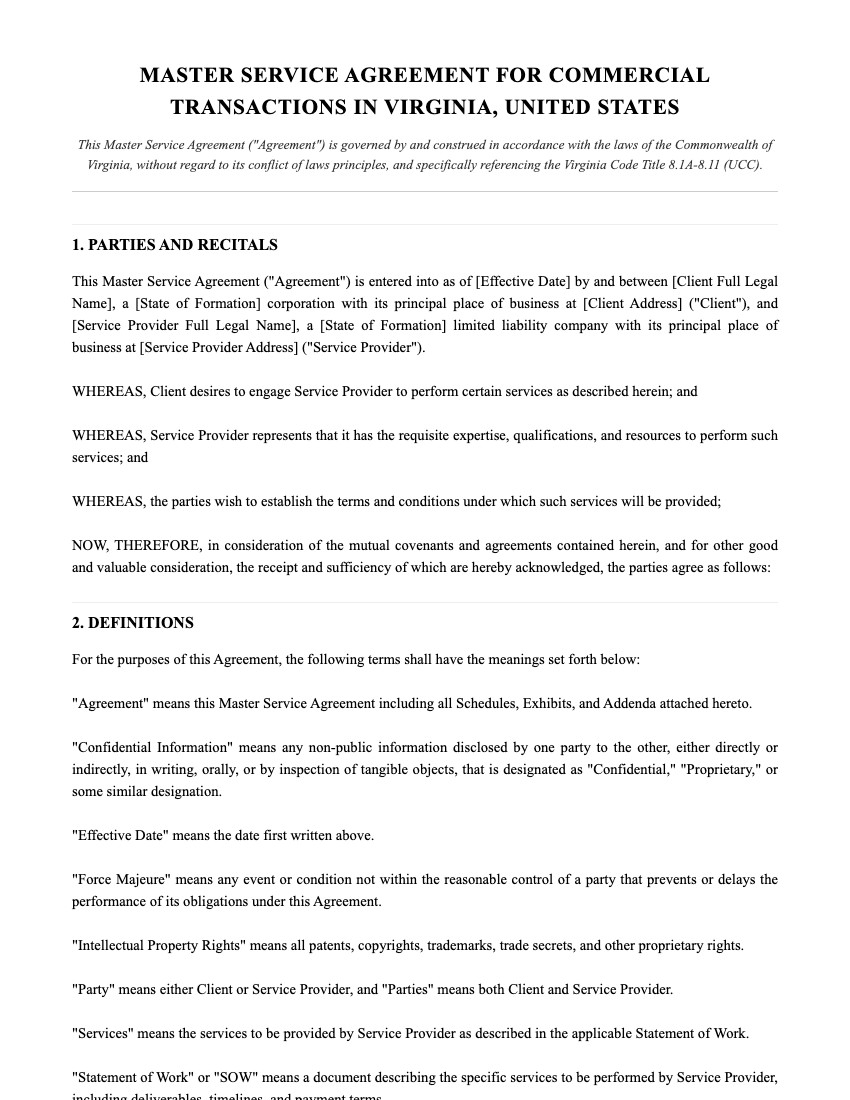
Why You Cannot Use a Generic MSA in Virginia
Generic MSAs are often drafted for “national use,” which sounds convenient until a dispute arises. Virginia is generally contract-friendly, but it has specific rules that can make boilerplate language risky—especially around worker classification, restrictive covenants, and ownership of deliverables. A Virginia-specific template helps you (1) reduce enforceability fights, (2) allocate risk predictably, and (3) avoid compliance gaps that are easy to miss when you copy a form from another state.
3a. Worker Classification Rules
Virginia does not use California’s ABC test as a universal standard for all contexts. Instead, Virginia commonly applies a common-law ‘right to control’ approach when analyzing whether a worker is an employee or an independent contractor, focusing on who controls the manner and means of the work. For unemployment and workforce enforcement, Virginia also has targeted statutes addressing misclassification. For example, Va. Code § 40.1-28.7:7 prohibits an employer from knowingly misclassifying an individual as an independent contractor to avoid obligations under Virginia law, and it authorizes civil penalties. Virginia further requires certain employers in construction to use E-Verify (Va. Code § 40.1-11.2) and has specific “employee vs. contractor” scrutiny in that industry.
For a comprehensive guide to structuring MSAs and SOWs that protect your business, see our Freelancer Contracts Guide.
In an MSA, classification language matters, but it is not magic. If your SOW reads like an employment arrangement—fixed hours, daily supervision, mandatory tools, exclusive service—labels won’t save you. A Virginia-ready template should include (1) independent contractor representations, (2) a clear “no benefits/taxes withheld” allocation, and (3) operational guardrails (e.g., provider controls methods; client controls deliverables) to match Virginia’s control-based analysis. Misclassification can lead to tax, wage, unemployment insurance, and penalty exposure beyond the contract itself.
3b. Non-Compete Enforceability
Virginia can enforce non-competes, but enforcement is narrow and fact-specific. Courts generally require restrictive covenants to be reasonable and no broader than necessary to protect legitimate business interests; overly broad clauses are at high risk because Virginia courts often will not “blue pencil” an unreasonable restriction to make it reasonable. Practically, that means your MSA should avoid one-size-fits-all non-competes and instead use tailored restrictions that match the role, customer relationships, and confidential information actually at issue.
Virginia also has a major statutory limit: Va. Code § 40.1-28.7:8 prohibits employers from entering into, enforcing, or threatening to enforce a covenant not to compete against a “low-wage employee” as defined by the statute (including certain interns and contractors in some circumstances). Even if you are a B2B services firm, this statute can become relevant if your “contractor” is later argued to be functionally a low-wage employee, or if you use employment-style restrictive covenants in a services contract.
For many Virginia SMBs, the safer alternative is to replace broad non-competes with enforceable protections: (1) robust confidentiality and trade secret terms, (2) narrow non-solicitation of customers tied to accounts the provider actually worked on, and (3) return/destruction of data and credential access controls at termination. Your template should clearly define “Confidential Information,” include survival periods, and specify injunctive relief language consistent with Virginia practice.
3c. IP/Work-for-Hire Considerations
Virginia does not have a unique “work for hire” statute for general business services; copyright “work made for hire” is mainly a federal concept (17 U.S.C. § 101). The Virginia-specific risk is practical: generic MSAs often rely only on “work made for hire” language, which may fail if the relationship does not fit federal categories. A Virginia-ready MSA should include a belt-and-suspenders approach: (1) “work made for hire” where applicable and (2) a present-tense assignment (“hereby assigns”) of all right, title, and interest in deliverables upon payment (or upon creation, depending on your deal). Also address pre-existing materials and open-source components to avoid accidental transfer or licensing conflicts.
What’s Included in This Template
Flexible SOW Structure. The template separates the legal terms (MSA) from business specifics (SOW). You sign the MSA once, then issue short SOWs for each project—scope, timeline, acceptance criteria, and fees—without reopening liability, confidentiality, or dispute provisions every time.
Virginia-Specific Indemnification. Indemnity is drafted for B2B services with clear triggers (third-party claims, IP infringement, bodily injury/property damage) and common carve-outs (client-provided materials, misuse, unauthorized changes). It aligns risk with control and is designed to be enforceable under Virginia’s contract-friendly common law.
Dispute Resolution and Venue. The template uses Virginia governing law and sets venue in Richmond, Virginia (state or federal courts located there), reducing the cost of out-of-state litigation. This is especially helpful when clients try to impose Delaware or New York venue clauses that raise your enforcement costs.
Additional Virginia provisions included:
- Written-contract limitations awareness: Va. Code § 8.01-246 (statute of limitations for written contracts)
- Late payment interest framework: Va. Code § 6.2-301 (legal rate of interest as a reference point)
- Data security/privacy alignment: Virginia Consumer Data Protection Act, Va. Code § 59.1-571 et seq.
- Non-compete restriction for low-wage workers: Va. Code § 40.1-28.7:8
Who Needs This Document?
| User Type | Relationship | Key Benefit |
|---|---|---|
| Marketing/Creative Agencies | Retainers + multiple campaigns | MSA once, then SOWs per campaign to prevent scope creep |
| IT Managed Service Providers | Ongoing support + projects | Clear SLAs in SOWs and predictable liability limits |
| Consultants (Ops/Finance/HR) | Advisory engagements | Defines deliverables vs. advice; controls reliance and payment terms |
| Software Developers/Dev Shops | Build + maintenance phases | IP assignment, acceptance testing, and change-order process |
How to Use This MSA Template
Step 1: Identify the Parties Correctly
Use the exact legal names and entity types (LLC, corporation, sole proprietor) and include Virginia addresses. If the client is out of state, still specify Virginia governing law if that’s your negotiation goal.
Step 2: Set the Term and Termination Mechanics
Choose a fixed term (e.g., 12 months) or evergreen with notice termination. Include what happens to in-flight SOWs, final invoices, and data return obligations when either party terminates.
Step 3: Attach Your First Statement of Work (SOW)
Keep deliverables out of the MSA. Put scope, milestones, acceptance criteria, pricing, and assumptions into the SOW so each project is clear and measurable.
Step 4: Sign Once, Then Reuse
After signatures, reuse the same MSA for future work. Each new SOW should say it is governed by (and incorporated into) the MSA, so your core protections stay consistent.
Related MSA Templates
Get the Template
Sign up for our newsletter to receive the template.
Frequently Asked Questions

About Designer Content
Designer Content creates practical legal document resources for landlords, contractors, and small business owners. We simplify complex legal concepts into actionable guidance. Connect with us on LinkedIn.