
A Virginia Non-Disclosure Agreement (NDA) is a contract that protects trade secrets and other confidential information in transactions and employment relationships while conforming to Virginia law. Unlike jurisdictions that broadly prohibit certain restraints, Virginia enforces confidentiality and reasonable restraints where they protect legitimate business interests such as trade secrets, customer lists, or proprietary processes.
What Is a Virginia NDA?
Definition: A Virginia Non-Disclosure Agreement is a contract in which the receiving party agrees not to disclose or misuse information defined as Confidential Information or Trade Secrets. Trade secret protection in Virginia is governed by the Virginia Uniform Trade Secrets Act (VUTSA) — codified at Va. Code § 59.1-336 et seq. — and by the federal Defend Trade Secrets Act (DTSA) when federal claims are available.
A Virginia NDA should clearly separate general confidential information (time-limited protection) from bona fide trade secrets (protected so long as secrecy is maintained). It should also be tailored so any restrictions are "reasonable" in scope, duration, and geographic reach — a core principle Virginia courts apply when evaluating enforceability.
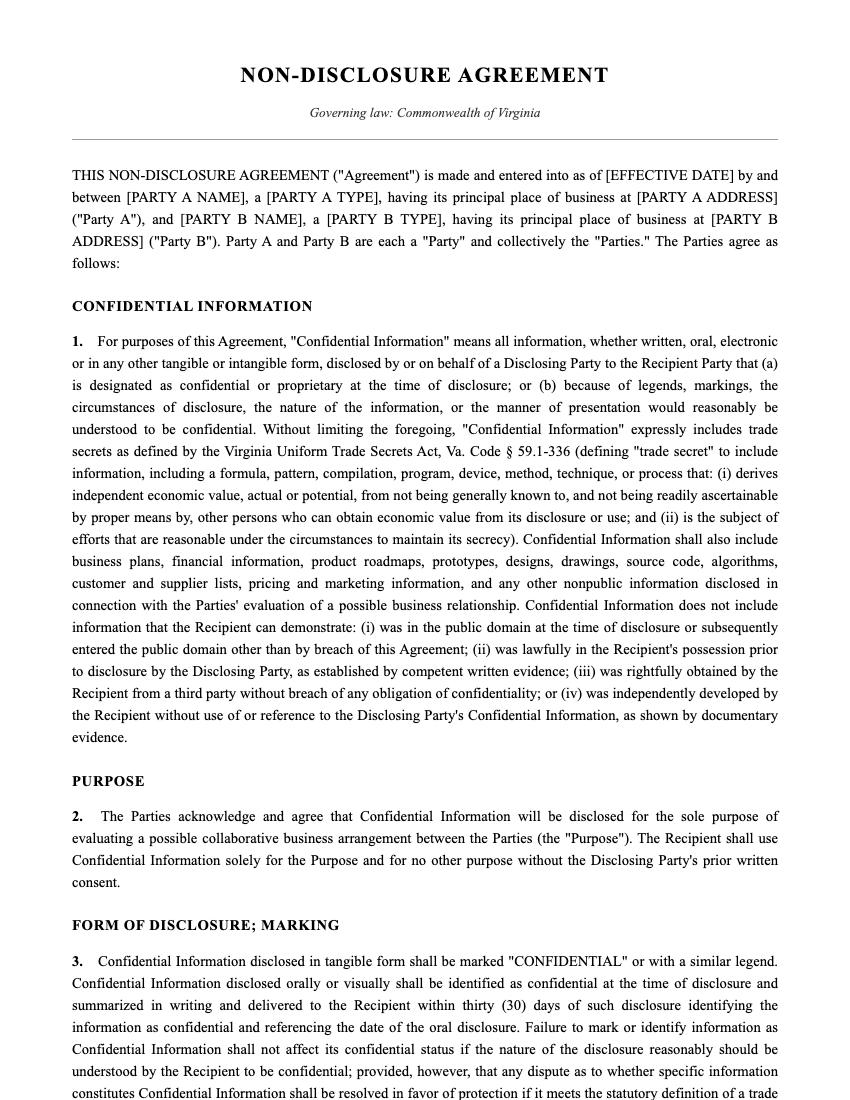
For a complete guide to NDA terms, duration, and standard exclusions, see our NDA Agreement Guide.
Why "Generic" NDAs Are Dangerous in Virginia
Many free NDA templates are written for jurisdictions with different emphases on
enforceability. Using them in Virginia creates several risks:
- Overbroad "no-use" language: Virginia courts will enforce restrictions that protect legitimate business interests but reject or reform provisions that unreasonably prevent a person from using general skills or performing their profession. If your NDA uses catch-all language that forbids any competitive activity, a court may deny enforcement or rewrite the term.
- Missing DTSA whistleblower notice: Like many states, Virginia is subject to the federal Defend Trade Secrets Act. To recover enhanced damages and attorney's fees under DTSA, the owner should include the DTSA whistleblower notice (per 18 U.S.C. § 1833(b)) in employee and contractor NDAs. Many templates omit this and lose valuable remedies.
- Personal data obligations under VCDPA: Since the Virginia Consumer Data Protection Act (Va. Code § 59.1-571 et seq.) became effective, NDAs that transfer or process personal data must align with controller/processor duties, data minimization, and consumer rights. A confidentiality clause that instructs parties to hide data-handling practices or avoid disclosures required by VCDPA can create legal conflict.
Paradigm-shifting insight for Virginia
Virginia is not a non-compete-free state. The shift many companies miss is: NDAs in Virginia are often used as enforcement-friendly instruments to protect mobility-sensitive interests when drafted correctly. That means two things:
- Properly scoped "use" restrictions tied to trade secrets, customer relationships, or confidential business plans are typically enforceable.
- But courts will not allow NDAs to operate as de facto non-competes by preventing someone from using their general skills or earning a living. The drafting discipline is to tie restrictions to identifiable confidential materials and to set reasonable durations.
If you draft an NDA that protects real, verifiable interests, Virginia courts will generally uphold it. If you draft vague, unlimited prohibitions, you risk a court striking or reforming the clause — and losing remedies.
Real statutory development: VCDPA and what it means for NDAs
The Virginia Consumer Data Protection Act (VCDPA) (Va. Code § 59.1-571 et seq.), effective January 1, 2023, requires businesses to be transparent about consumer data use and to honor certain consumer rights. NDAs used in due diligence or joint development must not attempt to conceal data processing practices or bar disclosures needed to comply with consumer requests or regulator inquiries. This statutory change has immediate drafting consequences for NDAs that touch personal data.
Federal DTSA requirements (18 U.S.C. § 1833(b)) also remain crucial — include the DTSA whistleblower notice to preserve enhanced remedies.
Key Clauses (and how we adapted them for Virginia)
- Confidential Information definition: Tiered definition distinguishing Non‑Trade Confidential Information (2–5 year protection window) from Trade Secrets (protected indefinitely while secret), reflecting VUTSA (Va. Code § 59.1-336 et seq.).
- Permitted use / Purpose clause: Narrow the permitted uses (e.g., "evaluating a potential supply agreement for Project X") — necessary under Virginia reasonableness standards.
- Non-disparagement and residuals: Optional residuals clause that allows unaided-memory use of general skills; Virginia courts dislike absolute bans on ordinary knowledge retained in memory.
- DTSA whistleblower notice: Specific language to preserve federal remedies (18 U.S.C. § 1833(b)).
- Data handling and VCDPA compliance: Clauses requiring parties to comply with Va. Code § 59.1-571 et seq. when personal data is involved; carve-outs for regulatory disclosure.
- Remedies and limitation periods: Note that written-contract claims in Virginia are subject to a five-year limitations period (Va. Code § 8.01-246); trade secret claims may have different accrual rules under VUTSA and DTSA.
Who Needs This Document?
| User Persona | Usage Scenario | Key Benefit |
|---|---|---|
| SaaS Startups | Sharing technical roadmaps with partners | Protects source code, roadmaps, and customer lists while allowing developers to keep career mobility |
| Recruiters & Employers | Onboarding employees and contractors | Captures trade-secret notice and DTSA language without functioning as a hidden non-compete |
| Sellers in M&A | Due diligence exchanges | Enables safe file sharing while preserving VCDPA and trade-secret compliance |
| Manufacturers | Sending designs to overseas suppliers | Safeguards design specs and enforces remedies under VUTSA and DTSA |
How to Execute a Valid Virginia NDA
- Pick the right form (One‑Way vs. Mutual). Use One‑Way if only you disclose; Mutual if both sides share confidential data.
- Define Purpose narrowly. Tie permitted use to a concrete project so courts can judge reasonableness.
- Mark and secure documents. Use "CONFIDENTIAL" stamps, track access, and log disclosures to demonstrate reasonable secrecy efforts under VUTSA.
- Sign before sharing. Virginia recognizes electronic signatures under the federal E‑SIGN Act (15 U.S.C. § 7001) and Virginia's UETA — include signature blocks and use DocuSign or a signed PDF to create a clean record.
Already Receiving NDAs from Clients?
If a client sends you an NDA, watch for overbroad "use" or "no-compete"-style language, missing DTSA notice, and clauses that improperly limit VCDPA-required disclosures. an AI contract review tool can quickly flag risky provisions against Virginia law and suggest edits.
Related NDA Templates
Get the Template
Sign up for our newsletter to receive the template.
Frequently Asked Questions

About Designer Content
Designer Content creates practical legal document resources for landlords, contractors, and small business owners. We simplify complex legal concepts into actionable guidance. Connect with us on LinkedIn.