
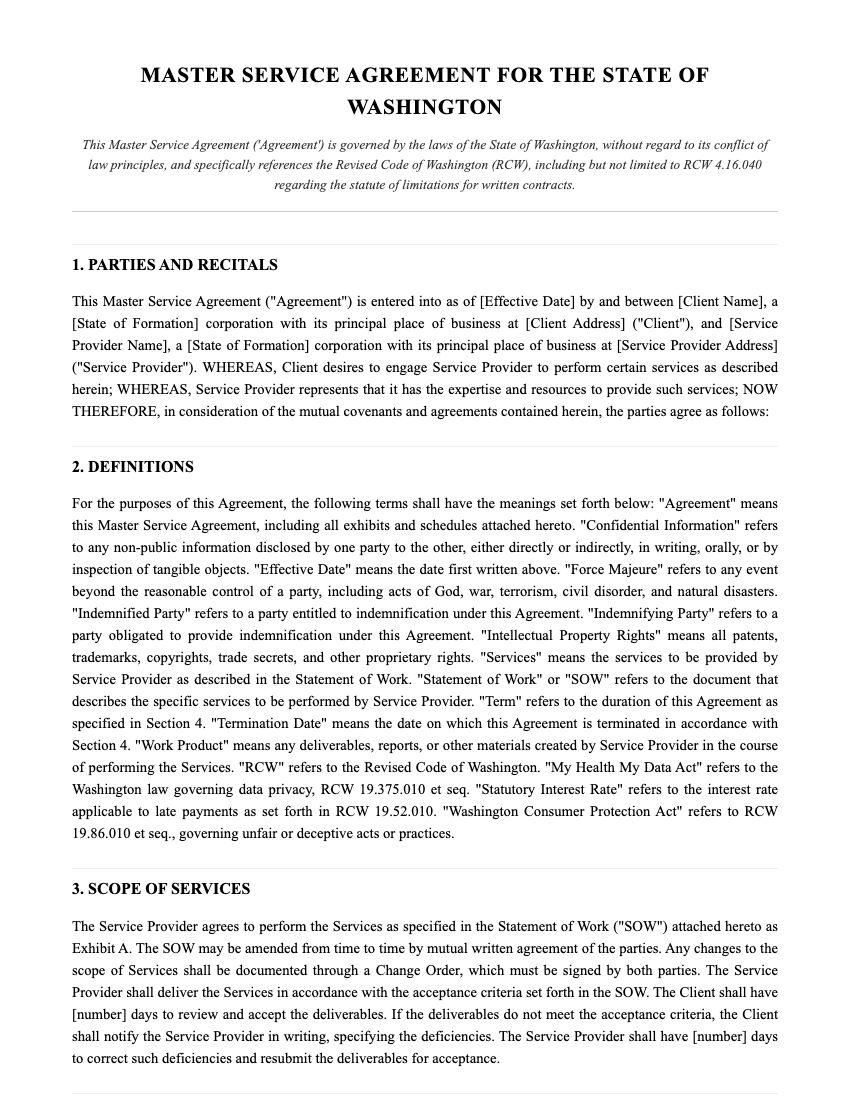
A Washington Master Services Agreement (MSA) is a reusable contract that sets the core legal terms for ongoing services between a provider and a client in Washington, so future projects can be launched with quick Statements of Work (SOWs). If you do repeat work—monthly consulting, agency retainers, software development, managed IT, or creative services—an MSA prevents renegotiating payment, ownership, confidentiality, and liability for every new project. Washington-specific rules on worker classification, non-competes, and indemnity waivers mean a generic template can create real compliance risk.
Definition: A Washington Master Services Agreement (MSA) is a governing agreement between two parties (usually a business client and a service provider) that establishes baseline terms—fees, invoicing, intellectual property, confidentiality, risk allocation, and dispute resolution—that apply to multiple future projects performed in Washington. Each project is then described in a separate Statement of Work (SOW) that plugs into the MSA. A Washington-tailored MSA also anticipates state-specific issues such as worker classification enforcement, enforceable (and unenforceable) non-compete limits under RCW 49.62, and privacy obligations where regulated data is involved.
Why You Cannot Use a Generic MSA in Washington
Many “free MSA templates” are drafted for a different state (often Delaware, California, or Texas). They may look professional, but Washington has specific statutes that change what is enforceable—or what can create liability. A Washington-ready MSA is not about adding legal jargon; it is about preventing three practical problems: (1) independent-contractor misclassification, (2) illegal or overbroad non-compete restrictions, and (3) vague IP provisions that fail when a dispute arises.
3a. Worker Classification Rules
Washington does not use one single universal “ABC test” for every context; instead, classification depends on the legal issue (wage/hour, unemployment, workers’ compensation, and tax can apply different tests). For many SMB service relationships, the biggest exposure is wage-and-hour claims and agency enforcement. Washington’s Minimum Wage Act defines “employee” broadly and is interpreted with a strong protective purpose, so “independent contractor” labels alone do not control. See RCW 49.46.010 (definitions) and RCW 49.46.020 (minimum wage obligations). Washington courts and agencies often focus on the reality of control and economic dependence—who directs the work, who provides tools, whether the worker can realize profit/loss, and whether the person is in business for themselves.
For a comprehensive guide to structuring MSAs and SOWs that protect your business, see our Freelancer Contracts Guide.
Misclassification can trigger back wages (including overtime), damages, and attorney’s fees under Washington wage statutes. A generic MSA that micromanages work methods, requires set hours, or prohibits outside clients can undermine contractor status even if your intent is “B2B.” A Washington-specific template typically includes: clear independent contractor language, responsibility for taxes/insurance, permission to serve other clients, and a deliverables-based SOW model that limits day-to-day control to what is necessary for results.
3b. Non-Compete Enforceability
Unlike California, Washington can enforce non-competes—but only if you follow Washington’s strict statutory limits. The controlling statute is RCW 49.62. Under RCW 49.62.020, a non-compete is generally void and unenforceable against employees unless, among other requirements, the worker’s earnings exceed a threshold amount (adjusted annually) and the restriction is reasonable. For many workers, the safer and more enforceable tools are confidentiality, trade secret protections, and customer non-solicitation clauses (carefully drafted).
Washington also presumes that a non-compete longer than 18 months is unreasonable unless the party seeking enforcement proves otherwise. See RCW 49.62.020(2). Generic MSAs often drop in a “2-year, nationwide” non-compete because it is common in other states; in Washington that is a red flag that can backfire. If a court reforms an overbroad non-compete, Washington law can still award statutory remedies and attorney’s fees in some circumstances. See RCW 49.62.030.
For consultants and agencies, the practical lesson is: do not rely on a broad non-compete as your primary protection. Instead, Washington-friendly alternatives include (1) a strong confidentiality clause, (2) IP ownership that is tied to payment, (3) a narrow non-solicitation of identified customers or employees where appropriate, and (4) clear return/destruction obligations for data. This template approach lets you protect business value without gambling on a clause that may be void under RCW 49.62.
3c. IP/Work-for-Hire Considerations
Washington follows federal copyright rules on “work made for hire,” meaning most freelancer-created works are not automatically owned by the client unless the work fits a statutory category and there is a compliant written agreement—or, more commonly, there is a written assignment. A generic MSA that only says “all work is work made for hire” can fail if the legal requirements are not met. A Washington-ready template typically uses a belt-and-suspenders approach: work-made-for-hire language where it applies, plus a present-tense assignment of IP to cover everything else. It also clarifies what remains the provider’s “background IP” (pre-existing tools, code libraries, templates) licensed to the client for the project.
What’s Included in This Template
Flexible SOW Structure. The MSA is the umbrella: it sets payment, confidentiality, IP, liability limits, and dispute rules one time. Each project uses a short SOW defining scope, deliverables, timeline, and price. This reduces “scope creep” fights and keeps repeat work fast to approve.
Washington-Specific Indemnification. Washington limits certain indemnity provisions in construction-related contexts. RCW 4.24.115 restricts agreements that require one party to indemnify another for the other party’s sole negligence in many construction contracts. A Washington-oriented template includes carve-outs so indemnity is not drafted in a way that is statutorily unenforceable.
Dispute Resolution and Venue. A generic template may force litigation in another state or impose one-sided arbitration rules. A Washington-friendly MSA typically selects Washington law and venue (state courts or federal courts in Washington), and it can include pre-suit notice and a cure period to resolve payment or deliverable disputes efficiently.
Additional Washington provisions commonly included:
- Statute of limitations awareness for written contracts (RCW 4.16.040)
- Late-payment interest aligned to Washington’s legal rate rules (RCW 19.52.010)
- Privacy/data handling obligations where regulated data is involved (My Health My Data Act, RCW 19.375.010 et seq.)
- Consumer-facing work caution to avoid practices that could trigger claims (Washington Consumer Protection Act, RCW 19.86.010 et seq.)
Who Needs This Document?
| User Type | Relationship | Key Benefit |
|---|---|---|
| Marketing/creative agencies | Retainers and recurring campaigns | Reusable terms + SOWs prevent scope creep and billing disputes |
| Software developers/IT providers | Build-and-maintain engagements | Protects background code and clarifies ownership/licenses |
| Consultants (ops, finance, HR) | Advisory services with changing tasks | Sets change-order rules and limits liability |
| Engineering/design firms | Project-based deliverables | Washington-tailored indemnity language (RCW 4.24.115) |
How to Use This MSA Template
Step 1: Identify the Parties
List each party’s exact legal name and entity type (LLC, corporation, sole proprietor). Use the same names that appear on invoices, W-9s, and Washington registration filings to avoid enforceability and collection issues.
Step 2: Set the Term and Termination Rules
Choose a fixed term (e.g., 12 months) or an evergreen term that continues until notice. Include a practical termination clause: how much notice is required, what happens to in-progress work, and what gets paid on exit.
Step 3: Attach the First Statement of Work (SOW)
Keep project scope out of the MSA itself. Put deliverables, milestones, acceptance criteria, fees, and timeline in the SOW. This makes changes easy: you revise the SOW rather than re-opening the entire contract.
Step 4: Sign, Then Reuse
Sign the MSA once, then issue new SOWs as needed. The template is designed so confidentiality, IP, payment terms, and dispute rules automatically apply to each SOW unless the SOW explicitly overrides a section.
Related MSA Templates
Get the Template
Sign up for our newsletter to receive the template.
Frequently Asked Questions

About Designer Content
Designer Content creates practical legal document resources for landlords, contractors, and small business owners. We simplify complex legal concepts into actionable guidance. Connect with us on LinkedIn.