
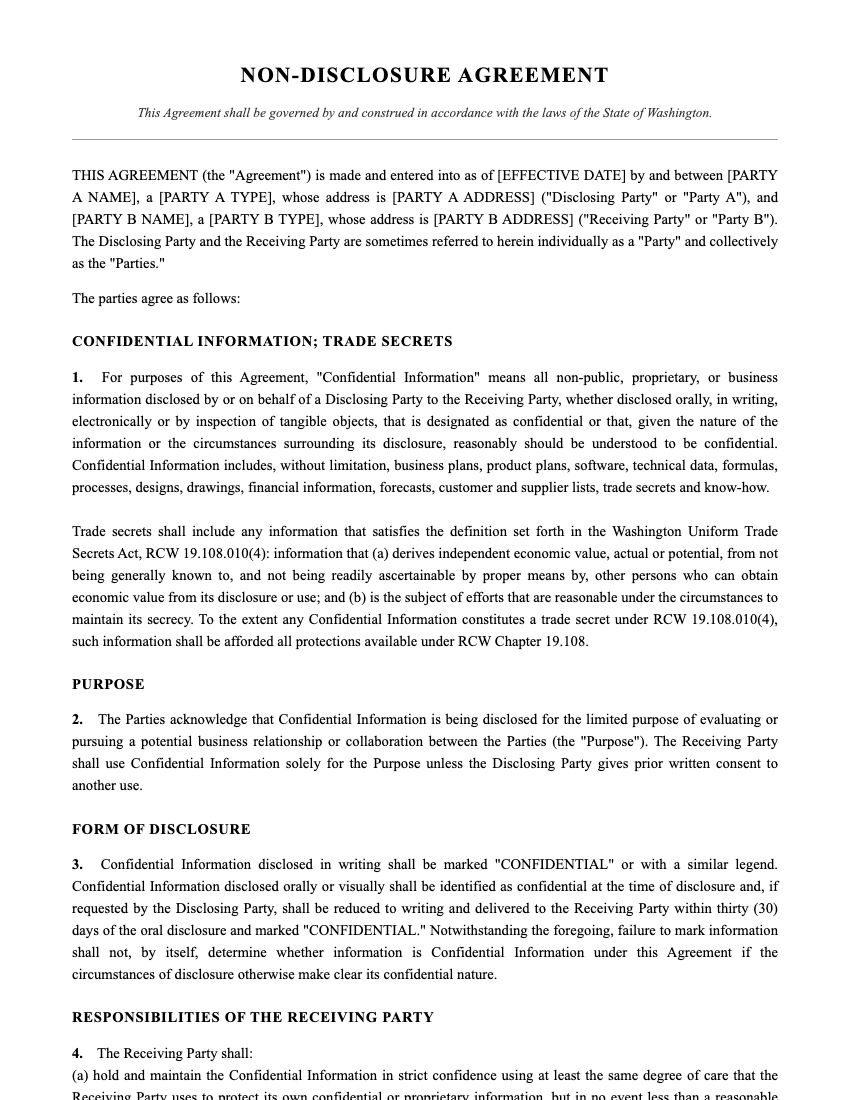
A Washington Non-Disclosure Agreement (NDA) is a contract designed to protect confidential business information and trade secrets under Washington law—most importantly the Washington Uniform Trade Secrets Act (WUTSA), RCW 19.108—while avoiding language that could be treated as an unlawful non-compete under RCW 49.62.
What Is a Washington NDA?
Definition: A Washington NDA is a written agreement that obligates a Receiving Party to keep specified Confidential Information secret and to use it only for a stated Purpose. For trade-secret-level protection, the NDA should reflect the WUTSA factors (RCW 19.108.010) — the information must derive independent economic value from secrecy and be subject to reasonable efforts to maintain secrecy.
Unlike some states, Washington restricts employer non-competes: RCW 49.62 makes non-compete covenants unenforceable against employees earning less than the indexed salary threshold (for 2024 that threshold is $116,593). The statute also imposes limits on duration, geographic scope and requires written signed agreements for covered workers. NDAs must be written carefully so they protect secrets without functioning as unlawful restraints on post-employment mobility.
For a complete guide to NDA terms, duration, and standard exclusions, see our NDA Agreement Guide.
Why Generic NDAs Are Dangerous in Washington
Many boilerplate NDAs contain catch-all phrases that effectively prevent a former employee from taking a job with a competitor—phrases like “Receiving Party will not use Confidential Information to compete” or overly broad “no-hire” language. In Washington, those provisions can trigger RCW 49.62 scrutiny and may be treated as unenforceable or give rise to regulatory or civil challenges.
Paradigm-shifting insight: Washington’s unique trap is the employer’s “classification and backdoor non-compete” problem. Employers frequently try to (1) classify workers as independent contractors to avoid the salary threshold, or (2) smuggle employment restraints into NDAs by forbidding use of any information that could conceivably help a competitor. RCW 49.62 and Washington AG guidance treat both tactics skeptically—NDAs should avoid express employment restraints, while non-solicitation and narrowly tailored confidentiality tied to protectable trade secrets remain viable.
Real-world development: The Washington Legislature enacted RCW 49.62 in 2020 and has since indexed income thresholds and clarified enforcement. The Washington Attorney General has actively published guidance for workers and employers explaining which clauses may be unlawful and encouraging employers to update agreements. Practical effect: many Seattle-area employers revised NDAs and severance agreements to remove overbreadth and include explicit DTSA whistleblower language.
Key Clauses (Washington‑focused)
- Trade Secret Definition (WUTSA-compliant): Use RCW 19.108.010 standards—economic value from secrecy and reasonable efforts to maintain secrecy. Distinguish trade secrets (indefinite protection while secret) from general confidential information (time-limited protection).
- Purpose Limitation: Narrowly state the permitted use (e.g., "evaluating a proposed software license for Project X"). Overbroad purposes create enforceability problems in Washington courts.
- Exclusions: Public information, prior knowledge, independently developed info, compelled disclosures (court order) and information lawfully received from a third party.
- Residuals / Memory Clause (optional): If you permit unaided memory use, craft it narrowly. Washington courts weigh such clauses against mobility rights—avoid language that reads like a functional ban on practicing a trade.
- Non-Solicitation Carve-Outs: RCW 49.62 targets non-competes, not all non-solicits. Properly tailored non-solicitation of clients or employees is often enforceable in Washington if reasonable in scope and duration.
- DTSA Whistleblower Notice: Include the federal Defend Trade Secrets Act notice (18 U.S.C. § 1833(b)) that allows employees to disclose to government officials or make protected disclosures in certain legal filings. Without this notice you may forfeit the right to seek enhanced damages in a federal DTSA claim.
- Choice of Law and Severability: Prefer Washington law for Washington-based agreements; include severability so one unenforceable clause doesn’t void the entire NDA.
Who Needs This Document?
| User Persona | Usage Scenario | Washington Benefit |
|---|---|---|
| Seattle tech startup | Pitching to investors or hiring contractors | Protects source code and product roadmaps while avoiding unlawful restraints under RCW 49.62 |
| Established SaaS company | Hiring senior engineers and product managers | Use WUTSA-compliant trade secret language and tailored non-solicits for key accounts |
| M&A participants | Due diligence for sale or merger | Mutual NDA protects sensitive financials and IP while permitting necessary disclosures under WUTSA rules |
| Manufacturers | Sharing tooling and drawings with factories | Establishes reasonable secrecy measures to preserve trade secret status under RCW 19.108 |
How to Execute a Valid Washington NDA
Step 1: Choose the right form — One-Way (unilateral) if only you disclose; Mutual if both sides share. Use a unilateral NDA to avoid unnecessary reciprocal obligations for disclosers.
Step 2: Define the Purpose and Scope — Be specific and tie confidentiality to demonstrable business reasons. Narrow purpose limits help enforcement and avoid being recharacterized as a restraint on employment.
Step 3: Show Reasonable Secrecy Efforts — Mark documents "CONFIDENTIAL," restrict access, use password protections and include internal policies. These efforts matter under RCW 19.108 (WUTSA) when courts evaluate trade-secret status.
Step 4: Sign and Record Before Sharing — Obtain a signed written NDA before sharing sensitive information. Washington recognizes electronic signatures under the Uniform Electronic Transactions Act (RCW 19.360). Keep execution records and delivery receipts.
Receiving an NDA? Watch for These Washington Red Flags
- Any clause that reads like a broad restraint on future employment or condition of employment for workers below the salary threshold.
- Lack of DTSA whistleblower notice (federal claim damage risk).
- Overbroad definitions that label everything as a "trade secret" without objective criteria.
an AI contract review tool helps spot these red flags instantly—compare incoming NDAs to RCW 49.62 and RCW 19.108 standards and get negotiation suggestions.
Related NDA Templates
Get the Template
Sign up for our newsletter to receive the template.
Frequently Asked Questions

About Designer Content
Designer Content creates practical legal document resources for landlords, contractors, and small business owners. We simplify complex legal concepts into actionable guidance. Connect with us on LinkedIn.