
A West Virginia Master Services Agreement (MSA) is a reusable contract that sets the legal ground rules for an ongoing client–service provider relationship under West Virginia law, so each new project can be approved with a short Statement of Work (SOW). If you do recurring work—IT support, marketing retainers, consulting, or implementation services—an MSA helps you stop renegotiating payment terms, liability, IP, and dispute procedures every time. A West Virginia-specific template also helps you avoid hidden risks around worker classification, enforceable restrictive covenants, and venue choices that can turn into expensive litigation later.
Definition: A West Virginia Master Services Agreement is a “master” contract between a service provider and a client that governs all future services performed in West Virginia (or with West Virginia parties) by setting baseline terms—scope framework, fees and invoicing rules, confidentiality, intellectual property ownership, warranties, indemnities, and dispute resolution. Individual projects are then documented in separate SOWs that plug into the MSA. This structure keeps day-to-day deals fast while keeping the legal terms consistent. In West Virginia, it’s also a practical way to address state-specific issues like the statute of limitations for written contracts (W. Va. Code § 55-2-6), late-payment interest concepts (W. Va. Code § 47-6-5), and local venue planning.
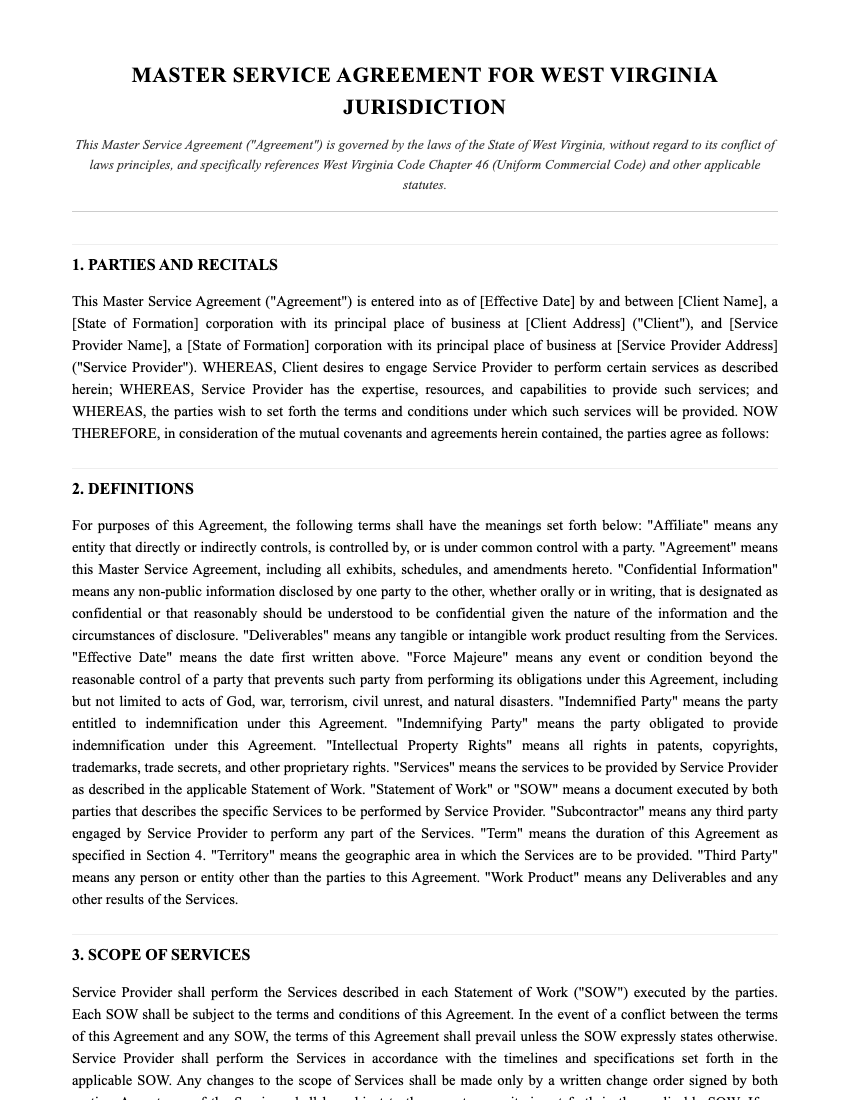
Why You Cannot Use a Generic MSA in West Virginia
A generic “50-state” MSA template usually assumes one-size-fits-all rules for independent contractors, non-competes, and dispute venue. West Virginia does not follow every trend you may have seen in California or New York, and courts here will focus on the actual relationship and reasonableness of restrictions—not just what your contract labels the parties. A West Virginia-ready MSA should be drafted to match how West Virginia courts and agencies evaluate (1) whether someone is truly an independent contractor, (2) whether a restrictive covenant is enforceable, and (3) whether your IP language actually transfers rights.
Another problem with generic templates is “procedural mismatch.” They often choose an out-of-state venue or apply another state’s law by default. That can be unworkable for a West Virginia small business if a dispute requires travel, local counsel in multiple states, or fighting about whether the choice-of-law clause should be enforced. Planning for venue—such as Kanawha County, West Virginia—can reduce friction and cost because it sets predictable rules for where claims are filed.
For a comprehensive guide to structuring MSAs and SOWs that protect your business, see our Freelancer Contracts Guide.
Finally, generic MSAs often ignore time limits and finance basics. West Virginia’s statute of limitations for written contracts is long compared to many states: 10 years under W. Va. Code § 55-2-6. That affects recordkeeping, warranty/acceptance language, and how long you want parties to have to bring certain claims. A good MSA will align the practical business terms (like notice of defects and acceptance) with the reality that written-contract claims can linger.
3a. Worker Classification Rules
West Virginia does not use a single universal “ABC test” for every context. Instead, worker status often turns on a right-to-control / common-law analysis, especially in unemployment and employment contexts. In unemployment compensation law, West Virginia defines “employment” broadly and then uses statutory criteria about control and the nature of the service relationship; see W. Va. Code § 21A-1-3 (definitions; inclusion/exclusion concepts used in unemployment determinations). Practically, if the client controls how, when, and where work is performed—and the worker is integrated into the business—calling the person a “contractor” in the MSA won’t save you.
Why this matters in an MSA: misclassification can trigger back taxes and unemployment contributions, wage-and-hour exposure, and penalties. Even in a B2B setting, a poorly drafted MSA can read like an employment handbook (set hours, supervision, mandatory tools, approvals for time off), which increases risk if a dispute reaches an agency or court. A West Virginia-specific MSA template should include clear independent contractor language, limit control to deliverables (not methods), and require the provider to handle their own taxes and insurance—while keeping the reality of the work consistent with those words.
3b. Non-Compete Enforceability
Unlike states that broadly ban non-competes, West Virginia can enforce non-compete agreements if they are reasonable and protect legitimate business interests. The leading framework comes from the Supreme Court of Appeals of West Virginia in Reddy v. Community Health Foundation of Man, 298 S.E.2d 906 (W. Va. 1982), which analyzes whether a restraint is reasonable in duration, geographic scope, and the activities restricted, and whether it is necessary to protect the employer/business (for example, customer relationships or confidential information).
For an MSA between businesses (or a company and an individual consultant), a generic non-compete clause is risky if it is overbroad—such as banning all work “in any capacity” nationwide for years. West Virginia courts may refuse to enforce an unreasonable restraint, and an overly aggressive clause can become a negotiation dealbreaker with sophisticated clients and vendors.
A West Virginia-ready MSA template should treat restrictive covenants as optional and narrow. If you include one, align it to a legitimate interest (like preventing the provider from poaching a specific client account or using confidential pricing). Consider alternatives that are typically easier to justify: strong confidentiality language, trade secret protections, and non-solicitation provisions limited to customers or employees the contractor actually worked with. The goal is enforceability—restrictions that fit the real risk, not boilerplate that looks like a “ban on competition.”
3c. IP/Work-for-Hire Considerations
West Virginia contract law generally allows parties to allocate ownership of deliverables by agreement, but copyright “work made for hire” is primarily governed by federal law (17 U.S.C. § 101). A generic template that says “everything is work made for hire” can fail if the relationship or deliverables don’t qualify. A better West Virginia MSA approach is to use a clear IP assignment clause for contractor-created deliverables, tied to payment, plus a license back for the provider’s pre-existing tools. This helps prevent disputes over who owns code, templates, or designs—especially when you reuse know-how across multiple SOWs.
What’s Included in This Template
Flexible SOW Structure. The template uses an umbrella MSA plus short SOWs for each project. The MSA covers recurring legal terms (payment, confidentiality, liability, dispute process), while each SOW lists deliverables, timelines, acceptance criteria, and pricing. This helps prevent scope creep and keeps approvals fast.
West Virginia-Specific Indemnification. Indemnity language is written for typical B2B services and emphasizes fair allocation of third-party claims, with carve-outs for a party’s negligence or willful misconduct. It also pairs indemnity with practical limits of liability so the deal’s risk matches the project value.
Dispute Resolution and Venue. The template includes a West Virginia-friendly venue approach, including an option to require disputes to be filed in Kanawha County, West Virginia. This reduces travel and procedural surprises, and it makes enforcement (like subpoenas and judgments) more straightforward for West Virginia businesses.
Additional West Virginia-focused provisions included:
- Written-contract limitations awareness: W. Va. Code § 55-2-6 (10-year limitations period) used to guide notice/acceptance and recordkeeping expectations.
- Late-payment interest guidance: W. Va. Code § 47-6-5 referenced for interest concepts and to support clear invoice/interest language.
- Commercial law alignment for goods/software components: W. Va. Code Chapter 46 (UCC) referenced where an SOW includes sale/licensing of goods or software deliverables.
- Consumer-credit/data handling caution: W. Va. Code § 46A-1-101 et seq. flagged when work touches consumer credit, debt collection, or regulated consumer data flows.
- Jury trial waiver option: included as an optional clause for sophisticated parties to reduce litigation cost and uncertainty.
Who Needs This Document?
| User Type | Relationship | Key Benefit |
|---|---|---|
| IT managed service providers | Monthly support + projects | Standardizes SLAs, invoicing, and limits of liability across SOWs |
| Marketing agencies | Retainers and campaigns | Controls scope creep and sets clear approval/acceptance rules |
| Software/dev consultants | Build + maintenance | Clean IP assignment and reuse rights for pre-existing tools |
| Industrial/B2B service contractors | On-site services | Clear safety responsibilities, insurance, and indemnity allocation |
How to Use This MSA Template
Step 1: Identify the Parties Correctly
Use the exact legal names (LLC/Corp names) and addresses. If you use trade names, list them as “d/b/a” but keep the registered entity as the contracting party.
Step 2: Set Term, Termination, and Renewal
Choose a fixed term (e.g., 12 months) or evergreen renewal. Make sure termination notice is realistic for your operations and that ongoing SOWs either survive termination or end on a defined wind-down plan.
Step 3: Attach the First Statement of Work
Put the specifics—deliverables, milestones, acceptance tests, and fees—into the SOW, not the MSA. If you do time-and-materials work, define hourly rates, minimum increments, and who can approve overages.
Step 4: Sign Once, Then Reuse for Future Projects
After signature, each new project is just a new SOW referencing the MSA. Keep executed copies and version control, especially because West Virginia written-contract claims can be brought within the long limitations period in W. Va. Code § 55-2-6.
Related MSA Templates
Get the Template
Sign up for our newsletter to receive the template.
Frequently Asked Questions

About Designer Content
Designer Content creates practical legal document resources for landlords, contractors, and small business owners. We simplify complex legal concepts into actionable guidance. Connect with us on LinkedIn.