
A West Virginia Non-Disclosure Agreement (NDA) is a written contract that creates enforceable duties of confidentiality and limits on use of proprietary information. Unlike some states with strict non-compete bans, West Virginia generally enforces reasonable restrictive covenants and recognizes long contractual limitation periods—so drafting details matter.
What Is a West Virginia NDA?
Definition: In West Virginia an NDA is a written agreement whereby one or both parties agree to keep identified confidential information secret and to use it only for a stated purpose. NDAs are interpreted as ordinary contracts and therefore are subject to West Virginia's contract law, including the 10-year statute of limitations for written contracts (W. Va. Code § 55-2-6).
NDAs in West Virginia operate alongside state trade-secret law (West Virginia's adoption of the Uniform Trade Secrets Act, codified at W. Va. Code § 47-22-1 et seq.), federal trade-secret remedies (the Defend Trade Secrets Act, 18 U.S.C. § 1836), and consumer-protection rules (the West Virginia Consumer Credit and Protection Act). All these regimes affect what you can and should include in your confidentiality agreement.
For a complete guide to NDA terms, duration, and standard exclusions, see our NDA Agreement Guide.
Why Generic NDAs Are Dangerous in West Virginia
Using a one-size-fits-all NDA written for other states creates four local risks:
- Enforceability of duration and scope: West Virginia courts enforce covenants if they are reasonable in time, geographic scope, and scope of prohibited activity. Overbroad NDAs that effectively function as long non-competes risk being partially or wholly voided by a court.
- Long limitation period: Written NDAs are subject to a 10-year statute of limitations for claims on written contracts (W. Va. Code § 55-2-6). That means an employer could bring a written-contract or confidentiality claim many years after a relationship ends if the agreement is written to extend obligations—so consider whether you want obligations that long.
- Trade-secret specificity: Under the West Virginia Uniform Trade Secrets Act (W. Va. Code § 47-22-1 et seq.), to obtain injunctive relief and damages for trade secret misappropriation you need to show the information qualifies as a trade secret (economic value from secrecy + reasonable secrecy measures). Calling everything a "trade secret" will backfire.
- Whistleblower / DTSA notice: If you ever sue under the federal Defend Trade Secrets Act and did not include the DTSA's whistleblower-notice language, you can still sue, but you may forfeit eligibility for enhanced remedies (exemplary damages and attorney's fees) tied to compliance with 18 U.S.C. §1833(b).
Paradigm-shifting insight for West Virginia: the combination of enforceable reasonable covenants and a long 10-year limitations period means NDAs drafted as "perpetual" or with very long post-termination restrictions can create durable exposure and litigation risk for both sides. Employers may obtain long-term protection when narrowly tailored, but overreach invites a court to rewrite or refuse enforcement—so calibrate scope, duration, and consideration carefully.
Real-world Development
Local practitioners have observed that West Virginia courts will apply a traditional reasonableness test to restrictive covenants and confidentiality obligations. See guidance from major West Virginia law firms and the West Virginia State Bar for recent practice tips on drafting restrictive covenants and NDAs to withstand judicial scrutiny.
Key Clauses (What this template gives you)
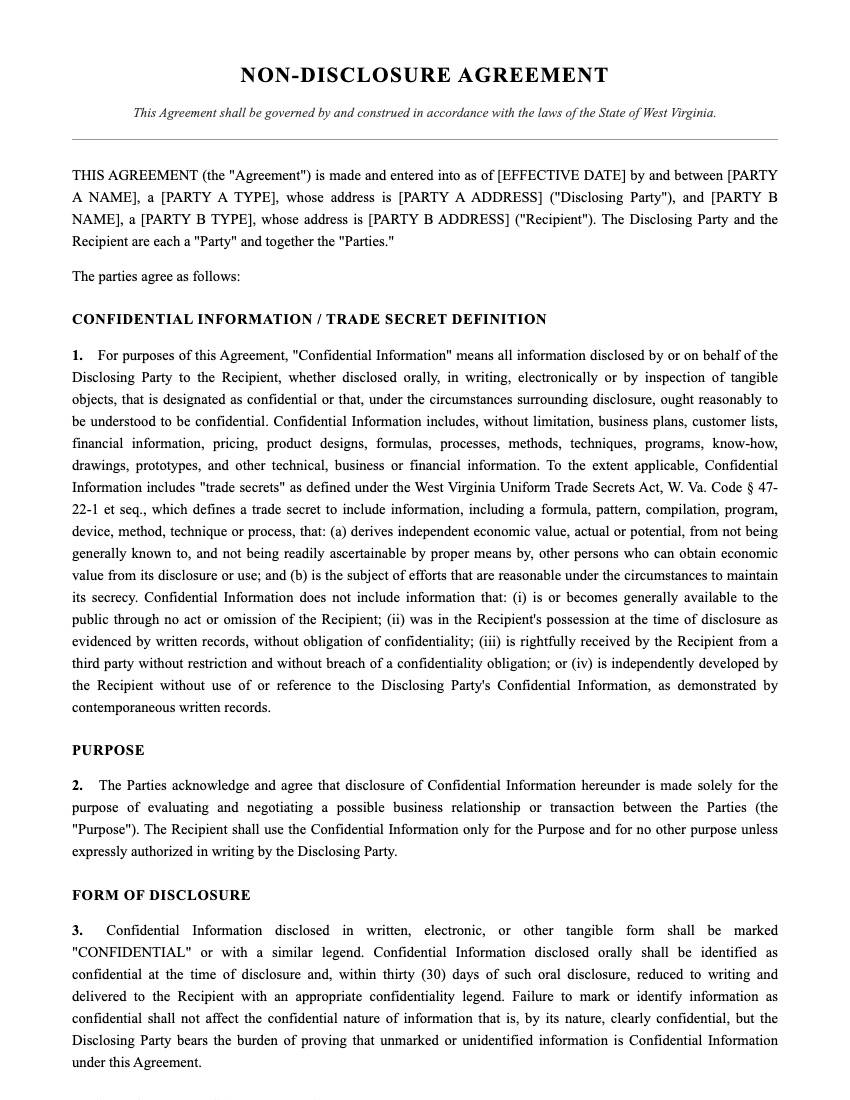
- Purpose clause: Narrowly limits use to a specific deal or evaluation to avoid after-the-fact disputes.
- Definition: Separates "Confidential Information" (time-limited protection) from "Trade Secrets" (potentially indefinite protection if secrecy is maintained), aligning with W. Va. Code §47-22-1 et seq.
- Duration: Optional two-tier structure—e.g., 2–5 years for business information; indefinite protection for properly identified trade secrets.
- Use and non-disclosure: Prohibits use outside the Purpose; avoids blanket non-compete language but allows narrow post-termination restraints where reasonable and supported by consideration.
- Return/destruction and certification: Practical instructions for end of relationship.
- Remedies and damages: Preserves contractual remedies and incorporates DTSA whistleblower notice (18 U.S.C. § 1833(b)).
- Carve-outs: Includes standard exceptions (prior knowledge, public domain, independently developed, compelled disclosure).
- Choice-of-law and venue: Defaults to West Virginia law but allows parties to negotiate forum.
Who Needs This Document?
| User Persona | Usage Scenario | Key WV Benefit |
|---|---|---|
| Manufacturers (Charleston–region) | Sharing designs with contract fabricators | Template protects trade secrets while enabling enforceable, reasonable post-engagement restrictions |
| Employers (energy & tech) | Onboarding employees or contractors | Drafted to avoid overbroad restraints yet preserve remedies under WV law and DTSA |
| Startups & investors | Due diligence in M&A and fundraising | Two-way NDA option enables reciprocal disclosure without accidental long-term covenants |
| Service providers | Outsourcing software or IP | Protects source code and know-how without unintentionally creating perpetual obligations |
How to Execute a Valid West Virginia NDA
Step 1: Choose the right type — One-way for unilateral disclosure, Mutual if both sides will exchange secrets. Wrong form invites disputes.
Step 2: Be specific about purpose and duration — Define the Purpose narrowly and pick a realistic duration. Use the two-tier approach: short-term confidentiality for business info, indefinite for true trade secrets.
Step 3: Take reasonable secrecy measures — Mark documents, restrict access, limit copies. Those steps are critical if you later claim trade-secret protection under W. Va. Code §47-22-1 et seq.
Step 4: Sign properly and preserve evidence — Execute before disclosure; use clear signatures or recognized e-signatures (see ESIGN Act, 15 U.S.C. § 7001, and West Virginia's electronic-transaction statutes). Keep execution records and version controls.
When Someone Sends You an NDA
Review for overly broad use restrictions, undefined "trade secrets," ambiguous durations, and missing DTSA notice. If an NDA looks like a disguised non-compete or contains perpetual unilateral obligations, negotiate narrowing language or add time limits and specific purposes.
an AI contract review tool can help by flagging clauses that are likely unenforceable or risky under West Virginia law, comparing your NDA to local norms, and producing negotiation notes.
Related NDA Templates
Get the Template
Sign up for our newsletter to receive the template.
Frequently Asked Questions

About Designer Content
Designer Content creates practical legal document resources for landlords, contractors, and small business owners. We simplify complex legal concepts into actionable guidance. Connect with us on LinkedIn.