
A Wisconsin Non-Disclosure Agreement (NDA) is a contract that protects confidential business information and trade secrets while reflecting Wisconsin’s legal landscape: trade secrets governed by statute, NDAs interpreted under common-law reasonableness, and a six-year contract limitation period. This template is drafted to align with Wis. Stat. § 134.90 (trade secret law), the state’s deceptive trade practices framework (Wis. Stat. § 100.18), and the 6-year limitations rule (Wis. Stat. § 893.43).
What is a Wisconsin NDA?
Definition: In Wisconsin, an NDA is a contractual promise by one or more parties to keep specified information secret. Trade secret claims in Wisconsin follow the state’s version of the Uniform Trade Secrets Act (Wis. Stat. § 134.90), which protects information that (1) derives independent economic value from not being generally known, and (2) is the subject of reasonable efforts to maintain secrecy.
Unlike jurisdictions that categorically void employee non-competes, Wisconsin enforces post-employment restraints when they are reasonable and supported by a legitimate business interest. That reality makes drafting NDAs in Wisconsin a two-edged sword: a broadly worded use or access restriction can be enforced aggressively — or successfully challenged — depending on the facts and the covenant's precision.
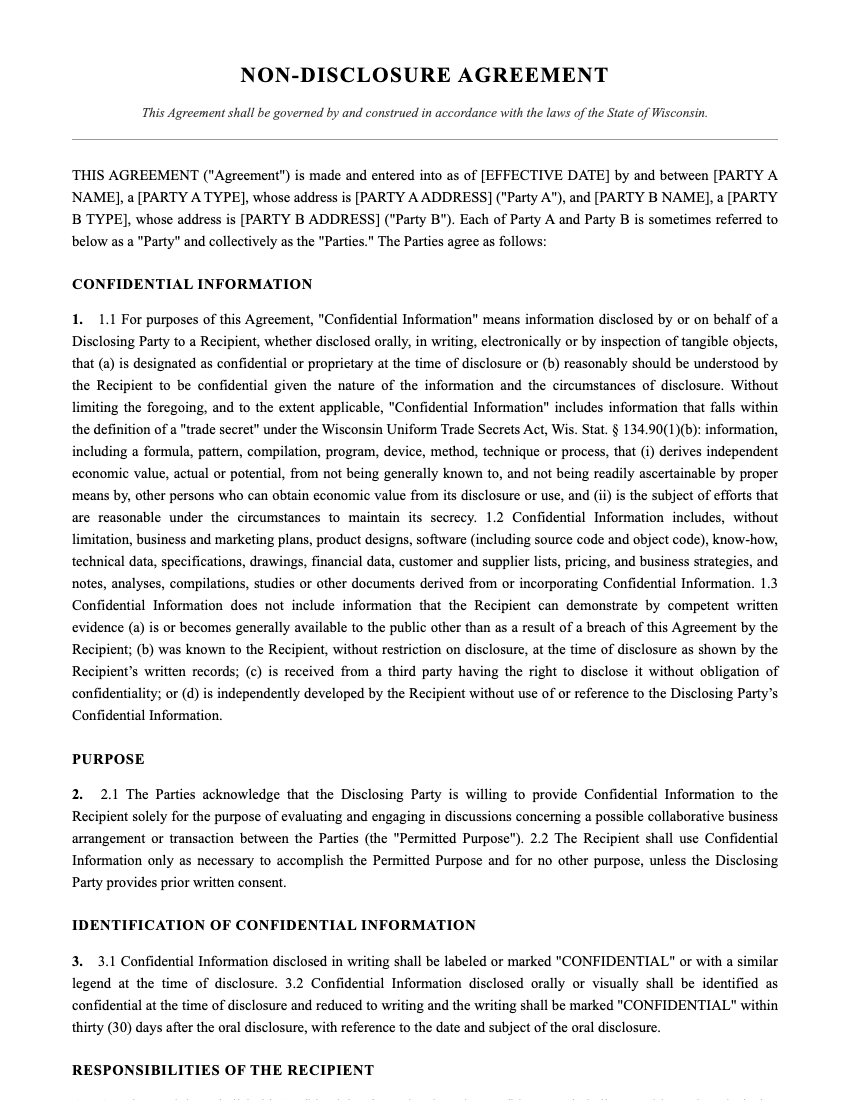
For a complete guide to NDA terms, duration, and standard exclusions, see our NDA Agreement Guide.
Why “Generic” NDAs Are Dangerous in Wisconsin
Most online NDA generators assume either a non-compete-hostile jurisdiction or a one-size-fits-all approach. In Wisconsin, those templates create three real risks:
- Backdoor restraints that courts may construe as enforceable non-competes. Because Wisconsin courts uphold reasonable restraints, an NDA that prohibits "use" of information in broad terms may be litigated as a de facto non-compete and result in injunctions or damages.
- Overbroad confidentiality definitions. Calling everything a “trade secret” without tying it to Wis. Stat. § 134.90 elements undermines credibility. Courts expect specificity — trade secret protection requires showing independent economic value and reasonable secrecy efforts.
- Failure to account for deceptive trade practices liability. Wis. Stat. § 100.18 can be a route for claims where an NDA is used to conceal deceptive conduct. NDAs should not be a tool to hide fraud or consumer-facing misstatements.
Paradigm-shifting insight (Wisconsin-specific): Because Wisconsin will enforce reasonably tailored non-competes, NDAs in employment contexts must carefully separate “confidentiality” from “restraint.” In Wisconsin an overzealous confidentiality phrase that effectively bars former employees from working with former customers or in a territory can be enforced — making a poorly drafted NDA more dangerous for the employer than the employee. In short: in Wisconsin, overly broad NDAs can be weaponized in post‑employment litigation.
Real statutory touchstone: Wisconsin’s trade secret protection is codified at Wis. Stat. § 134.90. Contract claims generally must be brought within 6 years under Wis. Stat. § 893.43. Use and access restrictions should also be examined against Wis. Stat. § 100.18 where consumer or competitor deception is implicated.
Key Clauses (Wisconsin-focused)
- Purpose / Limited Use: Narrowly limit the purpose for which information may be used (e.g., "evaluating a proposed distribution agreement for Product Z"). Purpose limits reduce the chance a court treats the clause as an employment restraint.
- Precise Definitions: Distinguish “Confidential Information” (time-limited, business data) from “Trade Secrets” (as defined by Wis. Stat. § 134.90). Require the disclosing party to identify trade secrets where feasible.
- Duration: For general confidential information, 1–5 years is customary; for trade secrets (Wis. Stat. § 134.90), protection continues so long as secrecy is preserved. If the NDA sits within employment documents, consider a separate, narrowly tailored non-compete or non-solicit (if necessary) with clear reasonableness in time, geography, and scope.
- Non-Solicitation vs. Non-Competition: If you need a covenant restricting solicitation of customers or employees, make it a distinct clause with specific limits. Wisconsin courts assess legitimate business interest and reasonableness.
- Carve-Outs / Exclusions: Standard exclusions for publicly available information, independently developed information, and information received from third parties avoid unfair traps.
- DTSA Whistleblower Notice: Include the federal Defend Trade Secrets Act notice (18 U.S.C. § 1833(b)) that allows disclosures to government officials or attorneys for reporting violations. Including this preserves certain federal remedies in trade secret litigation.
- Remedies and Injunctive Relief: State that injunctive relief is available, but be mindful that Wisconsin courts balance equities and reasonableness.
Who Needs This Document?
| User Persona | Usage Scenario | Key Wisconsin Benefit |
|---|---|---|
| Manufacturers | Sharing formulas with a vendor | Protects trade secrets under Wis. Stat. § 134.90 and documents secrecy efforts |
| Healthcare Providers | Contracting with consultants | Limits use of patient or proprietary operational data while complying with state and federal privacy laws |
| Technology Startups | Due diligence with investors/buyers | Lets you share sensitive IP while preserving trade secret claims and potential injunctive remedies |
| Employers | Onboarding employees with access to customer lists | Separates confidentiality from any separate non-solicit or non-compete covenant to avoid unintended enforceability |
How to Execute a Valid Wisconsin NDA
Step 1: Decide the Type — One-Way vs. Mutual. Use One-Way when only you disclose (e.g., vendor onboarding). Use Mutual for two-sided diligence. In employment settings, use a separate confidentiality agreement plus a narrowly tailored non-solicit if needed.
Step 2: Define the Purpose and Scope. Be specific — courts are more likely to enforce narrowly tailored, purpose-limited NDAs.
Step 3: Establish Reasonable Secrecy Efforts. Label documents, restrict access, and document security measures (passwords, access logs). These steps support trade secret claims under Wis. Stat. § 134.90.
Step 4: Sign Before Sharing. Use an executed agreement (paper or electronic). Wisconsin recognizes electronic transactions (align with the federal E-SIGN Act and state UETA provisions); for contested disputes, clear execution records are crucial.
Already getting NDAs from clients? Review them for sweeping use restrictions that could morph into enforceable restraints in Wisconsin. an AI contract review tool can review incoming NDAs, flag Wisconsin-specific issues (overbroad "use" clauses, missing DTSA notice, or inadequate carve-outs), and suggest edits.
Related NDA Templates
Get the Template
Sign up for our newsletter to receive the template.
Frequently Asked Questions

About Designer Content
Designer Content creates practical legal document resources for landlords, contractors, and small business owners. We simplify complex legal concepts into actionable guidance. Connect with us on LinkedIn.