
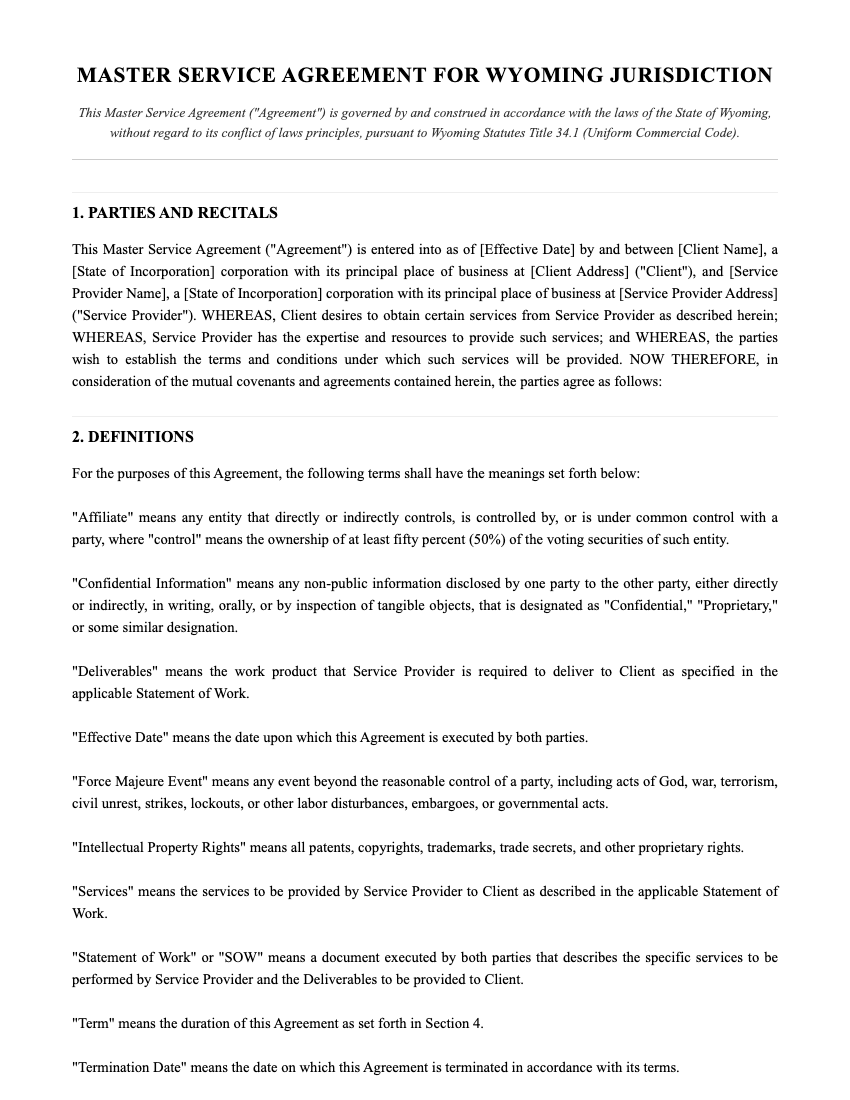
A Wyoming Master Services Agreement (MSA) is a reusable contract that sets the ground rules for ongoing services between a provider and a client under Wyoming law. Instead of renegotiating legal terms for every new project, you sign one MSA and then add short Statements of Work (SOWs) that describe each job’s scope, timeline, and price. For Wyoming SMBs, consultants, and agencies, a strong MSA can reduce payment disputes, clarify ownership of deliverables, and keep conflicts (if they happen) in a predictable Wyoming forum.
Definition: A Wyoming Master Services Agreement is a written umbrella agreement governed by Wyoming law that establishes baseline legal terms—payment, confidentiality, intellectual property, warranties, liability limits, and dispute resolution—for a continuing business relationship. Individual projects are documented in separate SOWs that incorporate the MSA by reference. This structure matters in Wyoming because written contracts can have a long enforcement tail (a 10-year limitations period for written agreements under Wyo. Stat. § 1-3-105) and because interest, venue, and consumer-protection issues can turn a “standard” template into a costly mismatch.
Why You Cannot Use a Generic MSA in Wyoming
A generic MSA often assumes another state’s rules for contractor status, restrictive covenants, and default remedies. That is risky in Wyoming because your MSA typically controls for years, and Wyoming’s statutes can change what happens when someone stops paying, a worker is reclassified, or a dispute is filed. Below are the three most common places out-of-state templates break.
3a. Worker Classification Rules
Wyoming does not use California’s “ABC test” as a universal rule for contractor classification in private B2B contracts. Instead, Wyoming agencies and courts generally analyze worker status using variations of the common-law “right to control” approach—focusing on who controls the manner and means of the work, not just the end result. In the unemployment context, Wyoming’s Employment Security Law uses statutory definitions and agency interpretation to determine whether services are “employment” and therefore subject to unemployment tax. The governing law is found in Wyo. Stat. § 27-3-101 et seq., including the definition provisions (for example, Wyo. Stat. § 27-3-102).
For a comprehensive guide to structuring MSAs and SOWs that protect your business, see our Freelancer Contracts Guide.
Why this matters for your MSA: boilerplate “independent contractor” language is not enough if the actual relationship looks like employment (fixed hours, close supervision, required tools, no business autonomy). If the state reclassifies a contractor as an employee, a business may face unemployment tax assessments, interest, and penalties under the unemployment insurance framework. An MSA that is Wyoming-aware should (1) describe the contractor’s control over how services are performed, (2) confirm the contractor’s separate business status (insurance, other clients, business registrations), and (3) avoid client-side controls that contradict independent status. Your SOW process should also reinforce this—scope and deliverables, not daily supervision and timeclock-style management.
3b. Non-Compete Enforceability
Unlike states that broadly restrict non-competes, Wyoming generally allows non-compete agreements in employment and commercial contexts when they are reasonable and supported by a legitimate business interest. Wyoming’s enforceability analysis is primarily driven by case law rather than a single “non-compete statute.” In Hopper v. All Pet Animal Clinic, Inc., 861 P.2d 531 (Wyo. 1993), the Wyoming Supreme Court recognized that covenants not to compete can be enforceable if they are reasonable in duration and geographic scope and necessary to protect legitimate interests (like goodwill, client relationships, and confidential information).
What goes wrong with generic MSAs is overreach: nationwide non-competes, long durations (e.g., 3–5 years), or restrictions that effectively prevent someone from earning a living. Those are the clauses most likely to be challenged as unreasonable. A Wyoming-specific MSA template should offer safer alternatives and narrower drafting:
- Use confidentiality and trade-secret protections first (often the real goal). Wyoming has adopted the Uniform Trade Secrets Act at Wyo. Stat. § 40-24-101 et seq., which supports injunctive relief and damages for misappropriation.
- If you include a non-compete (common for high-trust consulting, sales, or managed services), tie it to a defined legitimate interest, limit it to the relevant market area, and keep the duration short and explainable.
- Consider non-solicitation clauses (customers/employees) as a narrower tool—still subject to reasonableness, but often easier to justify than a broad “no competition” ban.
Bottom line: Wyoming is not “anything goes,” but it is not an automatic non-compete void state either. Your template should be drafted to withstand a reasonableness review under Wyoming precedent.
3c. IP/Work-for-Hire Considerations
Generic templates often misuse “work made for hire.” Under federal copyright law, work made for hire is limited to employee-created works within the scope of employment or certain specially ordered/commissioned works if the agreement meets statutory requirements (17 U.S.C. § 101). In Wyoming service deals, the practical solution is usually a clear IP assignment clause: the provider assigns deliverable IP to the client upon full payment, while retaining pre-existing tools, know-how, and reusable templates. Your MSA should also address trade secrets (via Wyo. Stat. § 40-24-101 et seq.) and define “Background IP” vs. “Deliverables” so the client gets what it paid for without accidentally claiming the provider’s entire toolkit.
What's Included in This Template
Flexible SOW Structure
This template uses the MSA as the legal backbone and an SOW as the project playbook. The MSA covers legal terms once, while each SOW lists specific deliverables, milestones, acceptance criteria, and pricing. That keeps negotiations shorter and helps prevent “scope creep,” because changes must be documented as an SOW amendment.
Wyoming-Specific Indemnification
Indemnification is written for practical B2B risk: third-party IP infringement claims, bodily injury/property damage where applicable, and misconduct carve-outs. The template also pairs indemnity with realistic limits of liability and insurance expectations, so a Wyoming court is less likely to view it as unfair or internally inconsistent.
Dispute Resolution and Venue
The template includes Wyoming governing law and a Wyoming venue clause, plus an optional binding arbitration provision for parties who want privacy and speed. The goal is to avoid being dragged into another state’s courts because a generic form defaulted to “Delaware” or the client’s home forum.
Additional Wyoming-focused provisions included:
- 10-year statute of limitations for written contracts acknowledgment (Wyo. Stat. § 1-3-105).
- Late-payment interest set with reference to Wyoming’s 18% per annum provision (Wyo. Stat. § 40-14-106), where applicable to the transaction.
- Waiver of unknown claims language aligned to Wyoming’s waiver statute (Wyo. Stat. § 1-1-109).
- Consumer-facing compliance reminder if any services touch consumers (Wyoming Consumer Protection Act, Wyo. Stat. § 40-12-101 et seq.).
Who Needs This Document?
| User Type | Relationship | Key Benefit |
|---|---|---|
| Marketing & creative agencies | Ongoing campaigns with multiple deliverables | Faster approvals via SOWs; clear IP transfer on payment |
| IT managed service providers (MSPs) | Monthly support + projects | Cleaner service levels, exclusions, and limitation of liability |
| Freelance consultants | Retainers and advisory work | Defines scope, change control, and payment terms |
| Software & automation developers | Build + maintenance engagements | Protects Background IP while assigning paid-for Deliverables |
How to Use This MSA Template
Step 1: Identify the parties correctly
Use each party’s exact legal name (LLC/Corp/Sole proprietor) and address. If a client signs through an entity, list the entity—not an individual manager—so enforcement is straightforward.
Step 2: Set the term and termination
Choose an initial term (e.g., 12 months) and define termination for convenience vs. for cause. In ongoing relationships, also specify what survives termination (payment, confidentiality, IP, dispute resolution).
Step 3: Attach your first SOW
Put the business details in the SOW: deliverables, timeline, price, and assumptions. If it’s time-and-materials, define rates and billing increments; if fixed-fee, define acceptance criteria and change orders.
Step 4: Sign once, then reuse
Sign the MSA once and reuse it for future work by signing new SOWs. Your process should require an SOW (or written change order) before starting additional tasks, so “verbal add-ons” do not become free work.
Related MSA Templates
Get the Template
Sign up for our newsletter to receive the template.
Frequently Asked Questions

About Designer Content
Designer Content creates practical legal document resources for landlords, contractors, and small business owners. We simplify complex legal concepts into actionable guidance. Connect with us on LinkedIn.