
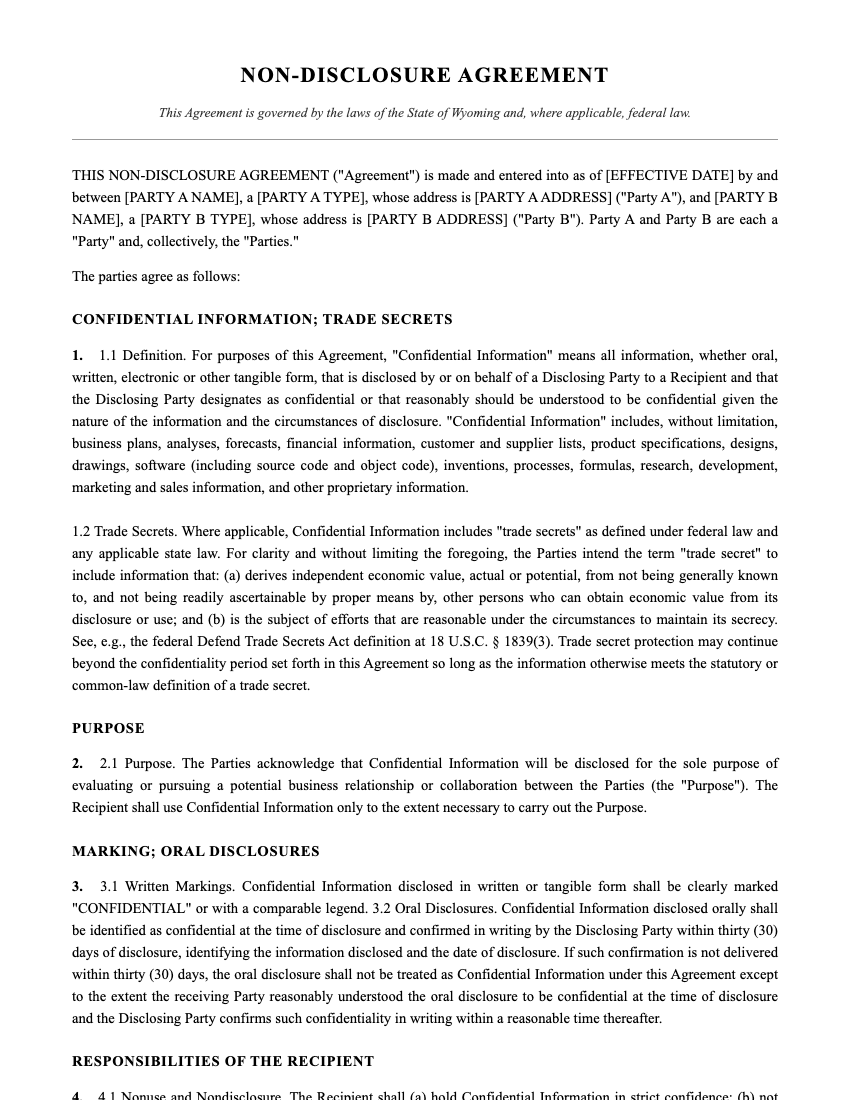
A Wyoming Non-Disclosure Agreement (NDA) is a written contract that protects confidential business information, trade secrets, and proprietary data while reflecting Wyoming’s commercial-law environment: courts generally enforce reasonable restrictive covenants and give wide contractual freedom. This template is designed to give employers and businesses enforceable confidentiality protection in Wyoming while avoiding common drafting traps.
What Is a Wyoming NDA?
Definition: A Wyoming NDA is a contract in which the Receiving Party agrees not to disclose or misuse Confidential Information disclosed by the Disclosing Party. In Wyoming, confidentiality agreements are governed by contract law and, when trade secrets are at issue, by federal law (the Defend Trade Secrets Act, 18 U.S.C. § 1836) and state law principles. For written-contract enforcement, remember the 10-year statute of limitations for written contracts (Wyo. Stat. § 1-3-105).
Wyoming is business-friendly: courts will generally enforce non-compete and restrictive-covenant language if the restraint is reasonable in scope, duration, and geography and supported by adequate consideration. That makes drafting precision essential: an overbroad clause risks reformation, reduction, or invalidation, but a carefully tailored covenant can be enforced.
For a complete guide to NDA terms, duration, and standard exclusions, see our NDA Agreement Guide.
Why 'Generic' NDAs Are Dangerous in Wyoming
Many free NDA templates are written for jurisdictions that either ban non-competes or apply different limits. In Wyoming, those generic forms create three risks:
- False comfort from vague non-compete language. Generic NDAs often try to stop “use” of confidential information by broadly preventing competition. In Wyoming, broad language may be enforced (to the employer’s advantage) or reformed by a court — but it may also produce litigation and injunctions you didn’t intend.
- The 10-year written-contract window. Wyoming’s written-contract statute of limitations (Wyo. Stat. § 1-3-105) gives parties a long period to bring enforcement claims. If you include a restrictive covenant in a written NDA (e.g., limited non-compete, restricted solicitation), a Wyoming court may allow enforcement or at least litigation years later. That’s the paradigm-shifting insight for Wyoming: the “10-year written-contract trap.” Employers can unintentionally create long-lived restraints if they fold covenants into written NDAs without considering duration and severability.
- Missing DTSA whistleblower notice. The federal Defend Trade Secrets Act (DTSA) requires certain whistleblower immunity notice language in an agreement to enable recovery of exemplary damages and attorneys’ fees in federal trade-secrets actions (18 U.S.C. § 1833(b)). If your NDA lacks the DTSA notice, you may limit remedies in a federal suit even if Wyoming’s courts otherwise protect your secrets.
Real-world example: When businesses in Wyoming rely on NDAs during hires, M&A, or vendor onboarding, disputes sometimes migrate to federal court under the DTSA. Properly drafted NDAs that (a) define trade secrets carefully, (b) include DTSA notice, and (c) limit restrictive covenants to reasonable bounds, preserve the strongest remedies and enforceability.
Key Clauses (Wyoming-Focused)
- Definition of Confidential Information vs. Trade Secrets: Distinguish general confidential business information (time-limited protection—commonly 2–5 years) from trade secrets (protected indefinitely while secret). Where trade secrets exist, note federal DTSA protections.
- Purpose and Narrow Use Restrictions: Limit use to a specific business purpose (e.g., "evaluating a potential software licensing relationship for Product X"). Broad uses invite challenge.
- Non-Compete / Non-Solicit Carve-Outs: If you include a restrictive covenant, make it a narrowly tailored separate clause with clear duration, geography, and scope, and include severability/reformation language. Wyoming courts assess reasonableness; better drafting improves enforceability.
- Duty to Protect and Return/Destroy Materials: Require reasonable security measures, immediate return or certified destruction of confidential materials on request, and an inventory of retained materials.
- DTSA Whistleblower Notice: Include the precise federal notice (per 18 U.S.C. § 1833(b)) informing employees they may disclose trade secrets to government officials or in a court filing under certain conditions.
- Remedies, Equitable Relief, and Limitations: Seek injunctive relief, and state that monetary damages and attorneys’ fees are available. Remember Wyo. Stat. § 1-3-105 for written-contract limits on bringing claims.
- Choice of Law and Venue: Wyoming-friendly companies should select Wyoming law and a Wyoming forum, but choose-of-law clauses can be contested if tied to unfair forum-shopping.
Who Needs This Document?
| User Persona | Usage Scenario | Key Wyoming Benefit |
|---|---|---|
| Wyoming Startups | Pitching to investors or hiring early engineers | Protects IP while allowing enforceable post-employment restraints where reasonable |
| Employers | Hiring senior staff & sales reps | Include limited non-solicit clauses that courts in Wyoming are likely to enforce |
| Manufacturers | Outsourcing production out of state | Trade secret protections paired with DTSA notice for federal backup |
| Sellers | M&A due diligence | Mutual NDA that supports enforceable obligations during deal talks |
How to Execute a Valid Wyoming NDA
- Choose the Right Form — Unilateral vs. Mutual: Use unilateral when only one side discloses. Use mutual for reciprocal diligence or collaboration.
- Be Specific About Purpose and Duration: Define exactly why the information is shared and limit confidentiality periods for non-trade-secret material.
- Add DTSA Whistleblower Language: To preserve federal enhanced remedies, include the DTSA notice (18 U.S.C. § 1833(b)).
- Sign Before Sharing: Under federal ESIGN (15 U.S.C. § 7001) and state practice, electronic signatures are generally recognized—still, always secure a signed agreement before disclosing sensitive materials.
Getting NDAs from Counterparties
If a client or vendor sends you an NDA, review it for overbroad use restrictions, vague definitions of Confidential Information, and missing DTSA notice. Watch for bundled restrictive covenants: in Wyoming, they may be enforced if reasonable — so negotiate scope and duration carefully.
an AI contract review tool can automatically flag risky clauses, compare terms to Wyoming practice, and recommend redlines—saving negotiation time.
Related NDA Templates
Get the Template
Sign up for our newsletter to receive the template.
Frequently Asked Questions

About Designer Content
Designer Content creates practical legal document resources for landlords, contractors, and small business owners. We simplify complex legal concepts into actionable guidance. Connect with us on LinkedIn.