
Introduction: Why a compliant lease is important
In Singapore, private residential tenancy relationships are governed primarily by contract and common law. Unlike some jurisdictions, Singapore has no uniform statutory cap on private residential rent or security deposits; however, specific housing types (for example HDB) and strata-titled properties may be subject to regulatory limits or management corporation rules that restrict uses, approvals and short-term letting. This template drafts clauses with reference to PDPA (Personal Data Protection Act), HDB policy guidance, BMSMA (Building Maintenance and Strata Management Act) considerations, and common practice from court and Small Claims Tribunals decisions, aiming to reduce the risk of future disputes and provide workable contractual provisions.
A compliant lease can:
For a comprehensive lease review checklist covering residential and commercial terms, see our Lease Agreement Review Guide.
Clarify the purposes for the deposit, deduction standards and refund procedure, reducing deposit disputes;
- Include required disclosures (PDPA, HDB / MCST notices, known material hazards, etc.) to avoid legal risk from information asymmetry;
- Provide reasonable default and eviction procedures, making it easier to present evidence in court or Small Claims Tribunals if necessary;
- Make the parties’ rights and duties clear (maintenance, repairs, visitors, subletting, etc.), lowering the likelihood of disputes.
Definition: What is a Singapore (Chinese-language) residential lease?
A Residential Lease is a written contract between the landlord (lessor) and tenant (lessee) that specifies the leased premises, lease term, rent, deposit, maintenance responsibilities, permitted uses and termination clauses. For private residential leases in Singapore, the contract terms largely determine the parties’ rights and obligations, but they must comply with specific rules (such as HDB policies, BMSMA/MCST by‑laws and PDPA) and public order requirements.
Why old templates are dangerous (Singapore-specific pitfalls)
- HDB-specific requirements ignored: Leasing HDB flats must comply with HDB policies (for example lease duration, whether HDB approval is required, eligible tenant criteria). Using a generic private property template can result in non-compliance, fines or orders to rectify. See HDB official guidance.
- PDPA disclosures overlooked: When collecting, using or disclosing tenants’ personal data, landlords must comply with PDPA’s notification and purpose-limitation principles. Old templates often lack clear personal data handling and retention period statements. See PDPC guidelines.
- Deposit clauses not specific: Singapore has no statutory cap on deposits for private residences, but failing to specify deductible items, inspection procedures and refund timing (recommended 14 days) causes disputes and may lead to Small Claims Tribunals finding improper deductions.
- Failure to cover strata management & MCST by‑laws restrictions: Management Corporations (MCSTs) of condominiums may restrict short‑term lets or certain uses. Ignoring these can result in MCST fines or orders to restore the premises.
- Blindly copying foreign forms or outdated legal phrasing: This can overlook Singapore case law and local statutes (such as restrictions on subletting/disposal under the Conveyancing and Law of Property Act).
What this template includes
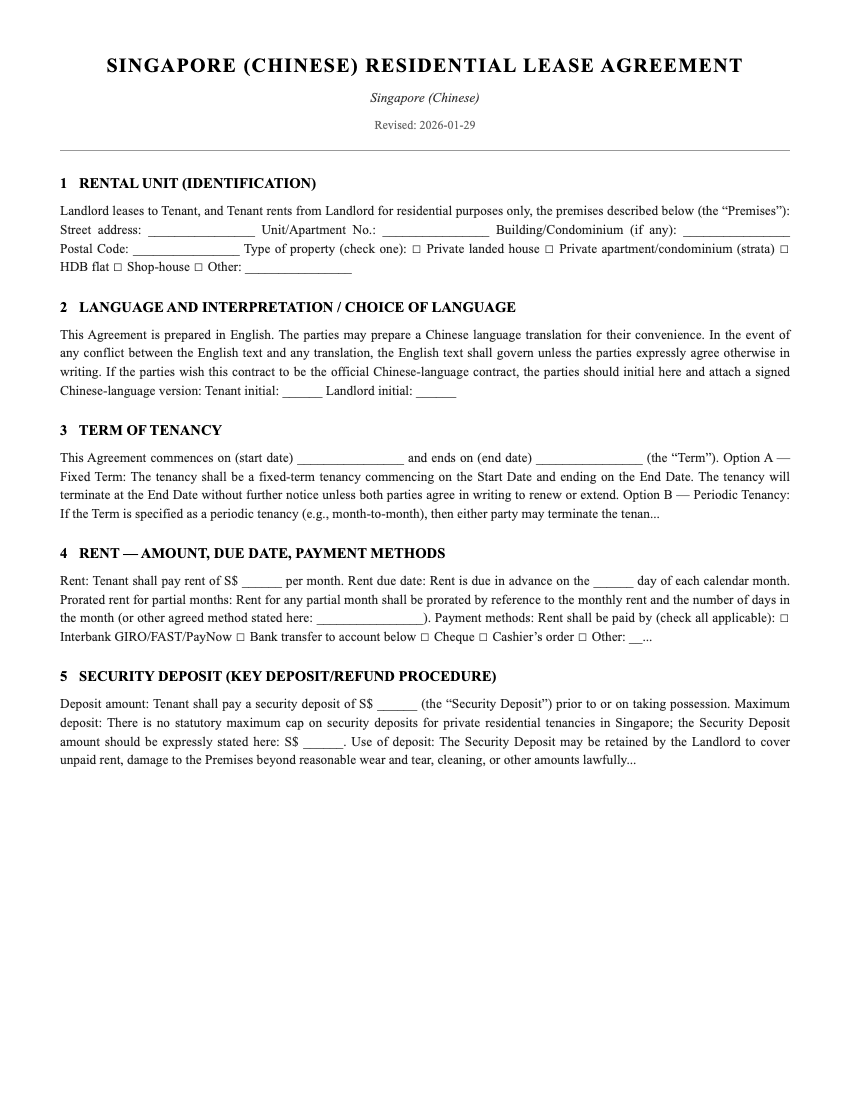
- Standard lease provisions: parties’ details, property description, lease term, rent and payment method;
- Deposit clause: deposit amount (freely negotiable), deductible items, refund process and suggestion: refund balance or provide an itemised list within 14 days after tenant returns the keys;
- PDPA privacy statement: purposes for personal data, retention period, third‑party disclosures and contact point;
- HDB / BMSMA specific notices: standard clauses and compliance prompts to enable when the property is HDB or governed by an MCST;
- Repairs, maintenance and alterations: clear division of responsibility between landlord and tenant for routine and structural repairs;
- Visitors, co‑occupants and subletting: restrictions and procedures for short‑term visitors, long‑term cohabitants and subletting approvals;
- Default and eviction procedures: suggested notice periods for payment demands, remediable defaults and serious grounds for immediate termination (e.g., illegal activities, serious safety hazards);
- Handover checklist and move‑in / move‑out procedures: recommend using photos, videos and signed inventories as the basis for deposit settlement;
- Dispute resolution suggestions: encourage negotiation and mediation first, with recourse to Small Claims Tribunals or civil courts if necessary;
- Template appendices: PDPA sample notice wording, HDB notification format, inventory and handover form samples.
Download options
- Single download (PDF): suitable for one‑time use or printing: /downloads/singapore-chinese-lease-agreement-2026.pdf
- Editable DOCX: convenient for modifying terms by agreement (recommended to re‑run through an AI contract review tool and a lawyer after edits);
- Multi‑language pack: parallel Chinese and English versions (recommended to sign the bilingual text and state which language prevails to avoid translation disputes).
How to complete (sign and bring into effect) your lease
- Fill in both parties’ information and detailed property particulars;
- Specify the deposit amount and refund mechanism (recommended to provide for refund of the balance or an itemised statement within 14 days);
- Select applicable HDB / MCST clauses (if the property is subject to those rules);
- Attach the PDPA privacy statement and data usage purposes and obtain consent;
- Both parties sign and exchange copies;
- Complete the property handover inspection and retain photos and the inventory as evidence;
- (Optional) Upload the contract to an AI contract review tool for automated review and seek final approval from a lawyer if necessary.
Related Lease Agreement Templates
Frequently Asked Questions (FAQs)
- Q: How many months’ deposit can a landlord take?
A: There is no statutory cap on deposits for private residential properties in Singapore; the amount is negotiable between the parties (commonly 1 to 2 months’ rent). However, the contract should specify deductible items, inspection procedures and refund timing (recommended refund the balance or provide an itemised deduction statement within 14 days after the tenant vacates and returns the keys). If the property is HDB, the landlord must comply with HDB policies and obtain approval where required. - Q: Is there rent control in Singapore? Can landlords increase rent at will?
A: There is generally no statutory rent control for private residences; rent levels and increases are mainly governed by the contract and market factors. Common practice is to provide written notice of a rent increase 30 days before the end of a fixed term or to agree the new rent during renewal negotiations. HDB, MCST or property deeds may impose additional restrictions on short‑term letting or permitted uses, but they typically do not directly set rent levels. - Q: What disclosures are mandatory?
A: Mandatory disclosures in this template include: PDPA privacy notice, HDB tenancy advisory (if applicable), BMSMA / MCST by‑laws relating to permitted uses (if applicable), any known material hazards or structural issues known to the landlord, and common risks such as pests/lead/asbestos if the landlord is aware. Failure to disclose known material hazards can give rise to legal liability. - Q: If a tenant does not pay rent, how should the landlord start eviction?
A: There is no uniform statutory notice period for “non‑payment” of rent; typically the landlord issues a written demand (for example providing a 7 to 14 day grace period), and then pursues the remedies set out in the contract for recovery of rent and possession. For small monetary disputes, the landlord may file with the Small Claims Tribunals (within its monetary limits); for more complex matters or to obtain a writ for possession, the landlord should apply to the State Courts for judgment and enforcement. HDB tenancies must follow HDB’s specific guidance. - Q: Can a tenant let a friend stay long‑term or sublet short‑term?
A: Subletting policy should be set out in the contract. Generally the tenant must obtain the landlord’s prior written consent and provide the subtenant’s particulars. Short‑term subletting may be prohibited or require approval for HDB properties and some MCST‑governed developments; breaches can lead to fines or termination of the lease. - Q: What remedies does a tenant have if the landlord makes improper deductions from the deposit?
A: The tenant may file a deposit dispute with the Small Claims Tribunals (if within its jurisdictional limits) or bring a civil claim in court. The Small Claims Tribunals can order refunds of the deposit, interest and costs; courts may award damages as appropriate. Keeping move‑in/move‑out inventories, photographs and communication records greatly improves chances of success.
Conclusion and recommendations
This template provides a structured, compliance‑oriented contract for common Singapore (Chinese) residential leasing scenarios, with emphasis on PDPA disclosures, HDB / MCST compliance and deposit handling mechanisms. Before use:
- Enable the relevant addenda according to property type (HDB, private house, condominium);
- Upload to an AI contract review tool for contract consistency and a risk summary;
- For complex or high‑risk situations, obtain written advice from a qualified Singapore lawyer.
This will minimize future disputes and enforcement risk, protecting the legal rights of both landlords and tenants.
<div class="ml-embedded" data-form="bBZ9zR"></div>
Frequently Asked Questions

About Designer Content
Designer Content creates practical legal document resources for landlords, contractors, and small business owners. We simplify complex legal concepts into actionable guidance. Connect with us on LinkedIn.