
Introduction
The landlord-tenant relationship in Switzerland is mainly governed by the Code des obligations (CO, arts. 253 et s.) and supplemented by other rules — notably the Loi fédérale sur la protection des données (LPD, RS 235.1) for the processing of personal data. This French lease template helps you draft a clear and compliant agreement: security deposit, indexation methods, maintenance obligations, end-of-lease notices and the statements required for cantonal conciliation.
Complying with procedural rules and mandatory statements reduces the risk of challenge before the conciliation authority and the cantonal courts. This guide explains the key points to adapt according to the canton and how to check your contract using a contract analysis tool .
Qu'est-ce qu'un bail résidentiel en Suisse (FR) ?
A residential lease is a contract by which the lessor places a dwelling at the disposal of a tenant for residential use in return for rent. In Switzerland, the rights and obligations of the parties are mainly set by the Code des obligations (CO, art. 253 et suivants). The contract may supplement the law, but cannot derogate from it when it concerns mandatory provisions. Cantonal rules and conciliation case law can clarify local application.
Why Old Templates Are Dangerous (jurisdiction-specific traps)
Old templates imported from other countries or dating from before the recent LPD/CO revisions pose serious risks:
- Non-compliant security deposit clause: some old clauses provide amounts or modalities contrary to cantonal practice (risk of being qualified as abusive). In Switzerland, widely accepted practice is a deposit up to three months' net rent — but the amount can be contested before conciliation if deemed unreasonable.
- Missing LPD statement: the lease must notify the collection and use of personal data (identity, contact details, copies of identity documents, etc.). The revised LPD requires information and legal bases for the processing.
- Poorly worded indexation: indexation formulas (consumer price index, etc.) must respect the CO and must not allow automatic increases without the proper procedure.
- Procedural defects regarding debt enforcement: failing to explain the consequences of non-payment (e.g. debt collection/poursuite/Betreibung) and deadlines may deprive the lessor of proof of information in case of enforcement.
- Missing cantonal statements: some municipalities/cantons require formalities or registers (e.g. in the case of social housing subsidies).
Using a template not adapted to Switzerland or not up to date can be costly in litigation and court fees.
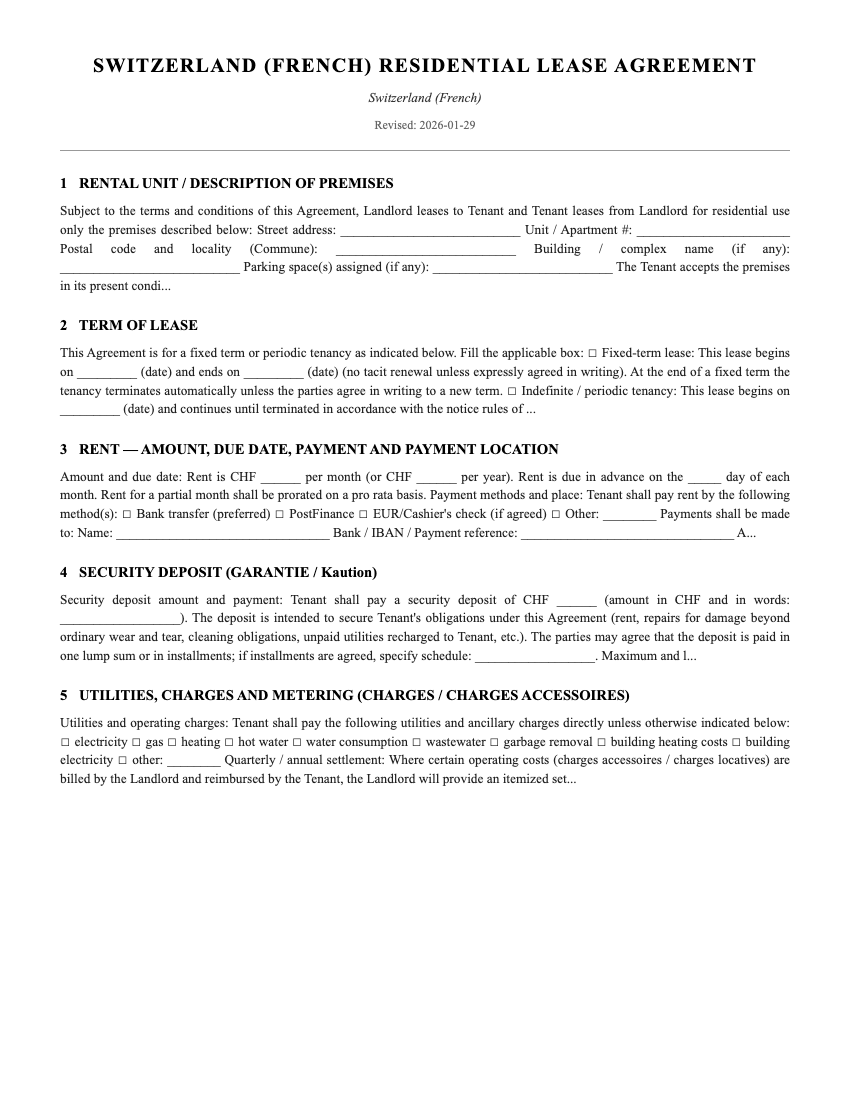
What's Included in This Template
The provided template includes:
- Identities of the parties, full description of the dwelling and accessories (cellar, parking).
- Term: fixed-term or indefinite, renewal modalities.
- Net rent and recoverable charges (service charges), payment terms.
- Security deposit clause (recommended amount up to 3 months' net rent), return modalities and final inventory.
- Indexation clause (optional) with application examples and formula based on the appropriate index.
- Maintenance and repairs: allocation of small repairs and tenant obligations.
- Subletting and extended hosting: conditions and need for landlord authorization.
- Procedure in case of late payment and information on debt enforcement (LP, RS 281.1).
- Mandatory statements: known defects, condominium rules, processing of personal data (LPD), known environmental risks.
- Termination modalities, usual notice periods (e.g. 3 months for monthly leases) and provisions for extraordinary termination.
- Clause regarding cantonal conciliation and coordination with federal law.
- Annexes: move-in condition report, inventory list, LPD form.
Each clause includes a note explaining the legal basis (référence aux art. du CO ou à la LPD) and variants according to canton where necessary.
Related Lease Agreement Templates
Download Options
- Standard PDF version (français) — immediate download: /downloads/switzerland-french-lease-agreement-2026.pdf
- Editable Word (.docx) version — includes legal comments and clause alternatives (available on request).
- Pro Pack — template + cantonal conciliation checklist + model debt collection letter (recommended for landlords managing multiple properties).
We recommend the editable version if you plan to adapt clauses according to cantonal practice or specific agreements between the parties.
How to Finalize Your Lease
- Carefully fill in the data (identity, dwelling description, exact rent amount and charge modalities).
- Choose and customize the deposit clause (amount, dedicated account, return period and interest method if applicable).
- Add the LPD notice: state purposes, legal basis, retention period and access rights.
- Verify the indexation clause and sample calculation; adapt according to the canton if necessary.
- Have the contract checked by an AI contract review tool to detect omissions or risky wording.
- If everything is compliant, sign in two copies and provide the signed move-in condition report: one copy for the lessor, one for the tenant.
See the "How to Finalize Your Lease" section below for a step-by-step checklist.
How to Finalize Your Lease
(Detailed steps and practical advice)
- Signature and evidence: handwritten or electronic signatures (check cantonal validity for advanced electronic signatures). Keep signed copies and annexes.
- Security deposit: agree on a dedicated bank account and provide a dated receipt. Specify the contractual return period (30–60 calendar days after departure + settlement of charges).
- Move-in condition report: carry out a detailed, dated move-in condition report. Attach photographs if possible.
- Registration and notifications: if the canton requires or recommends notification to the housing office, follow the local procedure.
- Dispute: remind the tenant of the right to bring the matter to the cantonal conciliation authority in case of dispute (a prerequisite before court proceedings for rental contracts in most cantons).
Final tip: keep all written exchanges (emails, certificates) and the AI contract review tool report as supporting documents in case of a dispute.
<div class="ml-embedded" data-form="bBZ9zR"></div>
Frequently Asked Questions

About Designer Content
Designer Content creates practical legal document resources for landlords, contractors, and small business owners. We simplify complex legal concepts into actionable guidance. Connect with us on LinkedIn.