
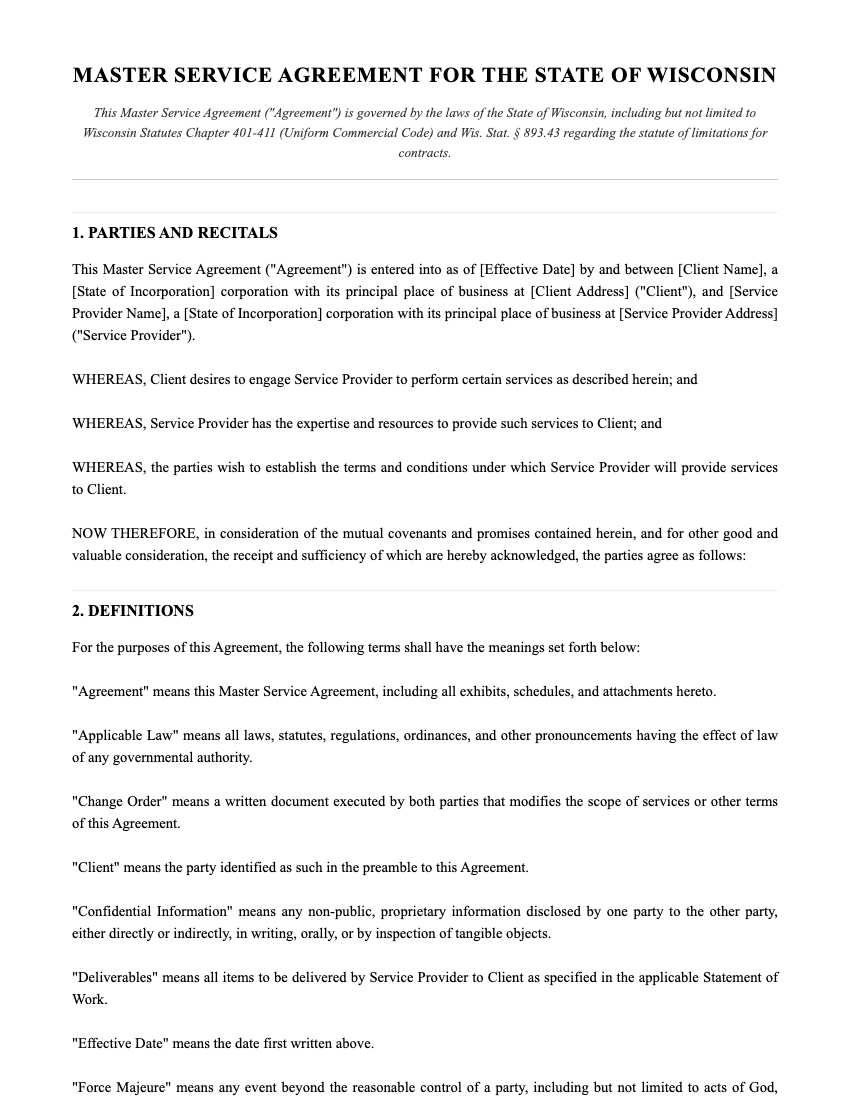
A Wisconsin Master Services Agreement (MSA) is a reusable contract that sets the baseline legal terms for ongoing services between a provider and a client operating in Wisconsin, so future projects can be started quickly using short Statements of Work (SOWs). Instead of renegotiating payment, liability, confidentiality, and IP ownership for every new engagement, you agree once on a consistent “umbrella” set of rules. For Wisconsin SMBs, freelancers, and consultants, a state-specific MSA matters because worker classification rules, non-compete limits, and payment/default remedies are not the same as other states.
Definition: A Wisconsin Master Services Agreement is a governing services contract used in Wisconsin that establishes the standing terms—such as fees, invoicing, confidentiality, intellectual property ownership, indemnification, limitation of liability, and dispute resolution—that apply to all work performed under the relationship. Individual projects are then documented through separate Statements of Work that reference the MSA, adding project-specific scope, milestones, timelines, and pricing. This two-document structure reduces negotiation time, improves consistency across engagements, and helps both parties manage legal risk under Wisconsin law.
Why You Cannot Use a Generic MSA in Wisconsin
A generic MSA downloaded online usually assumes “one-size-fits-all” rules about independent contractors, restrictive covenants, and remedies for nonpayment. In Wisconsin, those assumptions can create real exposure. The biggest problems show up when (1) the contract tries to label someone an “independent contractor” without matching Wisconsin’s classification tests, (2) the agreement uses non-compete language that is far broader than Wisconsin allows, or (3) the contract fails to clearly assign intellectual property created by a contractor or agency.
Wisconsin courts and agencies focus on substance over labels. Even if your contract says “independent contractor,” the relationship can still be treated as employment for unemployment insurance, workers’ compensation, wage-and-hour, or tax purposes depending on the facts and the applicable statutory test. Likewise, Wisconsin has a specific statute restricting non-compete agreements, and overly broad restrictions can be struck down entirely rather than “fixed” by a court. A Wisconsin-specific MSA template should therefore be drafted to (a) support the intended business-to-business relationship, (b) use enforceable restrictive covenant alternatives where appropriate, and (c) allocate IP ownership with clear work-product language and an assignment that survives termination.
For a comprehensive guide to structuring MSAs and SOWs that protect your business, see our Freelancer Contracts Guide.
3a. Worker Classification Rules
Wisconsin does not rely on a single universal “ABC test” for every context. For unemployment insurance purposes, Wisconsin applies a statutory test under Wis. Stat. § 108.02(12), which generally treats services performed for pay as “employment” unless the putative employer can satisfy conditions showing the worker is an independent contractor (including requirements tied to separate business status and entrepreneurial risk). For workers’ compensation, Wisconsin uses its own statutory framework under Wis. Stat. ch. 102, and agencies and courts examine the economic reality and control features of the relationship.
A generic MSA that only states “Contractor is an independent contractor” without including operational safeguards (control, tools, schedule, ability to work for others, separate business identity, invoicing practices) can backfire. Misclassification can trigger liability for back unemployment contributions, interest, penalties, and benefits exposure, and it can create cascading issues (for example, who is responsible for workplace injuries or payroll taxes). A Wisconsin-ready template should pair the independent contractor clause with practical “how the relationship operates” terms that align with Wis. Stat. § 108.02(12) and the reality of the engagement.
3b. Non-Compete Enforceability
Unlike states that largely ban non-competes, Wisconsin permits them—but only within strict limits. The controlling statute is Wis. Stat. § 103.465, which requires restrictive covenants tied to employment to be reasonable and necessary to protect the employer. Wisconsin courts are known for scrutinizing restrictions on duration, geographic scope, and the activities restricted, and if a covenant is overbroad, courts may refuse to enforce the restriction rather than rewrite it. In other words, copying a broad “industry-wide” non-compete from a generic template can leave you with no enforceable protection at all.
For many service businesses, the safer approach is to tailor restrictions to legitimate business interests: confidentiality/trade secrets, non-solicitation of customers you actually served, and limited non-solicitation of employees in narrow circumstances. A Wisconsin-specific MSA template should (1) avoid sweeping language that restrains someone from working in their profession, (2) use a focused non-solicitation when appropriate, and (3) rely heavily on confidentiality and IP protections so you are not depending on a fragile non-compete. If you do include a non-compete or non-solicitation, keep it narrowly tied to the relationship, time-limited, and aligned with what is actually “necessary” under Wis. Stat. § 103.465.
3c. IP/Work-for-Hire Considerations
Many generic MSAs rely on “work made for hire” language alone. Under U.S. copyright law, “work made for hire” is limited and often does not automatically apply to independent contractor work unless specific statutory categories and formalities are met. In practice, Wisconsin businesses should use a clear present-tense assignment (“hereby assigns”) of all deliverables and related IP upon payment, plus a promise to sign further documents if needed. The template should also reserve the provider’s pre-existing tools, code libraries, and know-how as “background IP,” granting the client a license only to what is necessary to use the deliverables.
What’s Included in This Template
Flexible SOW Structure. The MSA contains the standing legal terms, while each SOW defines scope, timeline, acceptance criteria, and fees. This reduces renegotiation, makes changes easier to document, and helps prevent scope creep because anything not in the SOW is clearly out of scope.
Wisconsin-Specific Indemnification. The template uses mutual indemnities tied to third-party claims and includes practical carve-outs for each party’s negligence or misconduct. It also aligns remedies with Wisconsin’s litigation realities, including clear notice, defense-control language, and settlement consent rules that help avoid surprise liability.
Dispute Resolution and Venue. The template offers Wisconsin-friendly venue and governing law provisions so disputes are not dragged into another state by a generic form. It also includes practical pre-suit notice and cure periods, and it anticipates Wisconsin’s contract limitation rules (generally six years) under Wis. Stat. § 893.43.
Additional Wisconsin provisions commonly included:
- Late payment interest structured with reference to Wis. Stat. § 138.04 (12% per annum interest when applicable).
- A representations clause designed to reduce marketing/advertising misstatements that can trigger liability under Wis. Stat. § 100.18 (Wisconsin Deceptive Trade Practices Act).
- A limitations/records approach that fits Wisconsin’s general contract statute of limitations, Wis. Stat. § 893.43.
- A data-handling and confidentiality section that flags consumer-credit and related compliance concepts under Wis. Stat. § 421.101 et seq. when the engagement touches consumer financial data.
- A remedies section that acknowledges Wisconsin’s civil-theft and damages framework in Wis. Stat. § 895.446 where misconduct involves theft-type conduct.
Who Needs This Document?
| User Type | Relationship | Key Benefit |
|---|---|---|
| Marketing or design agency | Ongoing campaigns and retainers | Faster project launches with consistent IP and approval terms |
| IT managed services provider (MSP) | Monthly support + projects | Clear service levels, change orders, and liability boundaries |
| Consultant (ops, finance, HR) | Advisory across quarters | Prevents scope creep and clarifies deliverables vs. advice |
| Software developer / dev shop | Multiple builds for the same client | Clean IP assignment, background IP licensing, and acceptance process |
How to Use This MSA Template
Step 1: Identify the parties correctly
Use the legal business names and entity types and match them to Wisconsin DFI/other registration records. Wrong entity names can complicate enforcement and payment collection.
Step 2: Set the term and termination mechanics
Choose an initial term (e.g., 12 months) with auto-renewal or month-to-month. Include a practical termination-for-convenience notice period and a clear statement about what fees survive termination.
Step 3: Attach your first Statement of Work (SOW)
Keep deliverables out of the MSA. Put scope, milestones, dependencies, and acceptance criteria in the SOW so disputes are about a short, concrete document.
Step 4: Sign once, then reuse
Sign the MSA one time and then execute a new SOW for each new project. This lets you move quickly while keeping consistent payment, confidentiality, and dispute terms.
Related MSA Templates
Get the Template
Sign up for our newsletter to receive the template.
Frequently Asked Questions

About Designer Content
Designer Content creates practical legal document resources for landlords, contractors, and small business owners. We simplify complex legal concepts into actionable guidance. Connect with us on LinkedIn.