
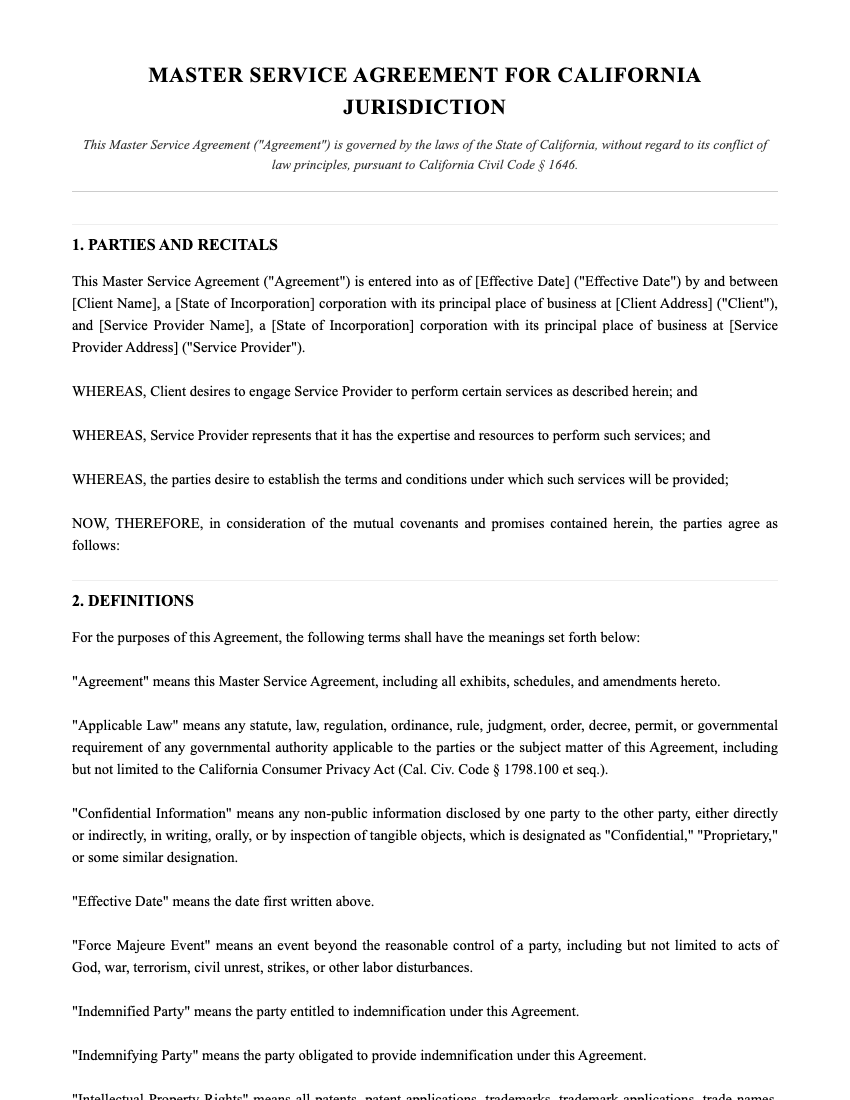
A California Master Services Agreement (MSA) is a reusable legal contract between a service provider and client that establishes the baseline terms—payment, liability, intellectual property, and dispute resolution—governing all future projects, allowing parties to execute simple Statements of Work (SOWs) for individual engagements without renegotiating the entire agreement.
What Is a California MSA?
Definition: A California Master Services Agreement is a governing contract between two parties (typically a client and service provider) operating in California. It outlines the legal framework—including payment terms, liability limits, and intellectual property rights—that applies to all future projects. Instead of drafting a new contract for each engagement, parties sign a single MSA and attach simple "Statements of Work" (SOWs) for individual tasks.
This structure is especially valuable in California, where strict labor classification laws and the nation's strongest non-compete ban create unique compliance requirements that generic templates fail to address.
For a comprehensive guide to structuring MSAs and SOWs that protect your business, see our Freelancer Contracts Guide.
Why You Cannot Use a Generic MSA in California
California's employment and contract laws are among the strictest in the United States. Using a template designed for Delaware or Texas exposes both parties to significant legal and financial risk.
The AB 5 Classification Trap
Since January 1, 2020, California law presumes that workers are employees—not independent contractors—unless the hiring entity can prove otherwise under the "ABC Test" established in Dynamex Operations West, Inc. v. Superior Court (2018).
Under the ABC Test, a worker is an independent contractor only if ALL three conditions are met:
| Prong | Requirement | What It Means |
|---|---|---|
| **A** | Free from control and direction | You cannot dictate how, when, or where they work |
| **B** | Outside your usual business | A marketing agency cannot hire a "contractor" to do marketing |
| **C** | Independently established | They must have other clients and their own business entity |
Failing any single prong means the worker is legally an employee. The California Employment Development Department (EDD) can assess back taxes, penalties, and require retroactive benefits—often $5,000 to $25,000 per misclassified worker.
This template includes explicit Independent Contractor status declarations, mutual representations about the business relationship, and indemnification clauses designed to establish compliance with California Labor Code § 2750.3.
The Non-Compete Ban (SB 699)
As of January 1, 2024, California Senate Bill 699 makes it a civil violation to include or attempt to enforce a non-compete clause—even if the contract was signed in another state. This is not merely unenforceable; it creates liability for actual damages, injunctive relief, and attorney's fees.
Generic templates often include non-compete provisions that are standard elsewhere but toxic in California. This template excludes all non-compete language and replaces it with enforceable alternatives:
- Confidentiality obligations protecting trade secrets
- Non-disclosure provisions covering client data
- Non-solicitation of employees (narrowly drafted to be enforceable)
These provide meaningful protection without triggering SB 699 liability.
Work Made for Hire Nuances
California has a hidden trap that catches many businesses: under Labor Code § 3351.5(c), if you hire an individual contractor to create copyrightable work and include "work made for hire" language where you obtain all copyright rights, that contractor becomes a statutory employee for unemployment insurance and workers' compensation purposes.
This template provides two IP options:
| Option | Best For | How It Works |
|---|---|---|
| **Assignment of IP** | Most freelancer relationships | Contractor creates work, then assigns rights to client |
| **Work Made for Hire** | Contractors operating through LLCs/Corps | Entity-based contractors not subject to § 3351.5 |
Choose Assignment if working with individual freelancers; choose Work Made for Hire only when the contractor operates through a business entity.
What's Included in This Template
Flexible Statement of Work (SOW) Structure
The MSA acts as the legal "umbrella" while attached SOW templates handle specific deliverables, deadlines, and fees. This structure means:
- Sign the MSA once with a new client
- Execute a simple 1-2 page SOW for each project
- No lawyer review needed for routine engagements
California-Specific Indemnification
The indemnification clause is tailored to California Civil Code standards, balancing risk fairly between Client and Provider. It includes:
- Mutual hold-harmless provisions
- Carve-outs for gross negligence and willful misconduct
- Insurance requirements appropriate for the engagement type
Dispute Resolution and Venue
The template pre-sets venue to the Superior Court of California, preventing the common problem where generic templates default to Delaware or require arbitration in distant jurisdictions. If you're a California-based provider, this keeps any disputes in your home state.
Additional California Provisions
- Late payment interest per Cal. Civ. Code § 3289(b)
- Waiver of unknown claims per Cal. Civ. Code § 1542
- CCPA compliance provisions for data handling
- 4-year statute of limitations acknowledgment per Cal. Civ. Proc. Code § 337
Who Needs This Document?
| User Type | Relationship | Key Benefit |
|---|---|---|
| Creative Agencies | Retainers with corporate clients | Separates billing from legal—faster SOW approvals |
| Consultants | Long-term advisory roles | Defines "scope creep" and additional billing rates |
| Software Developers | Project-based milestones | Protects source code IP until final payment |
| Marketing Freelancers | Multiple client engagements | AB 5 compliant IC status language |
| General Contractors | Subcontractor management | Insurance and liability requirements included |
How to Use This MSA Template
Step 1: Define the Parties
Fill in the legal name and entity type (LLC, Corporation, Sole Proprietor) for both Provider and Client. Use the exact name as registered with the California Secretary of State.
Step 2: Set the Term
Decide if the agreement runs for a fixed period (e.g., 12 months) or auto-renews (Evergreen). Evergreen agreements continue until either party provides written notice of termination.
Step 3: Attach Your First SOW
Do not put project deliverables in the MSA itself. Fill out the attached Statement of Work template with specific scope, timeline, and payment terms for your first engagement.
Step 4: Execute the Agreement
Both parties sign the MSA once. Future projects only require signing a new SOW—the MSA terms automatically apply to each subsequent engagement.
Related MSA Templates
Get the Template
Sign up for our newsletter to receive the template.
Frequently Asked Questions

About Designer Content
Designer Content creates practical legal document resources for landlords, contractors, and small business owners. We simplify complex legal concepts into actionable guidance. Connect with us on LinkedIn.