
What Is a Hawaii MSA?
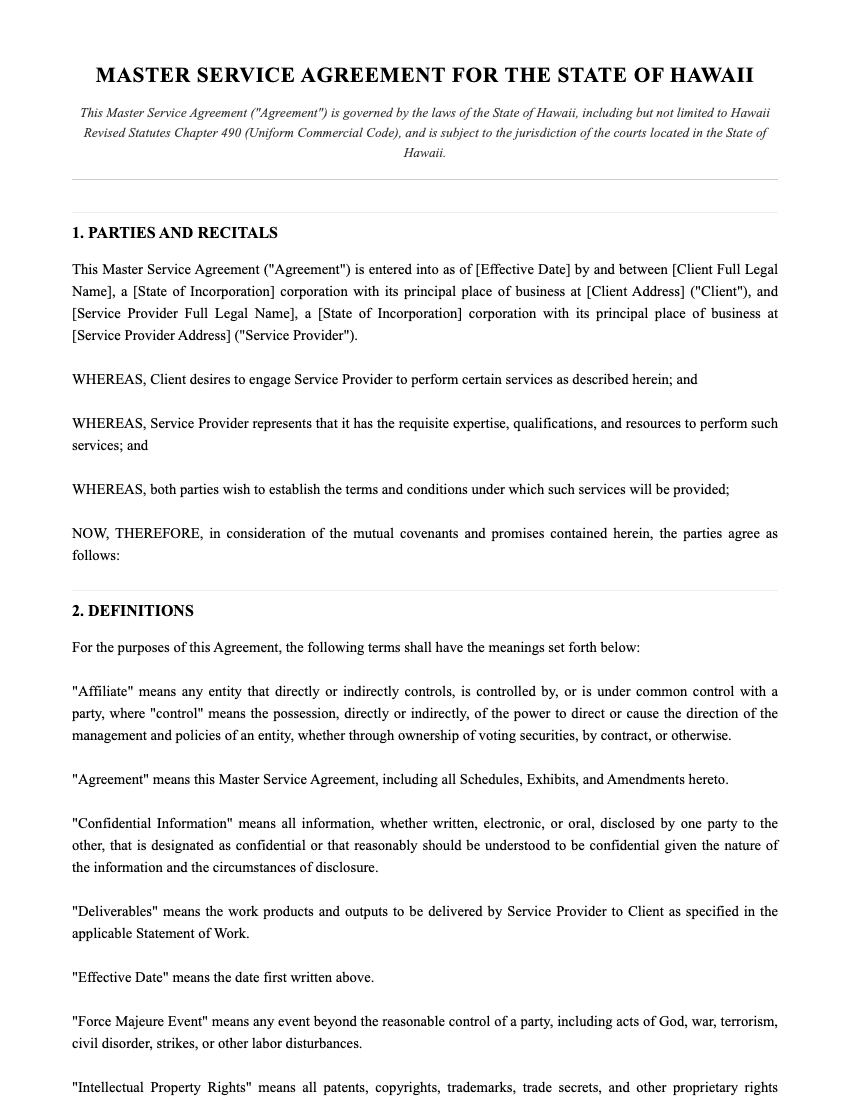
A Hawaii Master Services Agreement (MSA) is a comprehensive legal document that establishes the foundational terms—such as payment, liability, intellectual property, and dispute resolution—between a service provider and a client. This agreement governs all future projects, allowing the parties to execute simple Statements of Work (SOWs) for individual engagements without renegotiating the entire contract each time.
For a comprehensive guide to structuring MSAs and SOWs that protect your business, see our Freelancer Contracts Guide.
Definition
Definition: A Hawaii Master Services Agreement is a governing contract between two parties, typically a client and a service provider, operating within Hawaii. It outlines the legal framework, including payment terms, liability limits, and intellectual property rights, applicable to all future projects. Instead of drafting a new contract for each engagement, parties sign a single MSA and attach simple "Statements of Work" (SOWs) for individual tasks.
Why You Cannot Use a Generic MSA in Hawaii
Using a generic Master Services Agreement in Hawaii can expose both parties to significant legal and financial risks due to the state's unique legal requirements and statutory provisions. Here are key reasons why a Hawaii-specific MSA is essential:
Worker Classification Rules
Hawaii follows the common law test for worker classification, which examines the degree of control a business has over a worker. This is similar to the IRS's guidelines but is informed by state-specific statutes, such as Hawaii Revised Statutes Chapter 490. Misclassifying an employee as an independent contractor can lead to penalties, including back taxes, fines, and potential liability for unpaid benefits. The Hawaii Department of Labor and Industrial Relations enforces these rules, emphasizing the importance of accurate classification to avoid costly repercussions.
Non-Compete Enforceability
Non-compete agreements are enforceable in Hawaii, but they must meet specific requirements to be considered reasonable. According to Hawaii Revised Statutes § 480-4, a non-compete must be limited in scope, duration, and geographic area to protect legitimate business interests. Typically, these agreements should not exceed a duration of two years and must be narrowly tailored to prevent undue hardship on the employee. Alternatives to non-competes include confidentiality agreements and non-solicitation clauses, which can provide protection without the stringent requirements of a non-compete.
IP/Work-for-Hire Considerations
In Hawaii, intellectual property assignments and work-made-for-hire provisions must be clearly outlined to avoid disputes. The Hawaii Revised Statutes Chapter 490 provides guidance on these matters, ensuring that IP rights are properly assigned to the client while respecting the creator's contributions. A well-drafted MSA will include clauses that specify whether the work is considered 'work made for hire' or if the IP will be assigned post-creation, protecting both parties' interests.
What's Included in This Template
Flexible Statement of Work (SOW) Structure
The MSA serves as an overarching agreement while attached SOWs handle specific deliverables, timelines, and fees, making project management efficient.
Hawaii-Specific Indemnification
The indemnification clause is tailored to Hawaii's legal standards, balancing risk between the client and provider, with carve-outs for gross negligence and willful misconduct.
Dispute Resolution and Venue
The template pre-sets venue to the Circuit Court of the First Circuit, Hawaii, ensuring that any legal disputes are resolved locally, which is beneficial for Hawaii-based entities.
- Statute of limitations for written contracts: HRS § 657-1
- Interest rate for late payments: HRS § 478-2
- Data privacy compliance: HRS § 487N-1 et seq.
Who Needs This Document?
| User Type | Relationship | Key Benefit |
|---|---|---|
| Creative Agencies | Retainers with corporate clients | Streamlines project-specific agreements |
| Consultants | Long-term advisory roles | Defines scope and billing for additional work |
| Software Developers | Project-based milestones | Protects source code IP until final payment |
| Marketing Freelancers | Multiple client engagements | Ensures compliance with Hawaii's labor laws |
How to Use This MSA Template
Step 1: Define the Parties
Fill in the legal name and entity type (LLC, Corporation, Sole Proprietor) for both the Provider and Client. Use the exact name as registered with Hawaii's Department of Commerce and Consumer Affairs.
Step 2: Set the Term
Decide if the agreement runs for a fixed period (e.g., 12 months) or auto-renews (Evergreen). Evergreen agreements continue until either party provides written notice of termination.
Step 3: Attach Your First SOW
Do not put project deliverables in the MSA itself. Fill out the attached Statement of Work template with specific scope, timeline, and payment terms for your first engagement.
Step 4: Execute the Agreement
Both parties sign the MSA once. Future projects only require signing a new SOW—the MSA terms automatically apply to each subsequent engagement.
Related MSA Templates
Get the Template
Sign up for our newsletter to receive the template.
Frequently Asked Questions

About Designer Content
Designer Content creates practical legal document resources for landlords, contractors, and small business owners. We simplify complex legal concepts into actionable guidance. Connect with us on LinkedIn.