
Kansas Residential Lease Agreement — Why Compliance Matters
Using a lease that complies with Kansas law protects both landlords and tenants. The Kansas Residential Landlord and Tenant Act (K.S.A. 58-25a01 et seq.) sets the baseline for duties, disclosures, and remedies; federal law adds specific requirements such as lead-based paint disclosure for pre-1978 housing (42 U.S.C. § 4852d). This template is drafted to reflect those rules and common Kansas practices: no statewide rent control, contractual freedom to set rent, no general statewide interest requirement on security deposits, and a 30-day statutory deadline to return deposits and an itemized statement after tenancy ends.
A compliant lease reduces the risk of litigation, speeds up habitability and repair disputes, and helps ensure that eviction or termination steps follow the summary procedures recognized by Kansas courts. Always confirm municipal rules (city/county) that may add registration, inspection, or local disclosure obligations.
For a comprehensive lease review checklist covering residential and commercial terms, see our Lease Agreement Review Guide.
What is a Kansas residential lease?
A Kansas residential lease is a written contract between a landlord and tenant that sets the rights and obligations for occupancy of a dwelling in Kansas. It incorporates statutory duties from the Kansas Residential Landlord and Tenant Act (K.S.A. 58-25a01 et seq.), required disclosures (including federal lead-based paint when applicable), security-deposit handling and itemization, rent and payment terms, and procedures for termination and remedies under Kansas law.
Why Old Templates Are Dangerous (Kansas-Specific Pitfalls)
- Security deposit language that ignores Kansas timelines: Kansas requires an itemized accounting and return deadline (commonly 30 days after termination and delivery of possession unless local ordinance says otherwise). Old forms that use different or vague deadlines create disputes and statutory exposure.
- Missing federally required lead-based paint disclosures: Any dwelling built before 1978 requires the EPA/ HUD lead pamphlet and a written disclosure. Failing to include these federally required materials can lead to civil penalties and rescission rights.
- Incorrect notice periods: Kansas practice for nonpayment is a short "pay or quit" notice (commonly 3 days) before summary eviction. Old templates may use incorrect cure or termination periods inconsistent with K.S.A. or court practice.
- Failure to include manager/agent contact for service of process: Kansas statutes expect a designated address or agent for service; omitting this can complicate enforcement or defense.
- Ignoring local ordinances: Cities (for example, Wichita, Overland Park, Kansas City KS) may have registration, inspection, or smoke/CO alarm requirements. An old statewide form won't reflect local rules and can leave landlords noncompliant.
- Unenforceable penalties or fee language: Overly broad late fee or liquidated-damages clauses can be challenged under the Kansas Consumer Protection Act or general contract law.
What's Included in This Template
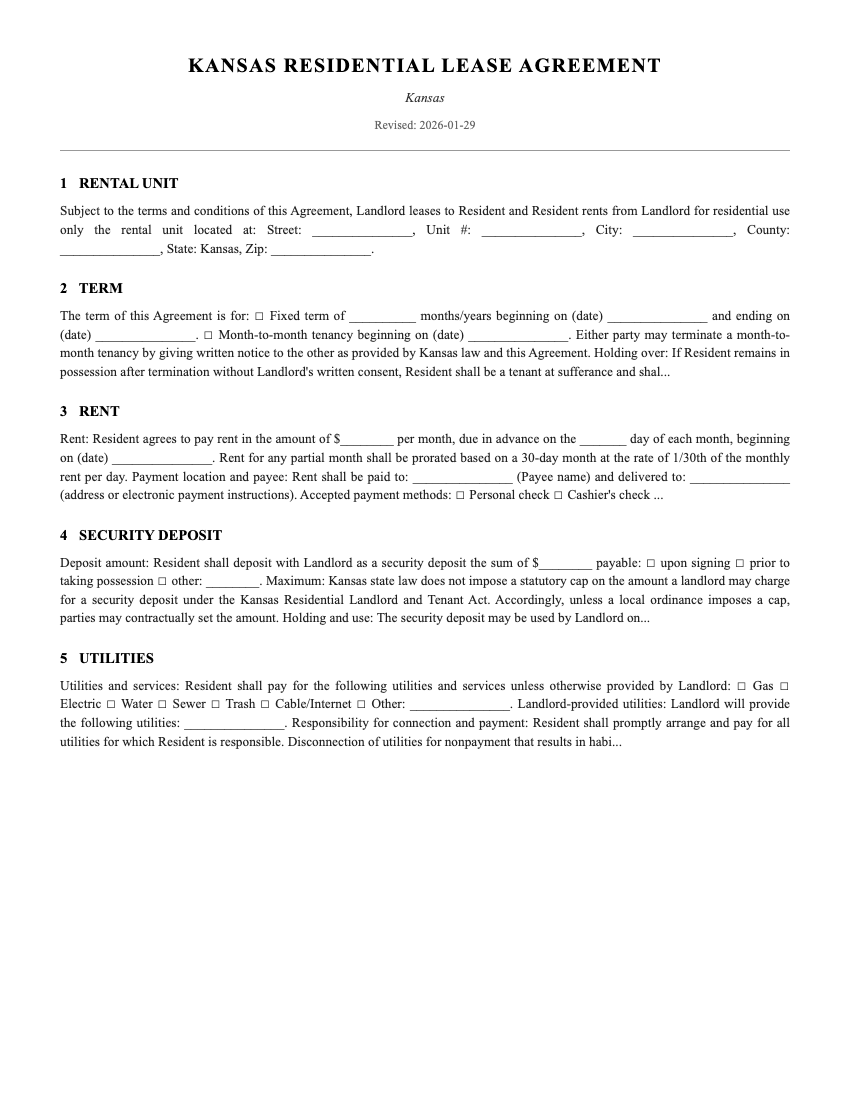
This Kansas Residential Lease Agreement package contains:
- Fillable lease (PDF) and editable .docx: term, rent, due date, grace period, late fee, and payment method.
- Security deposit clause consistent with Kansas practice: deposit amount (contractual), itemization requirement, 30-day return provision, and optional local-interest field.
- Required disclosures section: lead-based paint (for pre-1978 units), known environmental hazards/material facts, manager/agent contact for service of process, security deposit handling and return language.
- Entry and notice provisions: landlord access for repairs, inspection, and emergency entry consistent with Kansas standards.
- Termination procedures: fixed-term, month-to-month (30-day termination language), and statutory references for eviction steps (nonpayment and breach notices).
- Repair and habitability duties, assignment/subletting rules, pet policy, and utility allocation.
- Move-in/move-out condition report, inspection checklist, and sample itemized security deposit statement.
- Signature blocks for landlord and tenant(s), with space for witness or notary where required by local practice.
The template includes optional clauses you can toggle: pet addendum, guarantor, parking addendum, and addendum for furnished premises.
Download Options
- PDF (print-ready): /downloads/kansas-lease-agreement-2026.pdf
- Microsoft Word (.docx): editable for local customization
- Google Docs template: copy to your Google Drive and edit collaboratively
Each download includes a short instructions page listing the required disclosures and local checks to perform before you sign.
How to Finalize Your Lease
- Customize the key terms: rent amount, due date, security deposit, lease term, utilities and who pays what, and any optional addenda (pets, parking).
- Add required disclosures: attach the federal lead-based paint pamphlet for pre-1978 housing, list any known environmental hazards/material facts, and include the manager/agent service-of-process contact.
- Confirm municipal rules: check city or county ordinances for registration, inspection, smoke/CO alarm requirements, or deposit interest rules and adjust the template accordingly.
- Run the draft through an AI contract review tool: use an AI contract review tool to flag statutory, disclosure, or clarity issues and generate a short remediation checklist.
- Execute and distribute: have landlord and tenant sign and date each page, exchange copies, provide the itemized move-out condition report at move-in, and deliver possession.
- Retain originals: both parties should keep a signed copy. Landlord should maintain security deposit records and any escrow account documentation if local law requires it.
Persona Table
| User Persona | Property Type | Key Benefit of This Template |
|---|---|---|
| Small independent landlord | Single-family home or small duplex | Clear security deposit handling and itemized return form to avoid disputes |
| New landlord | First rental property (single-family or condo) | Step-by-step disclosures (lead paint, manager contact) and habitability checklist |
| Tenant signing first lease | Apartment or shared house | Transparent rights, notice requirements, and move-in condition checklist |
| Property manager | Multi-unit residential | Customizable addenda, uniform language across units, and Pact AI pre-sign review |
Related Lease Agreement Templates
FAQs
- Question: How much can a landlord charge for a security deposit in Kansas?
Answer: Kansas state law does not set a maximum deposit amount; landlords and tenants are free to contract for any reasonable deposit. However, local ordinances may limit deposit amounts or require interest. Regardless of amount, Kansas requires an itemized statement and return of the deposit within 30 days after tenancy termination and delivery of possession unless a different controlling statute or local ordinance applies (see K.S.A. 58-25a01 et seq.). - Question: Is there rent control or a statewide restriction on rent increases in Kansas?
Answer: No. Kansas does not have statewide rent control. Landlords and tenants may freely negotiate rent and rent increases, subject to the lease terms and any applicable local ordinances. For month-to-month tenancies, give customary notice (commonly 30 days) as provided by contract or local rule before changing terms or terminating the tenancy. - Question: What disclosures are required in Kansas rental agreements?
Answer: Required disclosures include the federal lead-based paint disclosure for housing built before 1978 (42 U.S.C. § 4852d), known environmental hazards or material facts, the name/address of the manager or agent for service of process, and security deposit handling and return procedures. This template includes fields for each required disclosure; confirm any additional municipal disclosure requirements. - Question: What is the usual eviction procedure for nonpayment of rent in Kansas?
Answer: For nonpayment, landlords typically provide a short "pay or quit" notice (commonly 3 days) before filing a summary eviction action in the appropriate Kansas court. The exact notice and procedure should follow K.S.A. 58-25a01 et seq. and local court rules. If the tenant does not pay or vacate within the notice period, the landlord may initiate summary eviction and seek a judgment and writ of restitution through the court. - Question: Can tenants have long-term guests or sublet the unit?
Answer: Lease terms control guest and subletting rules. This template includes reasonable limits on unauthorized occupants and a process for requesting landlord approval for subletting or assignment. Absent agreement, landlords may restrict long-term guests or require written consent for subtenants to protect occupancy limits, safety, and insurance requirements. - Question: Are there any unique local requirements Kansas landlords should watch for?
Answer: Yes. Municipalities may require rental registration, periodic inspections, smoke/CO alarm standards, floodplain disclosures, or local tenant-protection rules. Always check city/county codes for requirements that supplement state law. This template includes an item you can use to note local registration numbers or inspection dates.
Sources
- "Kansas Residential Landlord and Tenant Act (K.S.A. 58-25a01 et seq.) (Annotations)", Kansas Revisor of Statutes, https://www.ksrevisor.org/statutes/annotations/58/58-25.html, Kansas Legislature, accessed 2026-01-30.
- "Statute of Limitations — Actions on Written Contract (K.S.A. 60-511)", Kansas Revisor of Statutes, http://www.ksrevisor.org/statutes/chapters/ch60/060_005_0011.html, accessed 2026-01-30.
- "Kansas Consumer Protection Act", Kansas Revisor of Statutes, http://www.ksrevisor.org/statutes/chapters/ch50/050_006_0023.html, accessed 2026-01-30.
- "Real Estate Lead-Based Paint Disclosure", U.S. Environmental Protection Agency (EPA), https://www.epa.gov/lead/real-estate-disclosure, accessed 2026-01-30.
- "FEMA Flood Map Service Center", Federal Emergency Management Agency, https://msc.fema.gov, accessed 2026-01-30.
HowTo Steps to Finalize the Kansas Lease
- Review Local Law: Check city/county codes for rental registration, inspection, smoke/CO requirements, or deposit interest rules and note any additional obligations.
- Customize Terms: Fill in rent amount, security deposit, lease term, notice periods, utility responsibility, and any addenda (pets, parking, furnished items).
- Complete Required Disclosures: Attach the federal lead pamphlet for pre-1978 housing, list known environmental hazards, and add manager/agent contact for service-of-process.
- Run an AI contract review tool Review: Upload the completed draft to an AI contract review tool to detect statutory non-compliance, missing disclosures, ambiguous language, or local-conflict flags.
- Sign and Exchange: Have all parties sign and date each copy; provide tenant(s) with explanatory move-in documents and retain originals.
- Document Move-In: Complete the move-in condition report and keep the signed inspection report to support any future deposit itemization.
If you need a version tailored to a specific city in Kansas (Wichita, Overland Park, Kansas City KS, Topeka), include the municipality name when you request a customized checklist or run an AI contract review tool review to highlight local ordinance issues before signing.
<div class="ml-embedded" data-form="bBZ9zR"></div>
Frequently Asked Questions

About Designer Content
Designer Content creates practical legal document resources for landlords, contractors, and small business owners. We simplify complex legal concepts into actionable guidance. Connect with us on LinkedIn.