
Introduction
Creating a legally sound lease in Missouri means more than plugging names and dates into a form. Missouri does not maintain a comprehensive statewide landlord-tenant code that sets security deposit caps or uniform notice periods; many rules are governed by contract, common law, and targeted statutes such as RSMo Chapter 535 (forcible entry and detainer) and the Missouri Merchandising Practices Act (RSMo Chapter 407). This template is written for 2026 use and includes provisions to help you meet state statutory requirements and common court practices while guiding you to confirm local rules (St. Louis, Kansas City, Columbia, etc.) and federal disclosures (lead-based paint).
Why compliance matters
Noncompliant or outdated leases can create exposure for landlords (breach-of-contract claims, consumer-protection liability under RSMo Chapter 407, or rejection of eviction filings) and leave tenants without essential rights and disclosures. You should customize the template to match the actual business terms, add required federal and local disclosures, and consider a legal review or a contract-check vian AI contract review tool before signing.
What is a Missouri residential lease?
A Missouri residential lease is a written (or oral, though written is strongly recommended) contract between a landlord and tenant establishing the rights and obligations for use and possession of residential property in Missouri. It sets the term, rent, security deposit terms (note: Missouri has no statewide deposit cap but requires itemization of deductions), required disclosures (including federal lead-based paint where applicable), and the process for notices and dispute resolution. Written contracts in Missouri are governed by the ten-year statute of limitations for written agreements, RSMo §516.110.
Why Old Templates Are Dangerous (Missouri-specific traps)
- Security deposit misunderstandings: Missouri has no statewide deposit cap, but landlords must provide an itemized statement of deductions. Using an old template that omits itemization language or sets illegal deductions can trigger consumer-protection claims under RSMo Chapter 407.
- Eviction mistakes: Eviction in Missouri follows forcible-entry-and-detainer procedures (RSMo Chapter 535). Old templates that assume federal or out-of-state pre-filing notice requirements can lead to dismissed actions if local court rules or lease terms aren’t followed.
- Missing federal disclosures: Federal lead-based paint disclosure and EPA/HUD pamphlets are mandatory for most pre-1978 housing. Older forms sometimes omit the mandatory addendum and signatures.
- Local ordinance noncompliance: Cities like St. Louis and Kansas City may require landlord registration, minimum-habitability inspections, or additional notices. An old statewide template may not include city-specific terms or registration acknowledgments.
- Inaccurate limitation periods: Missouri uses a ten-year statute of limitations for written contracts (RSMo §516.110). Old templates sometimes cite incorrect limitations or misstate remedies.
- Consumer-protection exposure: Deceptive or ambiguous fee provisions can risk claims under the Missouri Merchandising Practices Act (RSMo Chapter 407).
What's Included in This Template
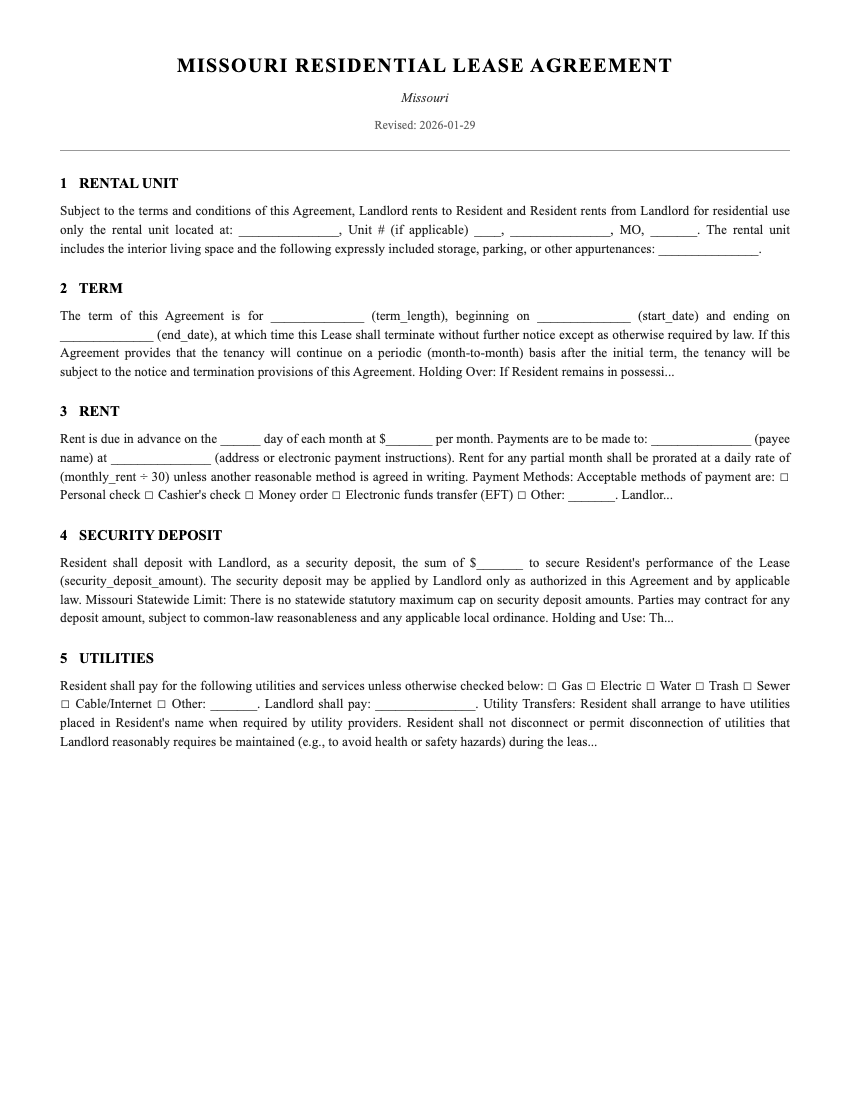
- Clear identification of parties, property, and lease term (fixed-term and month-to-month options)
- Rent amount, due date, late fees (customizable), and permitted rent-increase procedures
- Security deposit clause with amount editable, required itemization of deductions, recommended return timeframe (commonly 30 days), and receipt language
- Required federal lead-based paint disclosure and signature block (for buildings built before 1978)
- Maintenance and repairs, habitability obligations, and local-code compliance language
- Utilities, services, and responsibility allocation
- Pet and guest policies and deposit/fee options
- Default, cure periods (consistent with lease terms and common Missouri practices), and eviction process explanation referencing RSMo Chapter 535
- Access for inspections and repairs (reasonable notice standard)
- Optional mediation/arbitration clause and attorney-fee provision consistent with enforceability in Missouri courts
- Signature blocks and witness/acknowledgment lines
This template includes explanatory notes for fields that commonly require local customization (e.g., city-specific registration, inspection or licensing requirements).
Related Lease Agreement Templates
Download Options
- Standard PDF: /downloads/missouri-lease-agreement-2026.pdf (ready to print or attach to e-signature platforms)
- Fillable Word document: available on request—useful for customization before upload to an AI contract review tool
- Package option: template + sample move-in inventory checklist + lead-based paint addendum (recommended for older properties)
How to Finalize Your Lease
- Customize every variable clause: rent, deposit amount, late fee formula, term, utilities, and local notices.
- Add required disclosures: federal lead-based paint addendum for pre-1978 units; any local mandatory disclosures (registration, inspection notices).
- Provide the tenant a copy and obtain signatures from all adult tenants and the landlord/agent.
- Deliver a written move-in condition inventory and preserve photographs; collect the deposit and issue a receipt.
- File or store the executed lease and documents securely; consider e-signature archives with tamper-evident records.
- Upload the completed lease to an AI contract review tool for a final safety check and clause analysis.
Additional Notes on Security Deposits and Returns
Missouri does not set a statewide maximum for security deposits. The parties may agree to any amount in the lease subject to contract law and any applicable local rules. Missouri requires itemization of deductions from a security deposit; landlords should include specific language in the lease promising an itemized statement of damages and costs and a reasonable timeline for return (many Missouri landlords use a 30-day maximum practice). Failure to provide proper itemization or deceptive practices can result in claims under RSMo Chapter 407.
Local Ordinances and Municipal Rules
This template is statewide in scope and does not replace city- or county-level requirements. Check municipal codes where the property is located for rental registration, inspections, minimum-habitability ordinances, local notice requirements, or landlord licensing (examples include St. Louis, Kansas City, Columbia). When in doubt, add a clause requiring the landlord to comply with and disclose any local registration or inspection obligations.
When to Consult an Attorney
- You plan to include uncommon provisions (e.g., extensive indemnity, waiver of warranty claims, complex utility billing).
- Local ordinance compliance or registration requirements are unclear.
- You anticipate high-value deposits, eviction risk, or tenant-requested modifications.
an AI contract review tool is a useful contract-review tool but does not replace legal advice for complex or high-risk situations.
<div class="ml-embedded" data-form="bBZ9zR"></div>
Frequently Asked Questions

About Designer Content
Designer Content creates practical legal document resources for landlords, contractors, and small business owners. We simplify complex legal concepts into actionable guidance. Connect with us on LinkedIn.