
Introduction
A residential lease agreement in the Kyrgyz Republic is governed primarily by Гражданским кодексом Кыргызской Республики (ГК КР) and by the practice of applying the norms of civil and procedural law. To properly formalize the relationship, it is important to document the terms for rent, the payment and return of the security deposit, the inventory of the premises, and the processing of personal data. A poorly drafted agreement or the use of an outdated template increases the risk of litigation, wrongful withholding of the deposit, and violations during eviction.
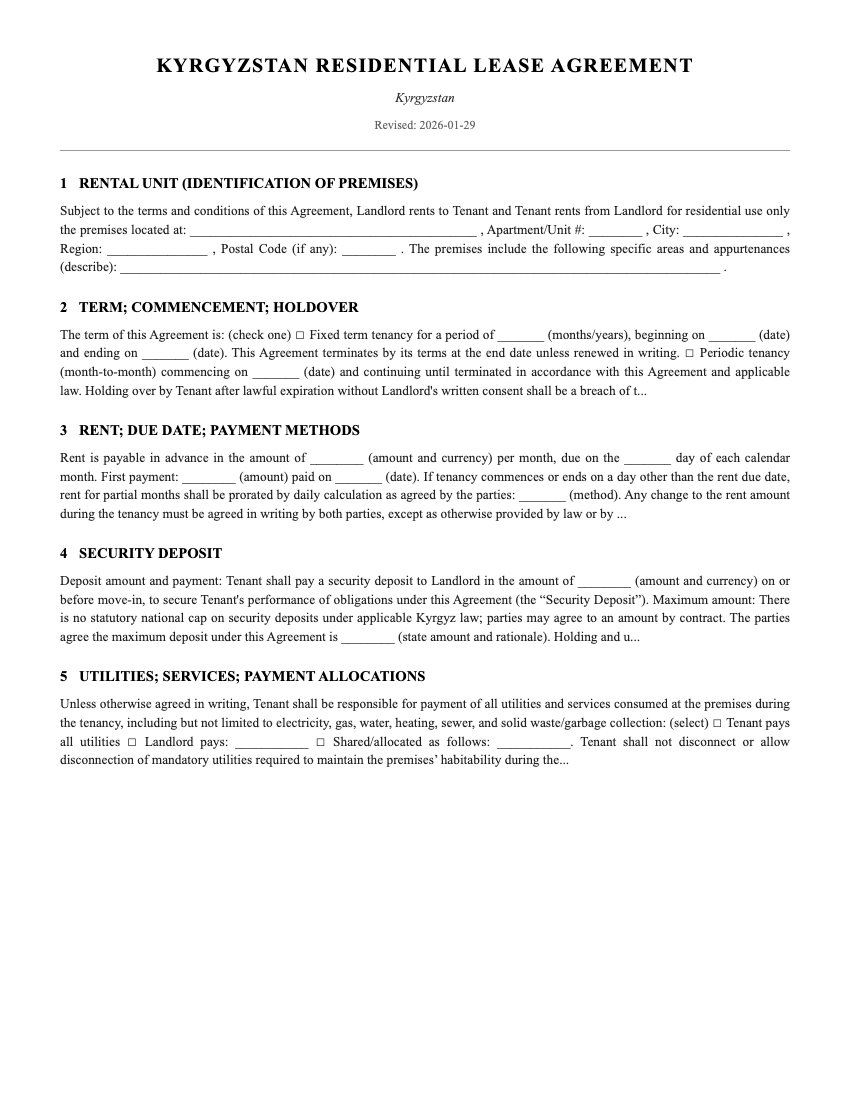
Our template has been prepared in accordance with the key requirements: drafting and documentation of collateral terms, mandatory notices, the procedure for handover and acceptance of premises (handover-acceptance act), and consent to the processing of personal data. It does not contain methods for circumventing the law and preserves the parties' freedom of contract within the limits permitted by the civil law of the Kyrgyz Republic.
For a comprehensive lease review checklist covering residential and commercial terms, see our Lease Agreement Review Guide.
Definition: A "residential lease agreement" in Kyrgyzstan is a contract between the owner (lessor/landlord) of a dwelling (apartment, house, room or part thereof) and a person (lessee/tenant) under which the lessor transfers to the lessee temporary possession and use of the residential premises for the purpose of habitation in exchange for payment (rent) or other consideration. The agreement specifies the subject and purpose of the lease (residential use only), the term, rent and payment procedure, rights and obligations of the parties (including maintenance, repairs, use restrictions and subletting), procedures for handing over and accepting the premises, and grounds and procedure for termination and eviction. The lease must comply with applicable Kyrgyz law and any formal requirements prescribed for particular types or durations of leases.
A residential lease agreement is a contract between the owner (the Lessor) and the person acquiring the residential premises for temporary possession and use (the Lessee), establishing the rights and obligations of the parties, the amount and procedure for payment of rent, the procedure for payment and return of a security deposit, and the conditions for transfer of the premises. The legal consequences are based on the provisions of the Civil Code of the Kyrgyz Republic and other applicable regulatory acts.
Why outdated templates are dangerous (jurisdiction-specific pitfalls)
- Failure to reference requirements for the processing of personal data. The Law "On Personal Data" requires the tenant's explicit consent to processing and specification of the purposes for which the data will be processed.
- Incorrect wording regarding the deposit. In Kyrgyzstan there is no national limit on security deposits, but the obligation to document any withholdings and to provide a detailed calculation is required by contract and by practice. Older templates often do not include a requirement for the return of the deposit or specify timeframes for its return.
- Absence of a handover-acceptance act and an inventory of the property. This complicates proving claims when withholding a deposit and in disputes regarding the condition of the premises.
- Improper practice of "self-help eviction." In the Kyrgyz Republic, eviction is carried out through the courts under the Civil Procedure Code; attempts at unauthorized forcible eviction create a risk of criminal and civil liability.
- Ignoring sanitary-epidemiological and environmental requirements. If sanitary or environmental risks (mold, hazardous substances) are known in the premises, the landlord is obliged to disclose that information.
What is included in this template?
- Identification details and particulars of the parties.
- Description and address of the residential premises, area, and utility information.
- Lease term (fixed or month-to-month) and the procedure for renewal.
- The amount and procedure for payment of rent, the deadlines and methods of payment.
- Terms and amount of the security (deposit), requirement for an inventory, procedure for deductions, and requirement to provide, upon request, a calculation of the deductions.
- Recommended period for returning the deposit: a clause providing for return within a reasonable period (recommended 30 calendar days) with the mandatory attachment of the acceptance-transfer act and the statement of deductions.
- Notices and contract termination periods; proposed notice periods (typically 7–30 days depending on the nature of the breach or the periodicity of the contract).
- Rights and obligations of the parties, and rules for the use of residential premises and utility services.
- Requirements for approval of alterations and placement of property.
- Clause on personal data: content of consent for processing the personal data of the tenant and occupants, the purposes for such processing, and the data retention period.
- Mandatory disclosures: known hazardous materials, sanitary and epidemiological risks, the presence or absence of registration/residence registration (propiska), and the procedure for notifying the competent authorities.
- Procedure for Transfer of Premises: Form of Handover-Acceptance Act and Inventory Statement
- Dispute resolution procedure; stipulation on the application of the provisions of the Civil Code and referral to court in accordance with the Civil Procedure Code.
Related Lease Agreement Templates
Download Options
- Full version (fillable PDF): /downloads/kyrgyzstan-lease-agreement-2026.pdf
- Conditionally free text (copy/paste): available on the download page.
- Adaptation consultation: if local adaptation is necessary (municipal regulations, local utility specifics) use an AI contract review tool + consultation with a lawyer in the Kyrgyz Republic.
How to Finalize Your Lease
- Fill in the template: enter the parties' details, the rent and deposit amounts, the exact term dates, and the payment details.
- Check the mandatory disclosures: hazardous materials, health risks, registration notices.
- Prepare a transfer and acceptance certificate and an inventory of the property to be signed upon move-in.
- Obtain the tenant's written consent for the processing of personal data (include the purpose and the retention period).
- Upload the final contract to an AI contract review tool for automated checking and to obtain a list of required revisions.
- Sign the contract in two copies; provide each party with a signed copy and retain the delivery/transfer certificates and payment receipts.
Additional recommendations
- Provide in the contract a notice-and-cure period (7–30 days) to remedy breaches before filing a claim in court.
- Document all payments with receipts or bank transfer records and retain correspondence in the event of litigation.
- If you suspect a sanitary threat, prepare the related documents (technical report, conclusions of СЭС) to have evidence of the disclosure of information.
Frequently Asked Questions (FAQ)
(see the section below for detailed questions and answers)
<div class="ml-embedded" data-form="bBZ9zR"></div>
Frequently Asked Questions

About Designer Content
Designer Content creates practical legal document resources for landlords, contractors, and small business owners. We simplify complex legal concepts into actionable guidance. Connect with us on LinkedIn.