
Introduction — Why legal compliance matters in Luxembourg
Signing a residential lease in the Grand Duchy of Luxembourg requires more than copying clauses from another country. Leases must respect the Luxembourg Code civil (bail), national and EU data-protection rules (GDPR), and sectoral obligations such as energy-performance documentation. Failure to include required disclosures or to follow the judicial procedures for termination and eviction can cause costly delays, nullify contract terms, or expose a party to damages and enforcement action.
This template is drafted to reflect common Luxembourg practice: parties freely agree the rent and the amount of any security deposit (no nationwide statutory cap), but mandatory notices and certificates (Certificat de performance énergétique — CPE, asbestos where applicable, état des lieux) and GDPR-compliant handling of tenant data are required. Termination and eviction require judicial proceedings and enforcement by a bailiff (huissier). Use this template as a compliant starting point and verify your final document against local law and case practice.
For a comprehensive lease review checklist covering residential and commercial terms, see our Lease Agreement Review Guide.
Definition — What is a Luxembourg residential lease (Bail résidentiel)
A residential lease (bail à usage d'habitation / bail résidentiel) in Luxembourg is a contract by which the landlord (bailleur) grants a tenant (locataire) the right to occupy a dwelling for residential purposes in return for a rent. The relationship is governed by the Luxembourg Code civil (principles on bail), supplemented by sectoral and EU rules (e.g., GDPR for personal data, energy-performance requirements). Parties must include required disclosures (Certificat de performance énergétique — CPE; diagnostics like asbestos where applicable), agree on the rent and security deposit, and perform an état des lieux (move-in inventory) at delivery of possession.
Why old templates are dangerous (Luxembourg-specific traps)
- Missing required diagnostics: Luxembourg requires an energy performance certificate (Certificat de performance énergétique — CPE) for most dwellings being marketed or leased. Older templates often omit the CPE clause or the place to attach the certificate.
- GDPR non-compliance: Templates that collect tenant personal data (identity documents, guarantor details, bank info) without a GDPR-compliant privacy notice (CNPD requirements) risk administrative fines and invalid data-processing bases.
- Security-deposit misunderstandings: There is no statutory nationwide maximum deposit amount. Templates that assert a legal cap or that do not require itemization of deductions can lead to disputes. Itemization (état détaillé des retenues) should be expressly required.
- Eviction and termination procedure errors: Eviction in Luxembourg requires a court judgment and execution by a bailiff. Templates that attempt to implement self-help remedies or immediate lockouts are unenforceable and illegal.
- Energy and health disclosures: Omitting asbestos, damp/mould, or pest disclosures (when applicable) can result in liability; Luxembourg practice and local municipal rules often require such information.
- Language and statutory names: Contracts that only use foreign statutory terms or do not include the French legal names (e.g., Certificat de performance énergétique, état des lieux, mise en demeure, huissier) may complicate court or administrative review.
What's included in this template
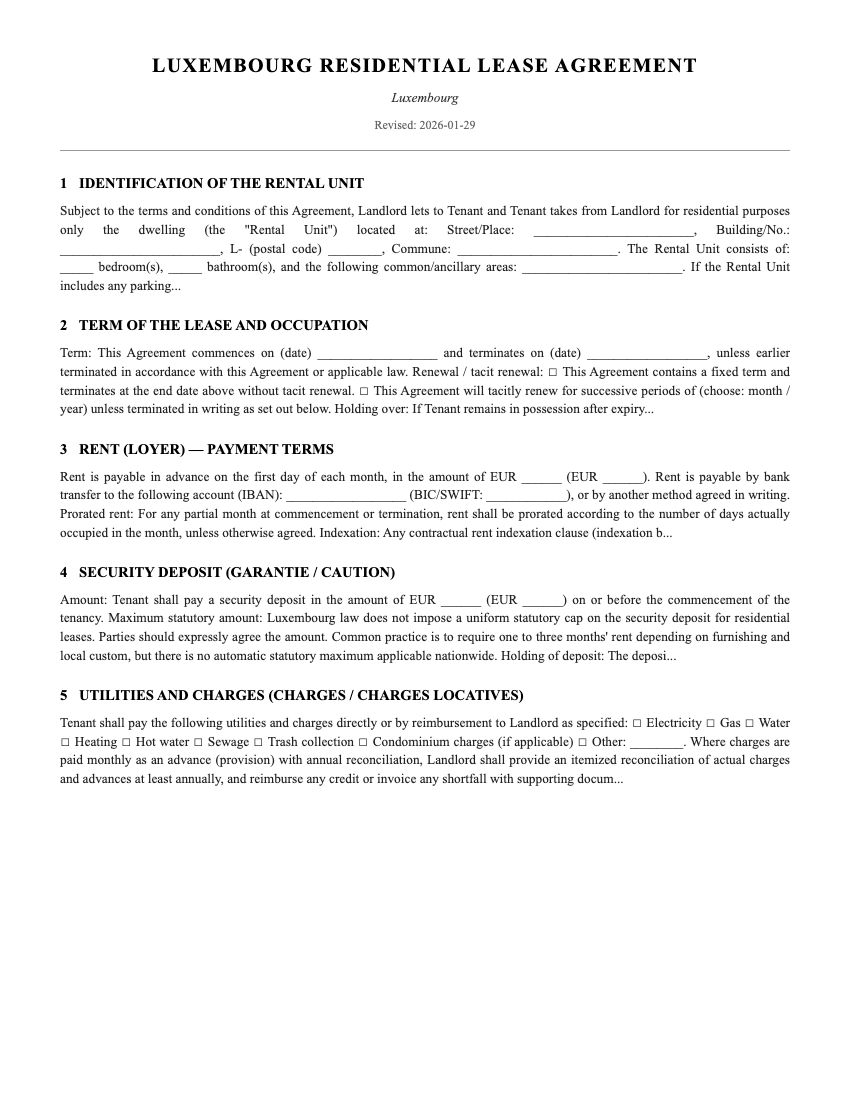
- Parties and property identification (with French statutory labels: Bailleur, Locataire, Logement)
- Term and type of lease (fixed-term vs. periodic), permitted use (residential only)
- Rent amount and payment method, permitted indexation wording consistent with private ordering
- Security deposit clause: agreed amount, holding arrangements, requirement to provide itemized statement of deductions, recommended timing for return (1–3 months commonly used)
- Mandatory disclosures section: Certificat de performance énergétique (CPE), asbestos and hazardous-materials disclosure (when applicable), damp/mould and pest/bed-bug notice, GDPR / CNPD privacy notice language
- Inventory and état des lieux provisions (move-in and move-out) and consequences of failing to perform an état des lieux
- Maintenance and repair allocation (habitation, délivrance en état habitable obligations of the Bailleur)
- Subletting and assignment rules
- Termination procedures, notice clauses, and recommended steps for mise en demeure prior to any judicial action
- Eviction and enforcement clause explaining that any eviction requires judicial order and enforcement by a bailiff (huissier)
- Optional clauses: guarantor (caution) wording, early-termination fee (subject to judicial review), pets and smoking rules
- Annex placeholders for: CPE, état des lieux template, GDPR privacy notice (CNPD reference), inventory checklist
Download Options
- Single-click PDF (ready-to-sign): /downloads/luxembourg-lease-agreement-2026.pdf
- Editable DOCX (customize terms and translate clause labels to French legal names): available on request
- Packaged tenant and landlord guide (short checklist in French and English): includes CNPD sample privacy notice and état des lieux checklist
How to Finalize Your Lease
- Attach required documents: include the Certificat de performance énergétique (CPE) and any asbestos/pest diagnostics as annexes.
- Complete the état des lieux at delivery of possession (signed by both parties or their representatives).
- Run the completed document through an AI contract review tool for an automated safety check (privacy, missing disclosures, ambiguous deposit clauses).
- Have both parties sign in duplicate (and retain copies); include French-language statutory names where possible to assist judicial review.
- If a deposit is held in a bank account, record the account and whether interest will be credited to the tenant in writing.
- If dispute-prone provisions are added (e.g., early termination penalties), obtain a brief review from a Luxembourg-qualified lawyer.
Related Lease Agreement Templates
Frequently Asked Questions (Luxembourg-specific)
Q: Is there a legal cap on security deposits in Luxembourg?
A: No nationwide statutory maximum exists. Parties must agree the amount. Common practice is 1–3 months' rent depending on furnishing and local custom. The lease should require the landlord to provide an itemized statement (état détaillé) of any deductions and set a reasonable timeline for return, commonly 1–3 months, although disputes may be resolved by the courts. (See Code civil principles and court practice; CNPD guidance if deposit data is processed.)
Q: Can a landlord increase rent during the lease term?
A: Rent increases must follow the terms agreed in the contract. There is no uniform national rent-control statute. If the agreement provides for indexation, use a clear and agreed formula. Special regulated or social-housing schemes may impose caps or rules that override private contracts.
Q: What disclosures am I required to give when renting in Luxembourg?
A: Mandatory disclosures commonly include: the Certificat de performance énergétique (CPE), asbestos and hazardous-materials information where applicable, known damp/mould or pest problems (e.g., bed-bugs), a recommended état des lieux (move-in inventory), and a GDPR / CNPD privacy notice explaining how tenant personal data will be processed and retained.
Q: How does eviction work if the tenant doesn't pay rent?
A: The landlord normally issues a formal written demand (mise en demeure) for payment. If unpaid, the landlord must bring a judicial claim; eviction requires a court judgment followed by enforcement (expulsion) performed by a bailiff (huissier). Self-help evictions (changing locks, removing tenant belongings) are unlawful.
Q: Are there rules about guests or subletting?
A: Subletting and long-term guests should be explicitly regulated in the lease. Many leases prohibit subletting without the landlord's written consent. Short-term guests are typically permitted unless the contract expressly restricts them. For regulated housing, additional restrictions may apply.
Q: Do I need a GDPR notice in my lease?
A: Yes. Any processing of tenant personal data (identity documents, guarantor information, bank details) must comply with Regulation (EU) 2016/679 (GDPR) and CNPD guidance. Include a clear CNPD-aligned privacy notice specifying the lawful basis, retention period, recipients, and tenant rights (access, rectification, erasure, restriction).
Sources
- Legilux — Official portal of Luxembourg legislation (Code civil and Grand-Ducal texts): https://legilux.public.lu (Legilux)
- Regulation (EU) 2016/679 (General Data Protection Regulation — GDPR): https://eur-lex.europa.eu/eli/reg/2016/679/oj (European Union)
- European Directive 2010/31/EU — Energy Performance of Buildings (EPBD): https://eur-lex.europa.eu/eli/dir/2010/31/oj (European Union)
- Justice.lu — Luxembourg Justice Portal (procedures, enforcement by huissier): https://justice.public.lu (Ministry of Justice Luxembourg)
- Commission nationale pour la protection des données (CNPD) — Guidance and templates: https://cnpd.public.lu (CNPD)
Legal Notes
This article provides general information and a starting-point template. It is not legal advice. For leases involving complex issues (social-housing rules, commercial conversion, major renovations, or high-value security arrangements), consult a Luxembourg-qualified lawyer for tailored advice and statutory citations relevant to your case.
<div class="ml-embedded" data-form="bBZ9zR"></div>
Frequently Asked Questions

About Designer Content
Designer Content creates practical legal document resources for landlords, contractors, and small business owners. We simplify complex legal concepts into actionable guidance. Connect with us on LinkedIn.